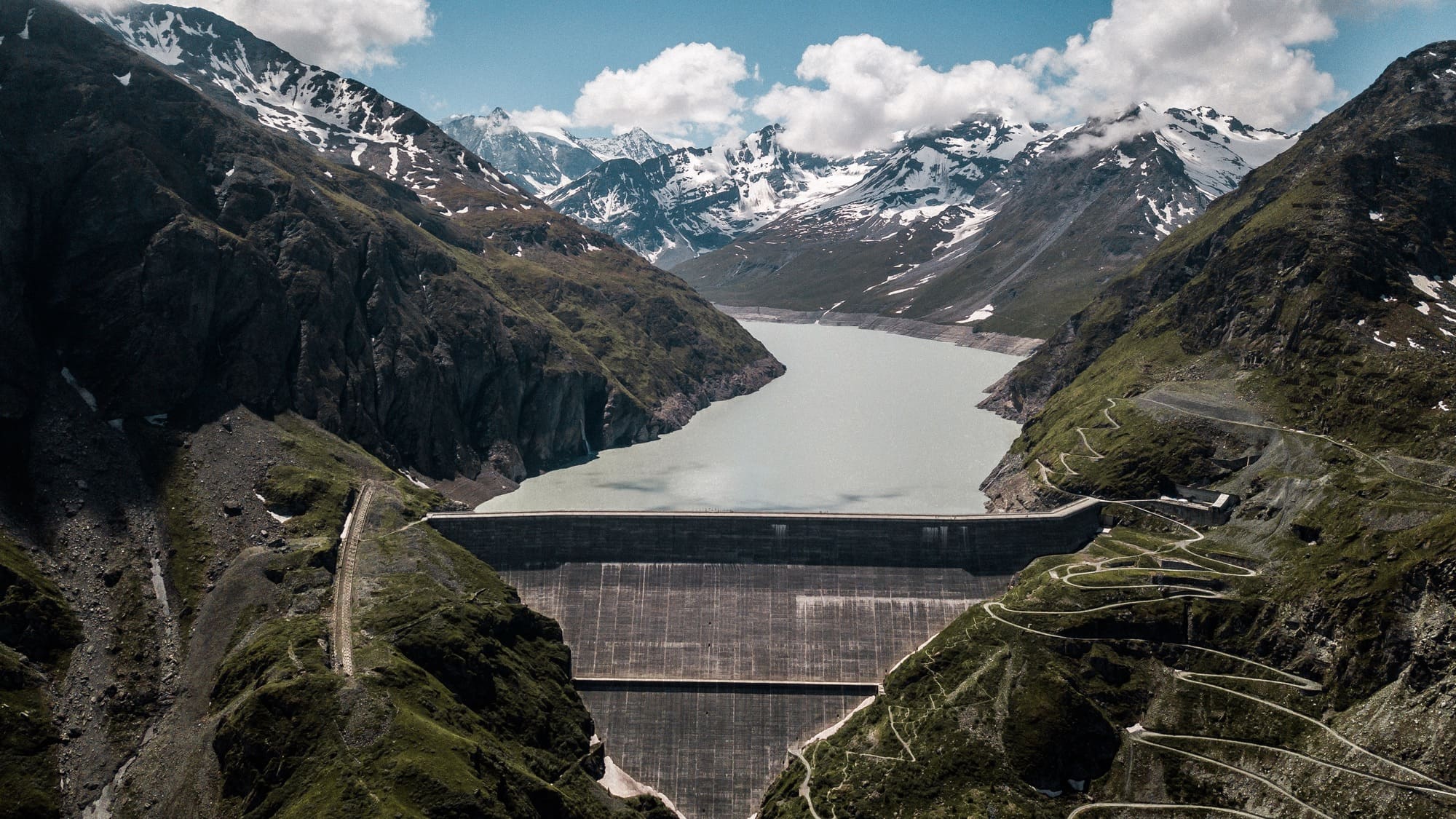




Grande Dixence Dam, 1951–1965 (Zschokke)
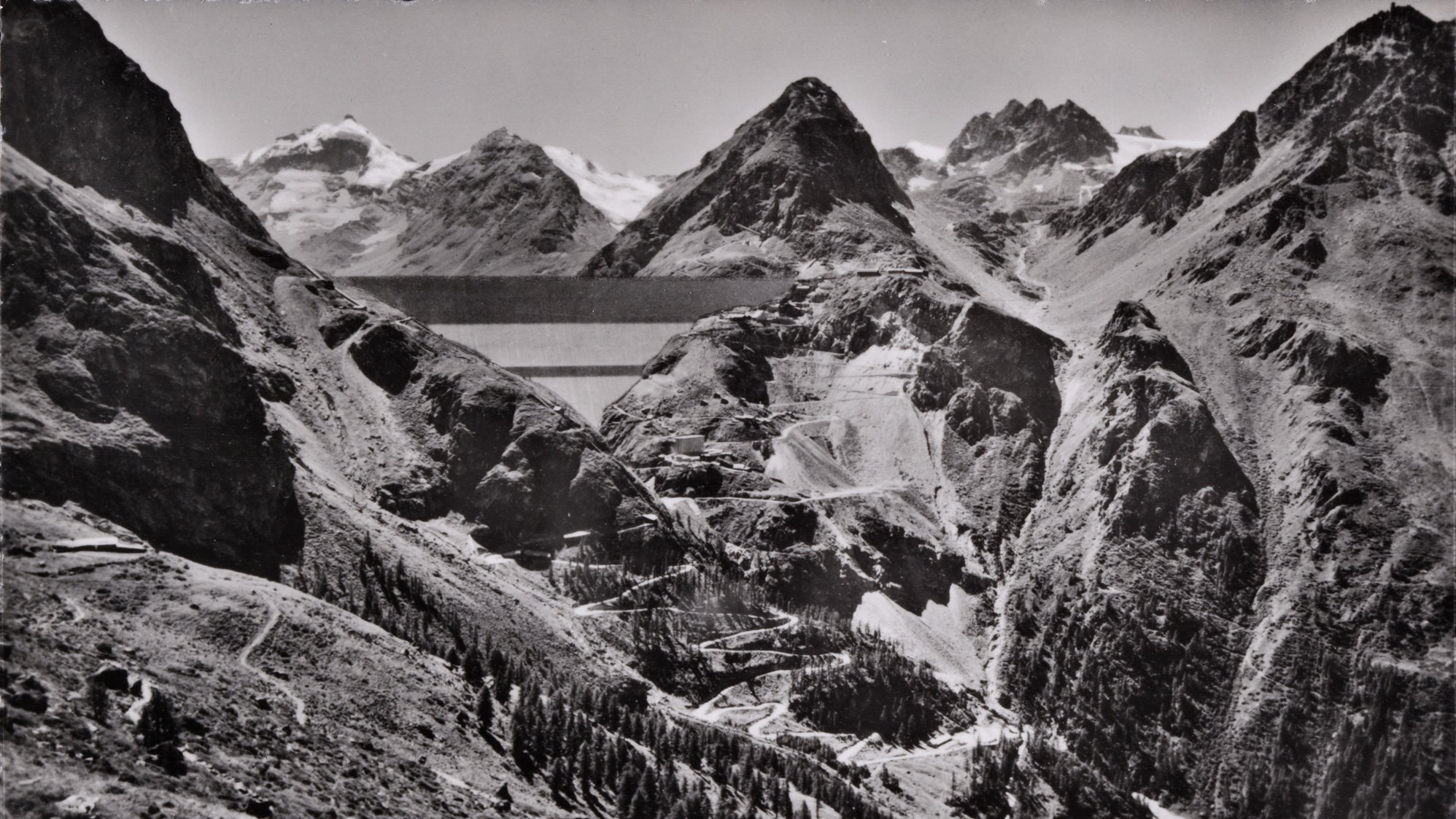
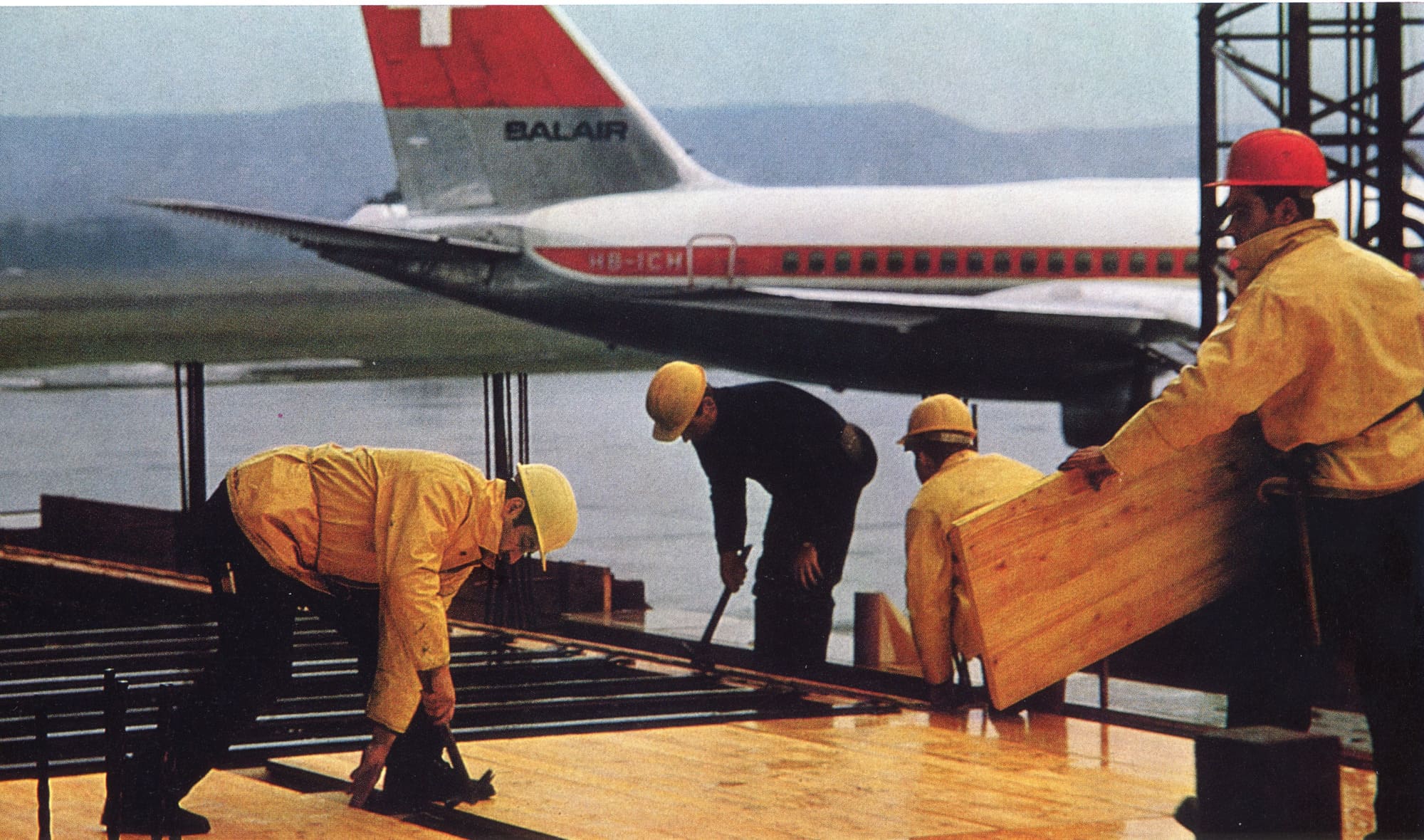
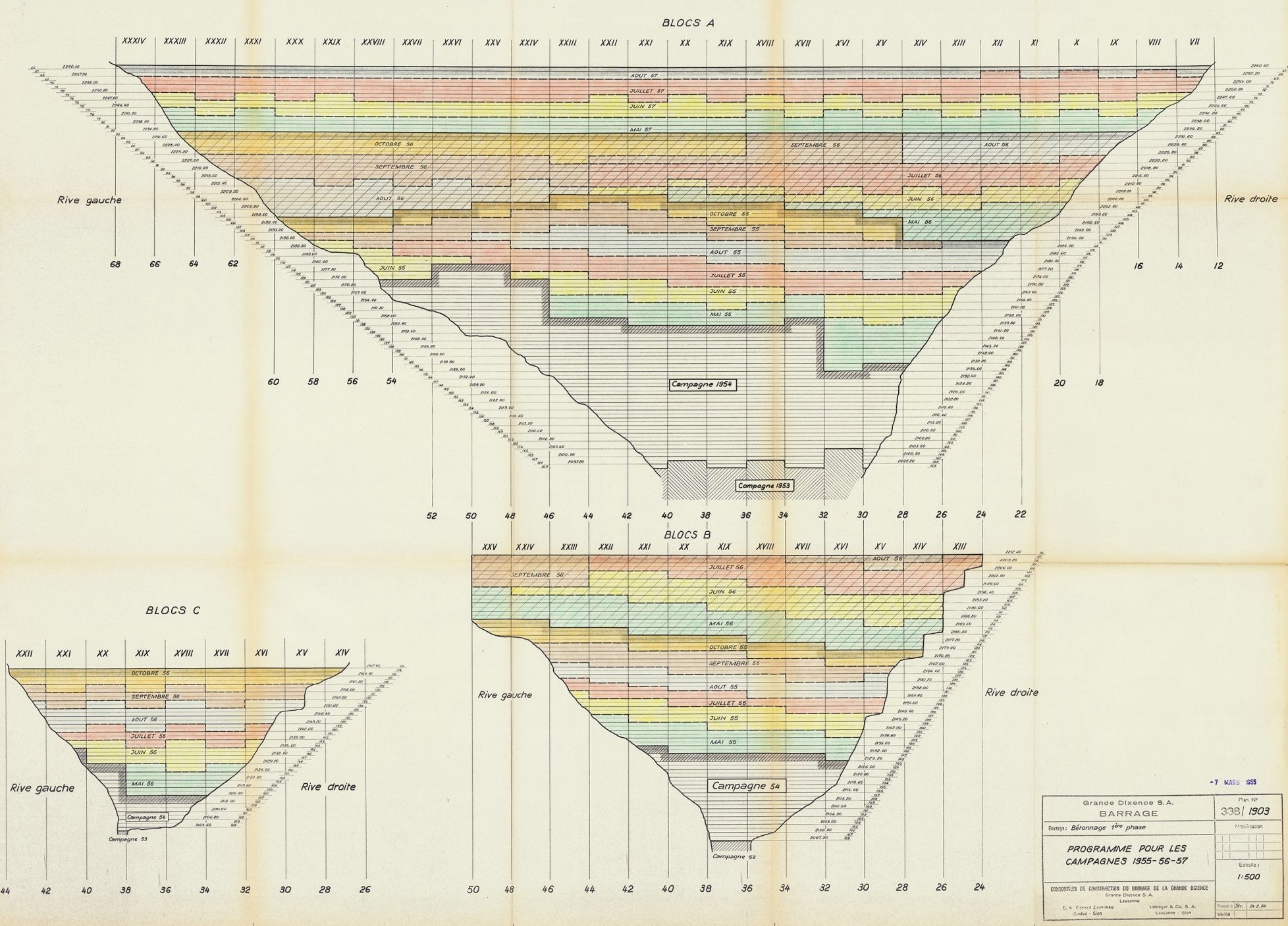
If there is one structure that towers over all others in the history of Implenia and its predecessor companies, it is this gigantic concrete wall: Grande Dixence. 285 m high, 700 m long. “The world’s tallest dam is rising inexorably from the narrow gorge of the Val des Dix,” wrote a reporter for Schweizer Illustrierte in 1956. Over 3,000 workers are employed at an elevation of about 2,500 meters above sea level—Europe’s highest construction site. Most are employed by the construction company in charge of the project, SA Conrad Zschokke. One of them is Jean-Luc Godard.
The 24-year-old actually dreams of a career as a film director in Paris. But now he’s broke. So he takes a job as a telephone operator at the Grande Dixence construction site. And, of course, Godard is captivated by the cinematic power of this monumental structure in the making. He can’t help himself—and on the side, he shoots his first film: “Opération Beton, ” a 16-minute documentary about the construction work in the heart of the Alps. The gamble pays off: The film receives rave reviews, and the dam’s developer, Grande Dixence SA, buys the film from Godard. Finally, he had enough money to shoot his first short feature film, “Une femme coquette.” When the Grand Dixence power plant began operations in 1961, Godard’s masterpiece“A bout de souffle,”starring Jean-Paul Belmondo and Jean Seberg, was already playing in theaters. Just as Grande Dixence revolutionized the world of hydropower forever, Godard’s masterpiece would shape the world of cinema as the starting point of the Nouvelle Vague.
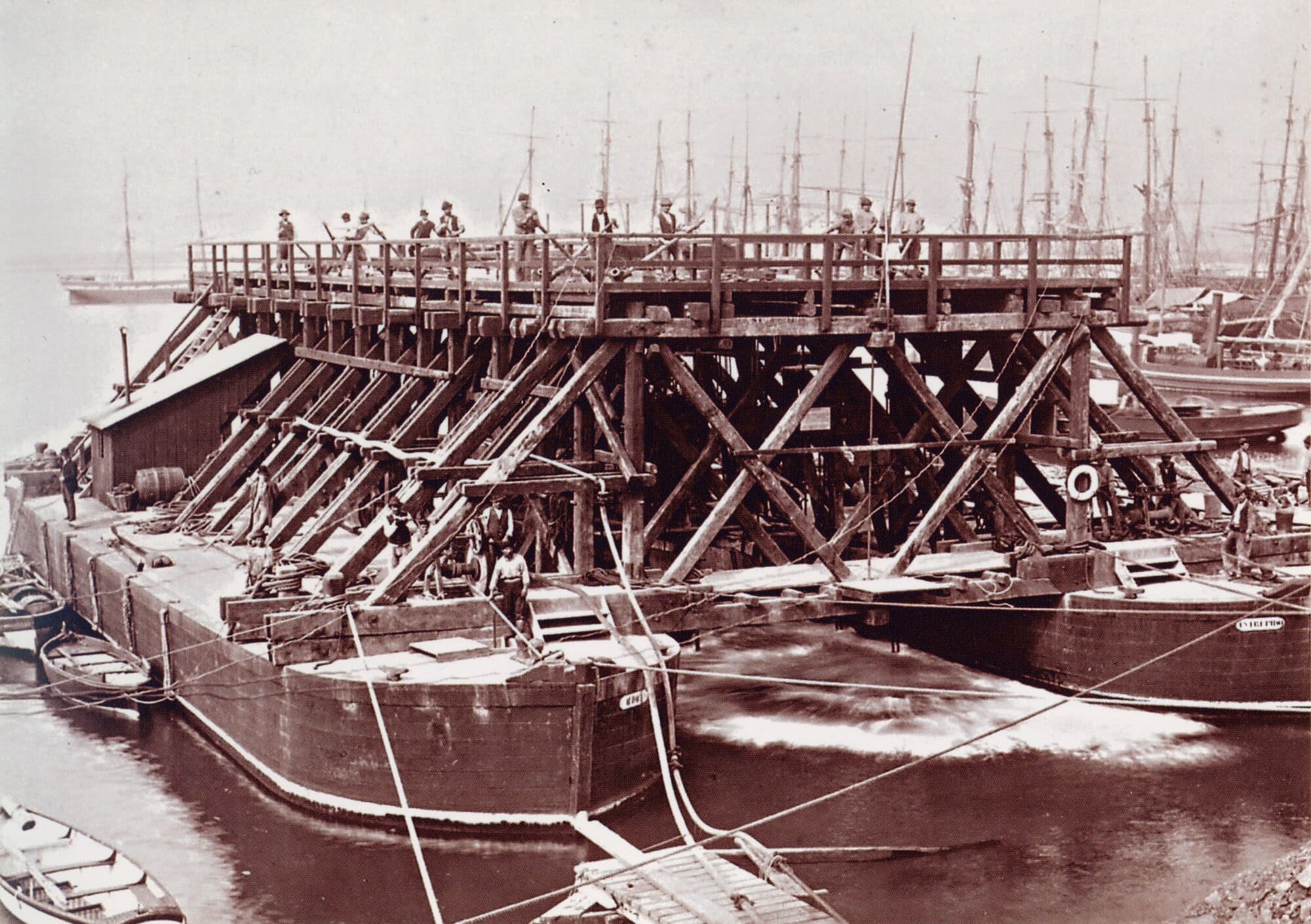
Weir at the Laufenburg Hydroelectric Power Plant, 1912–1914 (Zschokke)
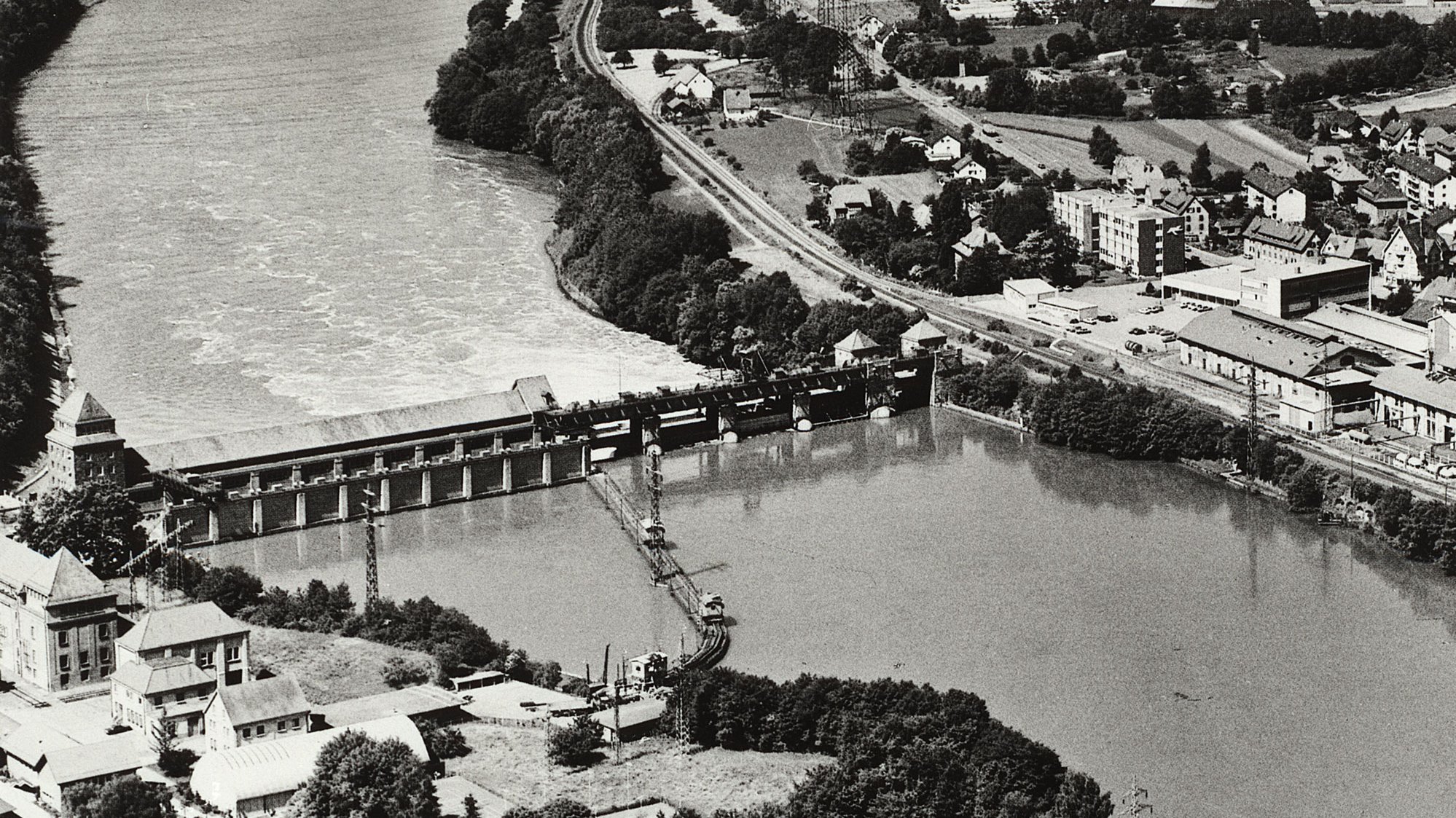
On the occasion of its 100th anniversary in 1972, SA Conrad Zschokke wrote: “Today, more than 50 dams and weirs bear witness to the Zschokke Group’s work across all five continents.”1 SA Conrad Zschokke—just as Implenia does today—owes this expertise to the pioneering spirit of its founder: Conrad Zschokke. He was a master of pneumatic pile driving, a technique that was in high demand in the early 20th century for the construction of hydroelectric power plants: for example, in Laufenburg on the Upper Rhine, where Conrad Zschokke AG—then still based in Aarau—not only built the foundations—the company’s specialty—but also above-ground structures such as the powerhouse.
Eglisau-Glattfelden Power Plant, 1916–1920 (Locher)
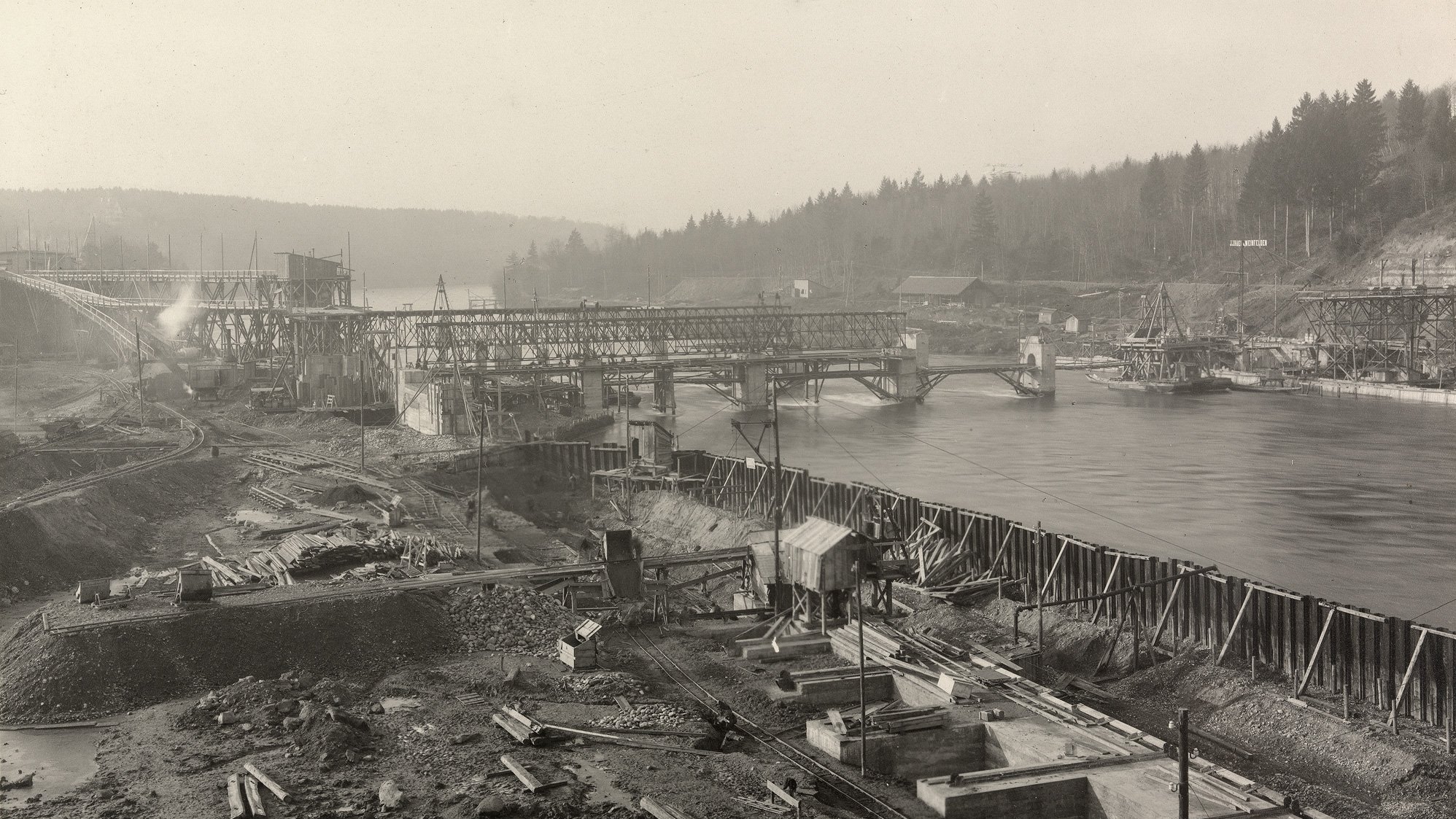
Conrad Zschokke AG in Laufenburg has just handed over its power plant to the client, and now, further upstream near Eglisau, construction is beginning on yet another marvel of civil engineering: the Eglisau-Glattfelden power plant, which is operated by Nordostschweizerische Kraftwerke AG (NOK). However, in this case, Zschokke’s major competitor—the Zurich-based construction firm Locher & Cie AG, also a “predecessor” of Implenia—is handling the planning and execution. A side note: Even back then, construction firms often relied on Italian seasonal workers. The atmosphere in the barracks settlements, inhabited solely by men, was harsh. In 1917, for example, the *Bülacher Volksfreund* reported on a shooting incident among Italian guest workers. Despite everything, the plant went into operation on schedule in 1920. Today, it is a designated historic landmark and serves as a reminder of the early triumph of hydropower at the beginning of the 20th century.
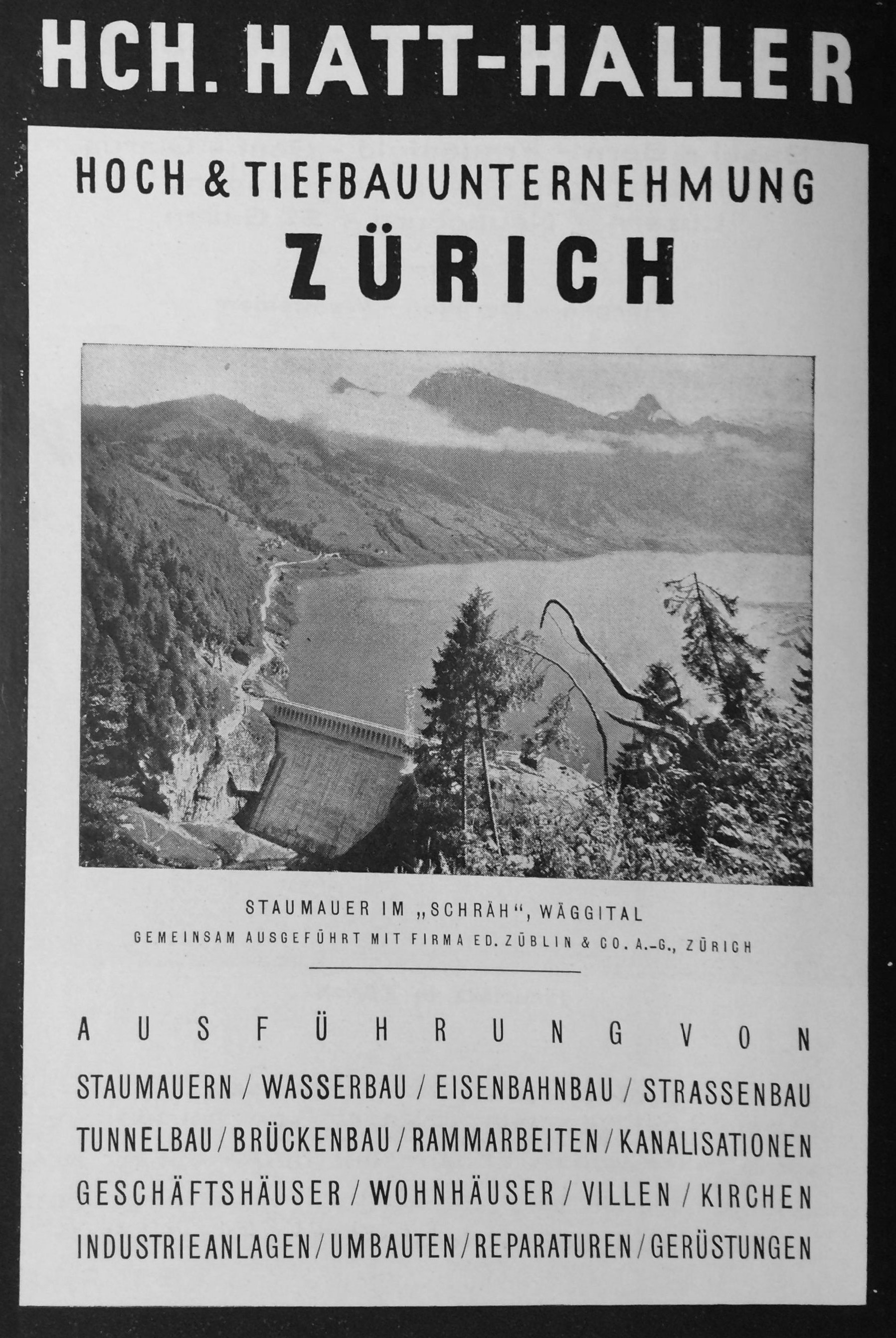
Schräh Dam, Wägitalersee, 1922–1926 (Heinr. Hatt-Haller)
And the third legendary construction company—which would later become Zschokke and eventually Implenia—was also involved in the expansion of hydropower in Switzerland: Heinr. Hatt-Haller (HHH). World War I painfully brought home to Switzerland just how dependent it still was on (German) coal at that time. Now the cantons are setting out to further reduce this dependence through the nationwide construction of hydroelectric power plants. In doing so, the focus is shifting increasingly away from the rivers of the Mittelland and up into the mountains.
For example, to the Wägital valley not far from Zurich. There—as in Eglisau—Nordostschweizerische Kraftwerke AG (NOK), in which the city and the canton of Zurich also hold stakes, is granted the concession to operate a hydroelectric power plant. Construction is being carried out by HHH, the Zurich-based industry leader. Upon completion in 1926, the 110-meter-high “Schräh” dam is the tallest in the world, and the pumped-storage power plant is the most powerful.
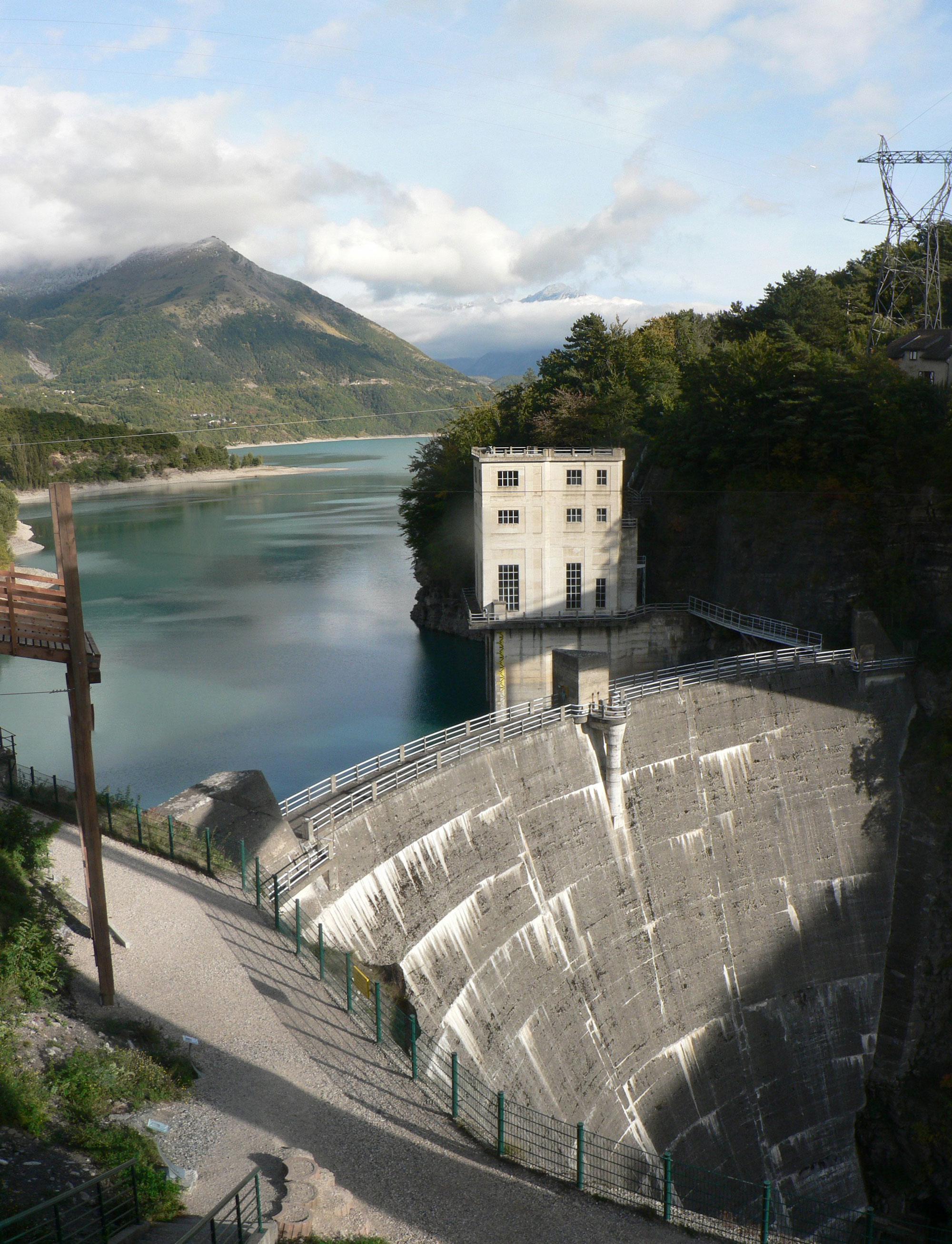
Sautet Dam, France, 1930–1935 (Zschokke)
HHH held the record for the world’s tallest dam for exactly nine years. Four years after the Wägital power plant began operations, SA Conrad Zschokke began construction of an arch dam at Lac du Sautet in the French Alps. The “Barrage du Sautet” stands 125 meters tall—a new world record.
Santa Maria Dam, 1960–1968 (Locher)
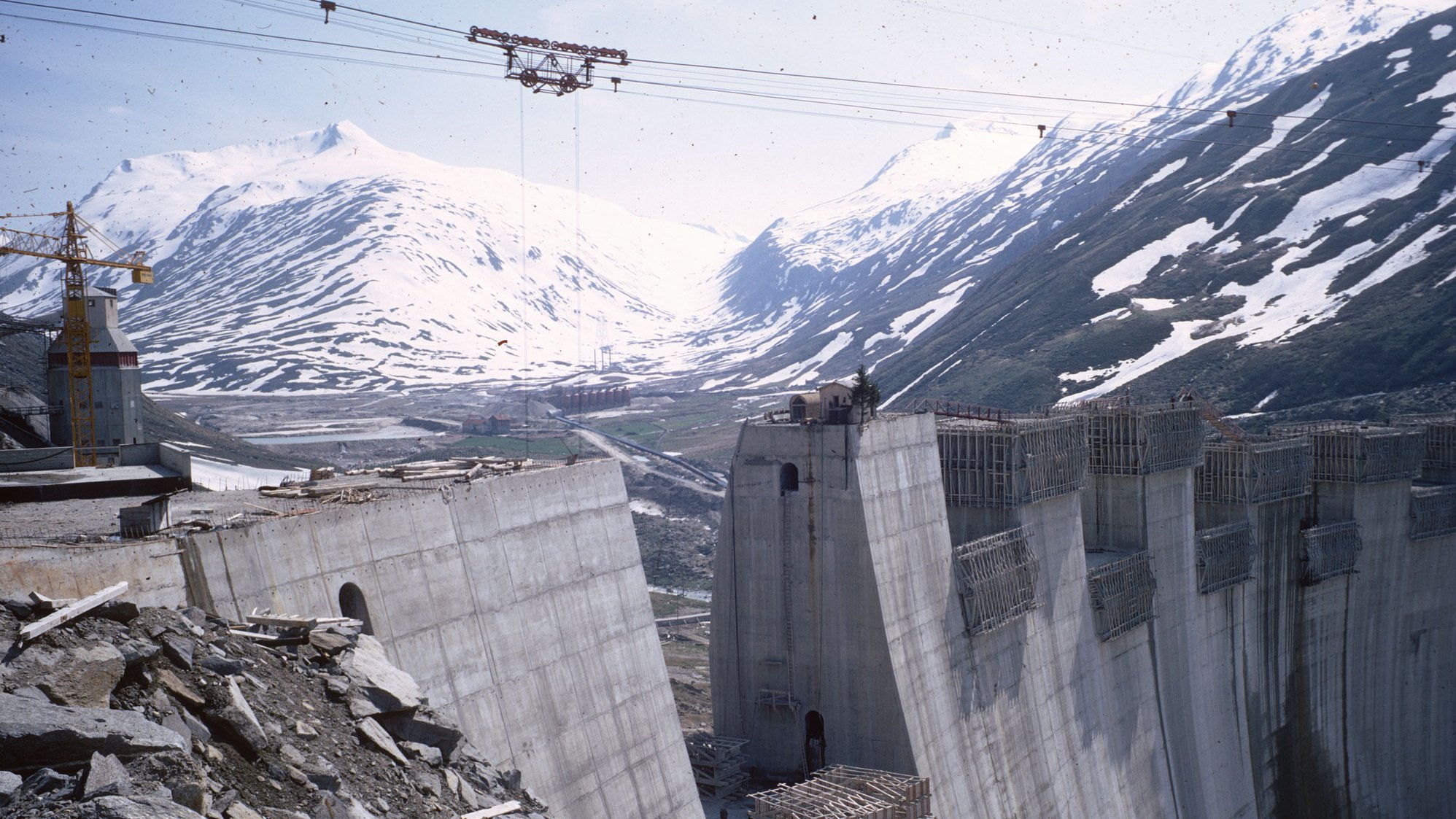
The 117-meter-high Santa Maria arch dam rises at the Lukmanier Pass. To this day, it remains a landmark visible from afar, symbolizing Swiss engineering excellence in Alpine hydroelectric power plant construction. But the internal infrastructure created by the Locher company between 1960 and 1968 is also impressive: a pressure tunnel approximately 8.8 km long connects the reservoir to the Lai da Nalps, ensuring the efficient use of hydropower. To this day, the hydroelectric power plant supplies green energy from the Grisons Alps.
Beznau I and II Nuclear Power Plants, 1965–1971 (Zschokke)
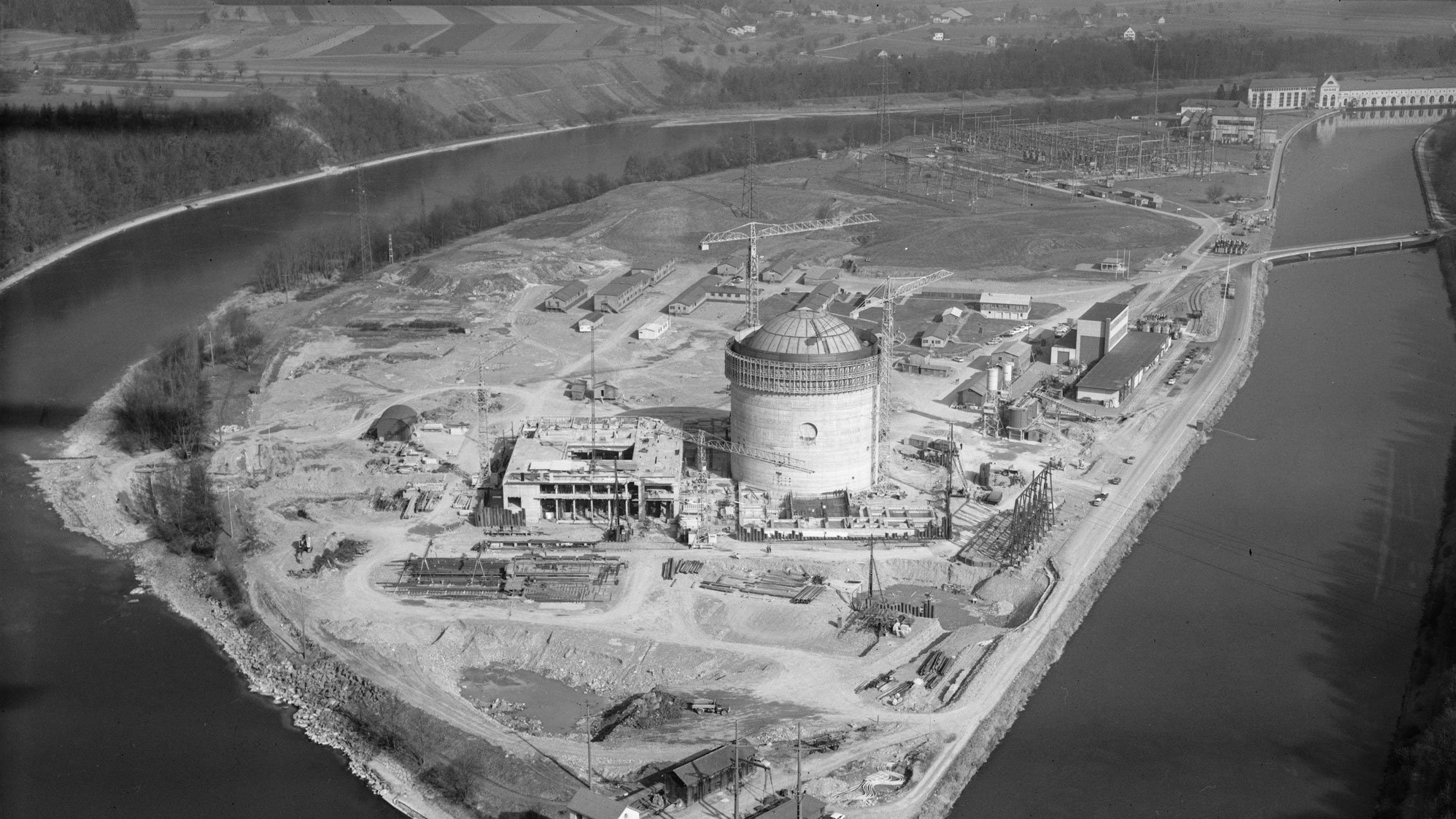
In the postwar period, the Swiss energy sector was initially skeptical of nuclear power plants. Hydropower plants were still the preferred option. In 1961, Grand Dixence began operations, while at the same time the Locher company was busy constructing the 117-meter-high Santa Maria arch dam at the Lukmanier Pass.
But in 1964, Nordostschweizerische Kraftwerke AG (NOK) decided to build a nuclear power plant with two reactors on the island of Beznau in the Aare River. SA Conrad Zschokke was awarded the contract for construction. In 1969, Switzerland’s first nuclear power plant, Beznau I, went online, followed by Beznau II in 1972. Together, they generate 5 TWh of electricity per year. By comparison, Grand Dixence generates just under 3 TWh in a record year like 2024. Today, Beznau I and II are among the oldest nuclear power plants still in operation worldwide. They are scheduled to be shut down in 2032 and 2033.
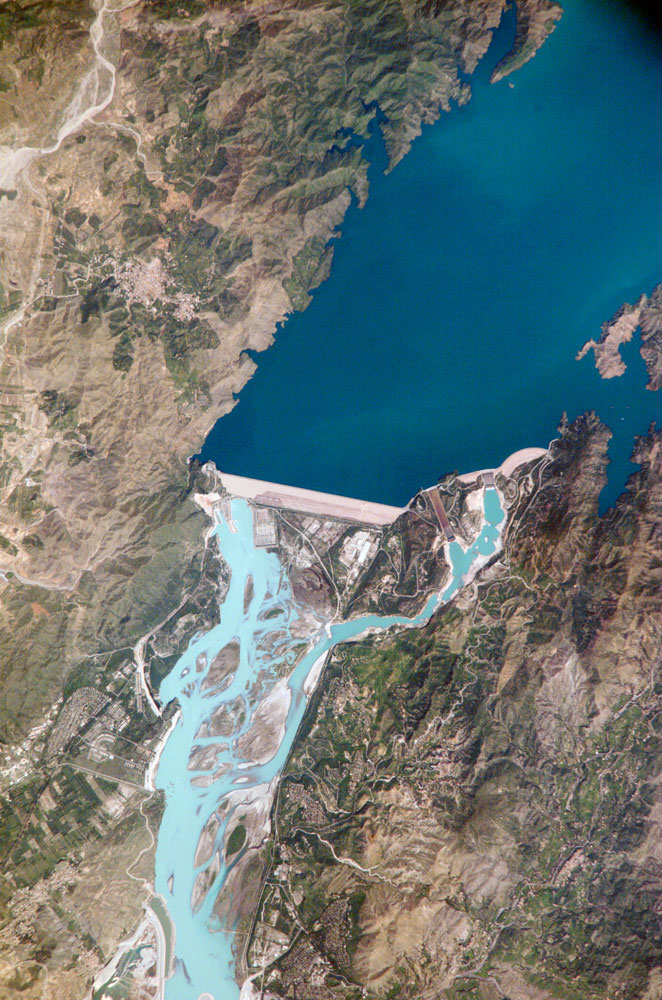
Tarbela Dam, West Pakistan, 1968–1977 (Zschokke)
The construction of the Tarbela Dam on the Indus River in West Pakistan in the 1960s was the largest construction project ever entrusted to a consortium of contractors. The Tarbela Joint Venture (TJV) consists of no fewer than 19 international construction firms, including SA Conrad Zschokke and Losinger AG from Switzerland. The project will cost approximately CHF 3 billion; the equipment alone will cost CHF 250 million. This is offset by the enormous capacity of this power plant, which will go online in 1977 and supply 28 percent of Pakistan’s electricity production.
This colossal project is overshadowed by armed conflicts between India and Pakistan and cost overruns. From today’s perspective, the social and environmental consequences of the project must also be viewed critically. For example, 120 villages with approximately 96,000 residents had to be relocated to make way for the dam’s construction, and the reduction in outflow caused parts of the mangrove area in the Indus Delta to dry up. In the end, SA Conrad Zschokke was likely glad to have been involved in this massive project as just one of many junior partners.
"Electric Mountain," Dinorwig Pumped-Storage Power Plant, Wales (UK), 1974–1984 (Zschokke)
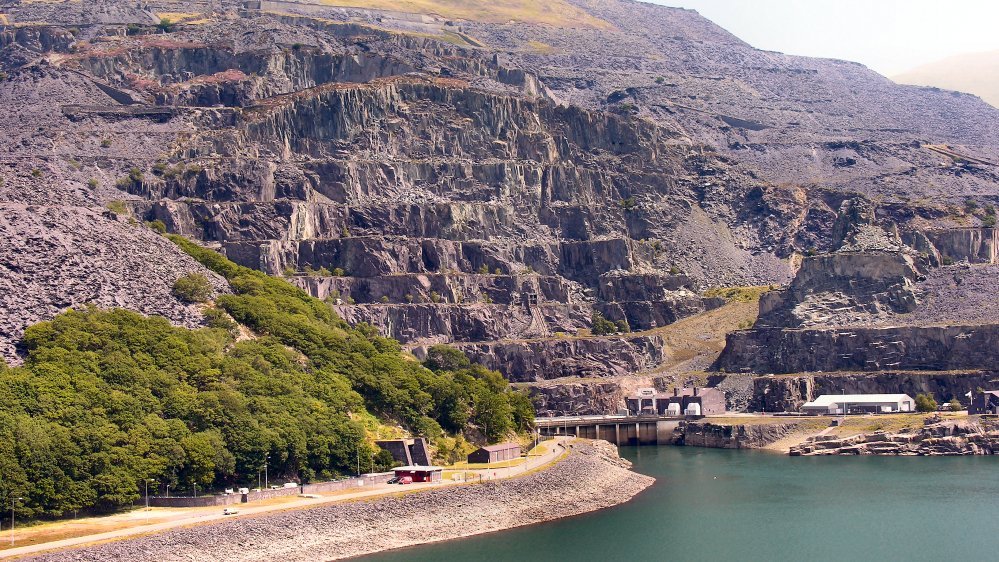
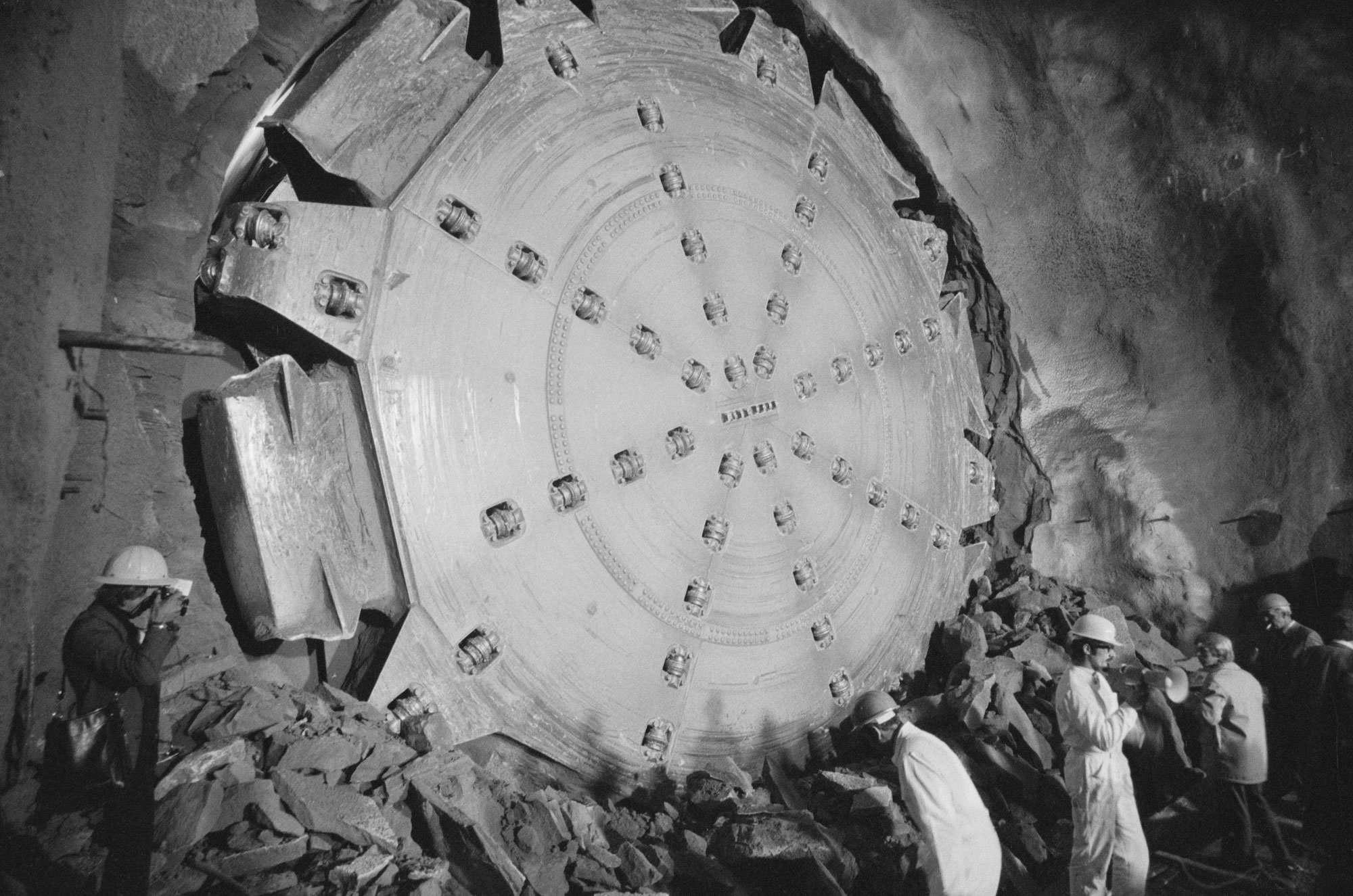
Construction of what was then the largest construction project in British history—the Dinorwig pumped-storage power plant in North Wales—took ten years. Twelve million metric tons of rock were excavated deep from the Elidir Fawr mountain, 1 million metric tons of concrete, 200,000 metric tons of cement, and 4,500 metric tons of steel were used to build Europe’s most powerful pumped-storage plant and the third-most powerful in the world.
The plant generates this immense amount of energy by pumping water from Llyn Peris Lake into the higher-elevation Marchlyn Mawr Reservoir during periods of low electricity demand and storing it there, so that it can be released through tunnels and turbines when electricity demand is high. Today, with its 16 km of adits and tunnels and a massive, 51-meter-high cavern, the power plant is also a tourist attraction known as “Electric Mountain.”
Nant de Drance Pumped-Storage Power Plant, Valais, 2008–2018 (Implenia)
In 2008, construction began on one of Europe’s most powerful power plants: the Nant de Drance pumped-storage power plant in Valais. It was one of the largest contracts for Implenia, which was still a young company at the time, and which, together with Marti, was awarded the contract for the extensive civil engineering work. This is because the two reservoirs—Vieux Emosson at 2,225 meters above sea level and Emosson at 1,930 meters above sea level—already existed.
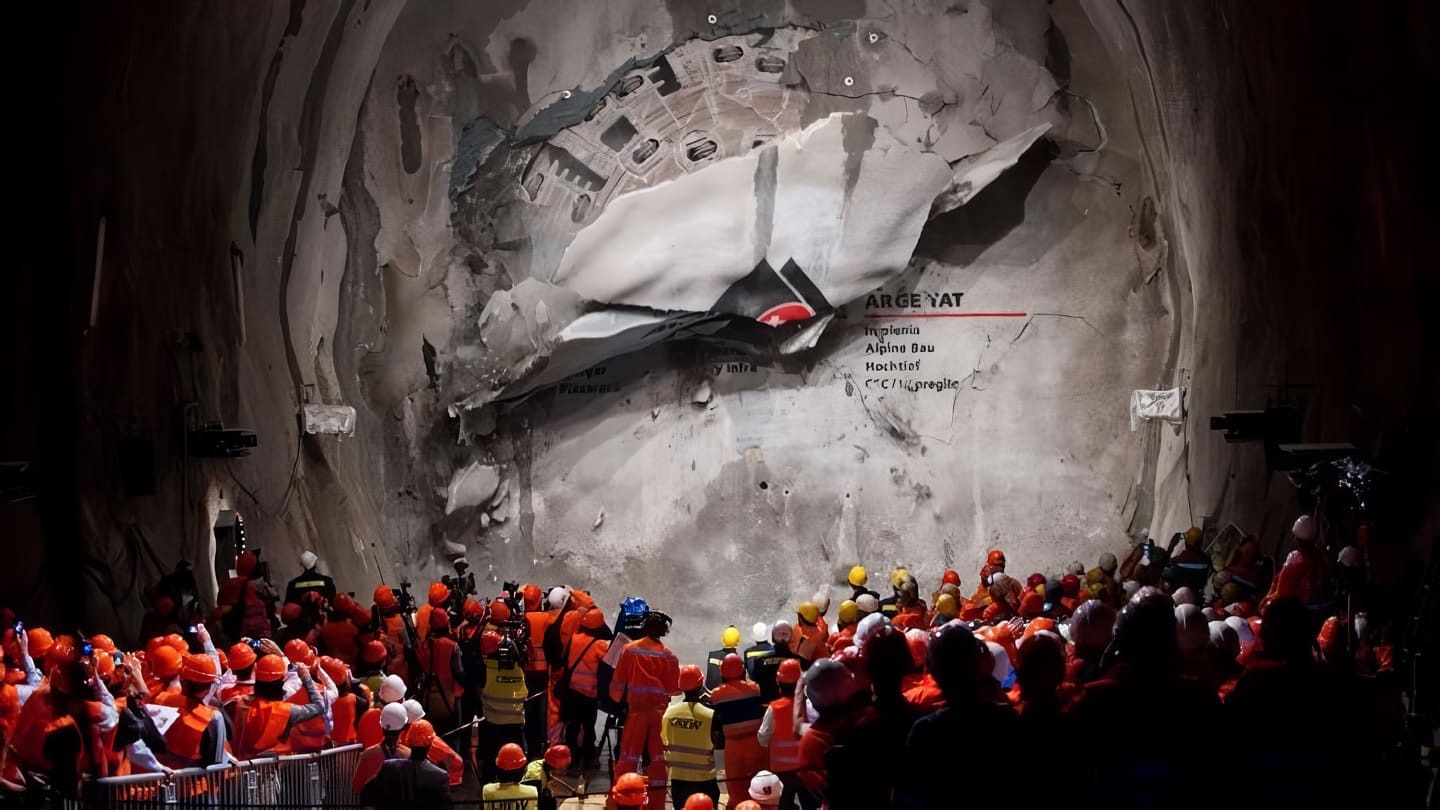
The Nant de Drance pumped-storage power plant does not generate new energy; rather, it is designed to stabilize grid fluctuations by pumping water back and forth between the two reservoirs. When a lot of electricity is needed, water is released from the upper reservoir into the lower reservoir and passed through turbines; when little electricity is needed, the water is pumped back into the upper reservoir and stored. To make this work, Implenia is working with Marti to build an 18-km tunnel, two pressure shafts 430 m deep, and a massive underground cavern. This giant rechargeable battery will be connected to the grid in 2022.
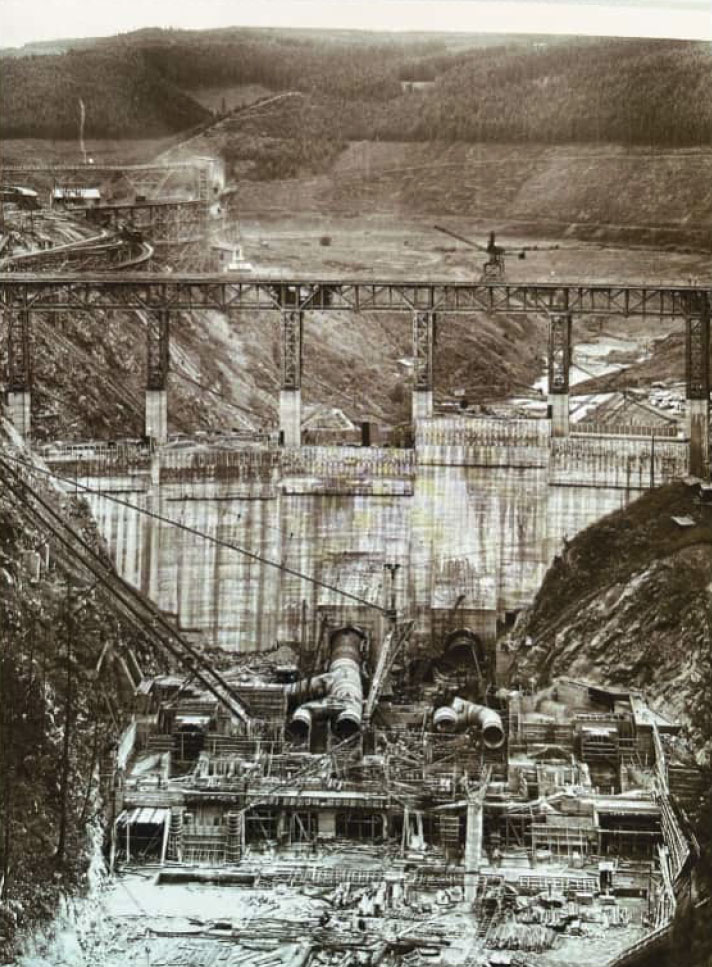
Bleichloch Dam, Thuringia (Germany), 1926–1932 (Bilfinger), 1999–2000 (Bilfinger+Berger), 2023 (Implenia)
In terms of reservoir capacity, the Bleiloch Reservoir in Thuringia—which covers 9.2m² and reaches depths of up to 70 m—is Germany’s largest reservoir. Today, the lake is not only a source of energy but also a popular destination—fittingly, even for electronic and techno music fans, who flock here every August for the popular “Sun, Moon, and Stars” festival.
The Bleiloch Dam was built between 1926 and 1932 by a consortium that included Grün und Bilfinger AG. In the midst of construction, the Great Depression struck the massive project—unemployed people from all parts of Thuringia and Saxony were conscripted here for six-month work assignments. One world war and Germany’s reunification later, in 1999, the Swedish operating company Vattenfall decided to demolish and rebuild the dam wall, which had been damaged by corrosion—the contract for this was awarded to Bilfinger + Berger, the successor company to Grün und Bilfinger.
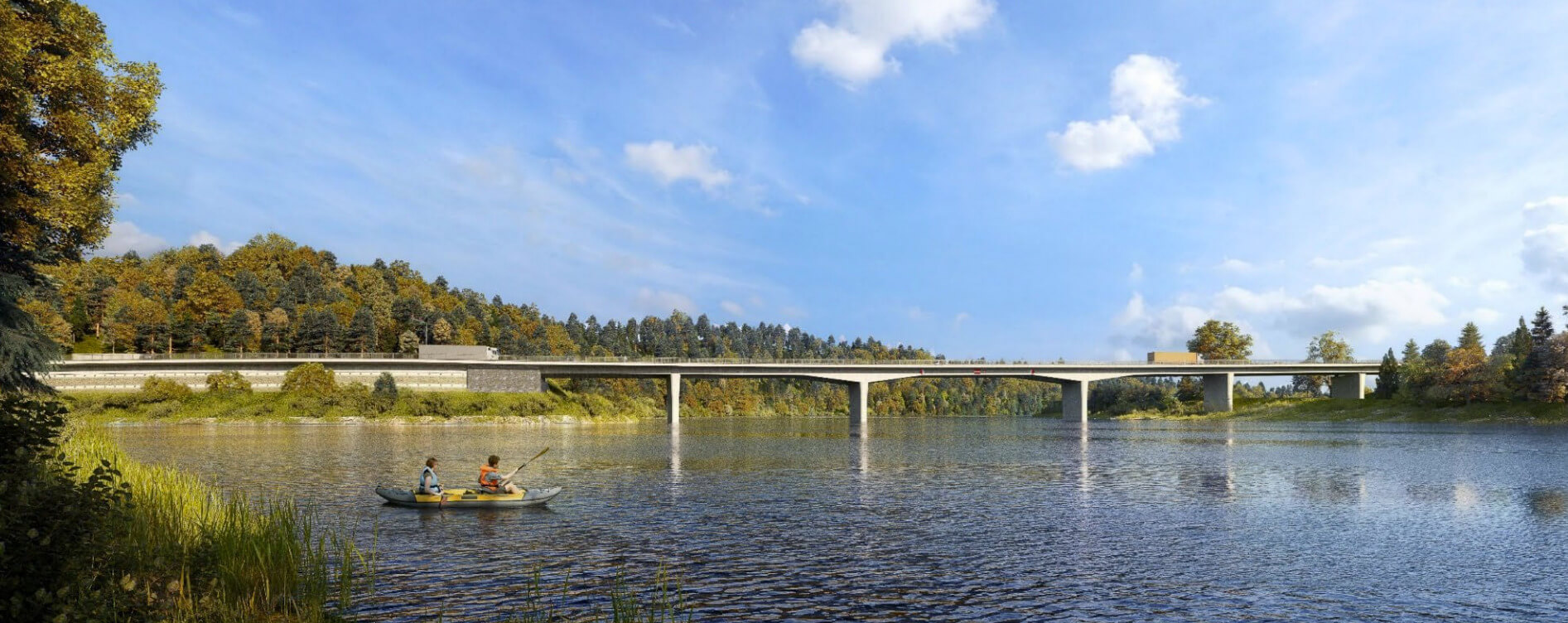
And the story continues: At the same time the dam was being built, a bridge was erected over the emerging reservoir 15 km upstream in the late 1920s. By 2023, this bridge will be nearing the end of its service life. In 2023, a bidding consortium consisting of Implenia and Amand is awarded the contract to rebuild the B90 dam bridge. The bridge is scheduled to open in 2027. By then, Implenia will be able to proudly say that, together with its predecessor companies, it has been helping to build the “Thuringian Sea” and the Bleiloch Dam for over 100 years.
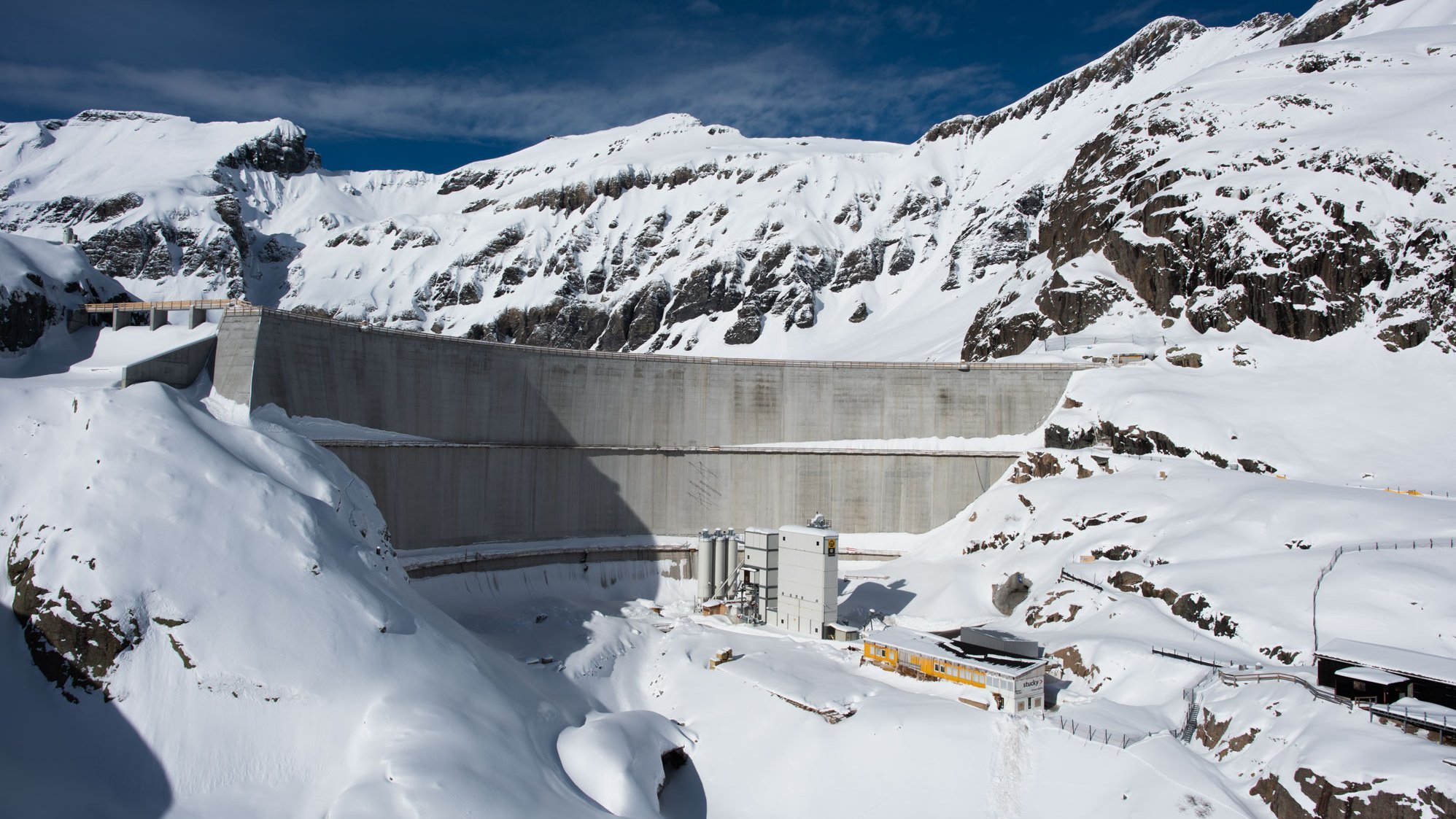
Spitallamm Dam, Grimsel, 2019–2026 (Implenia)
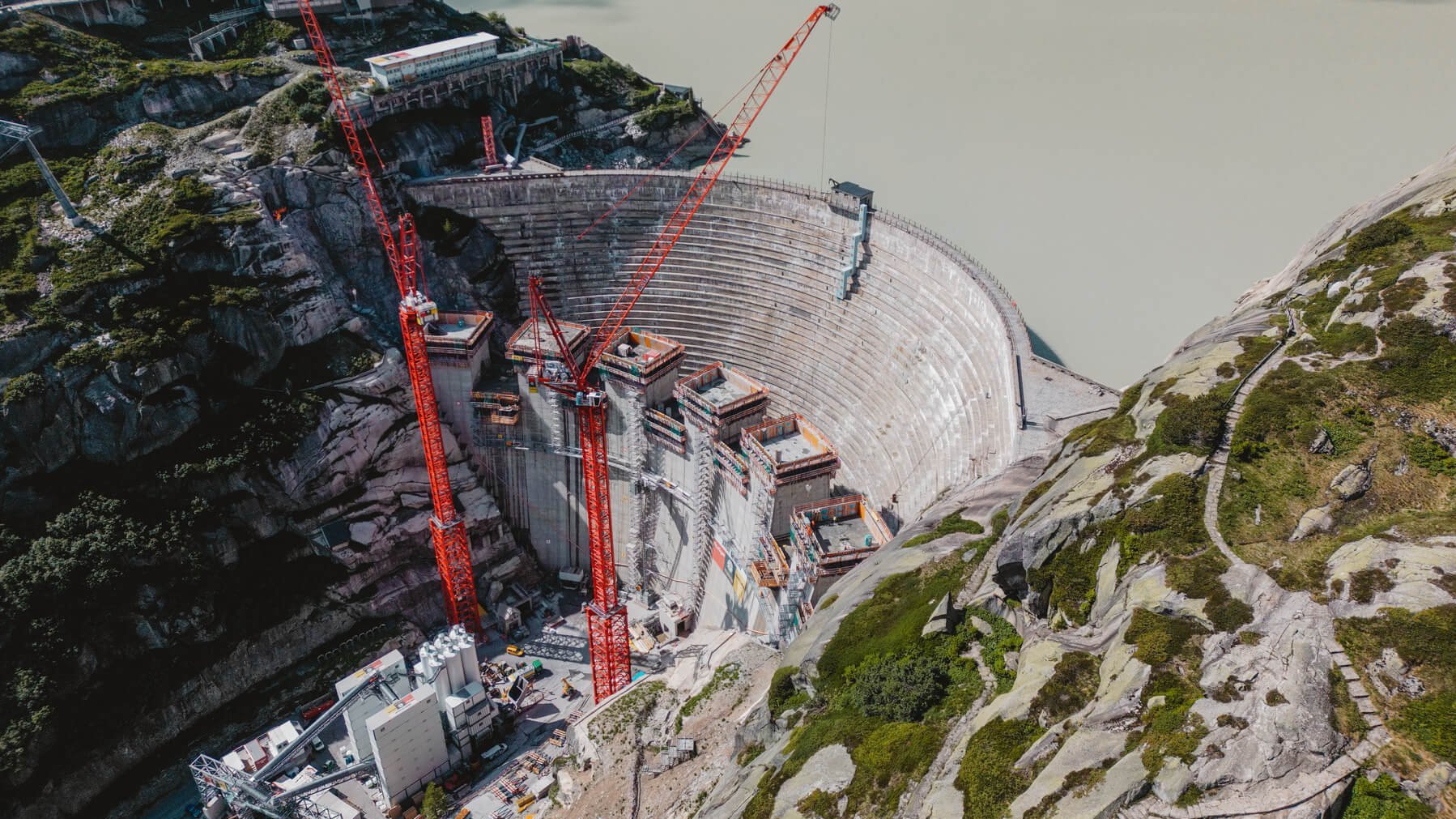
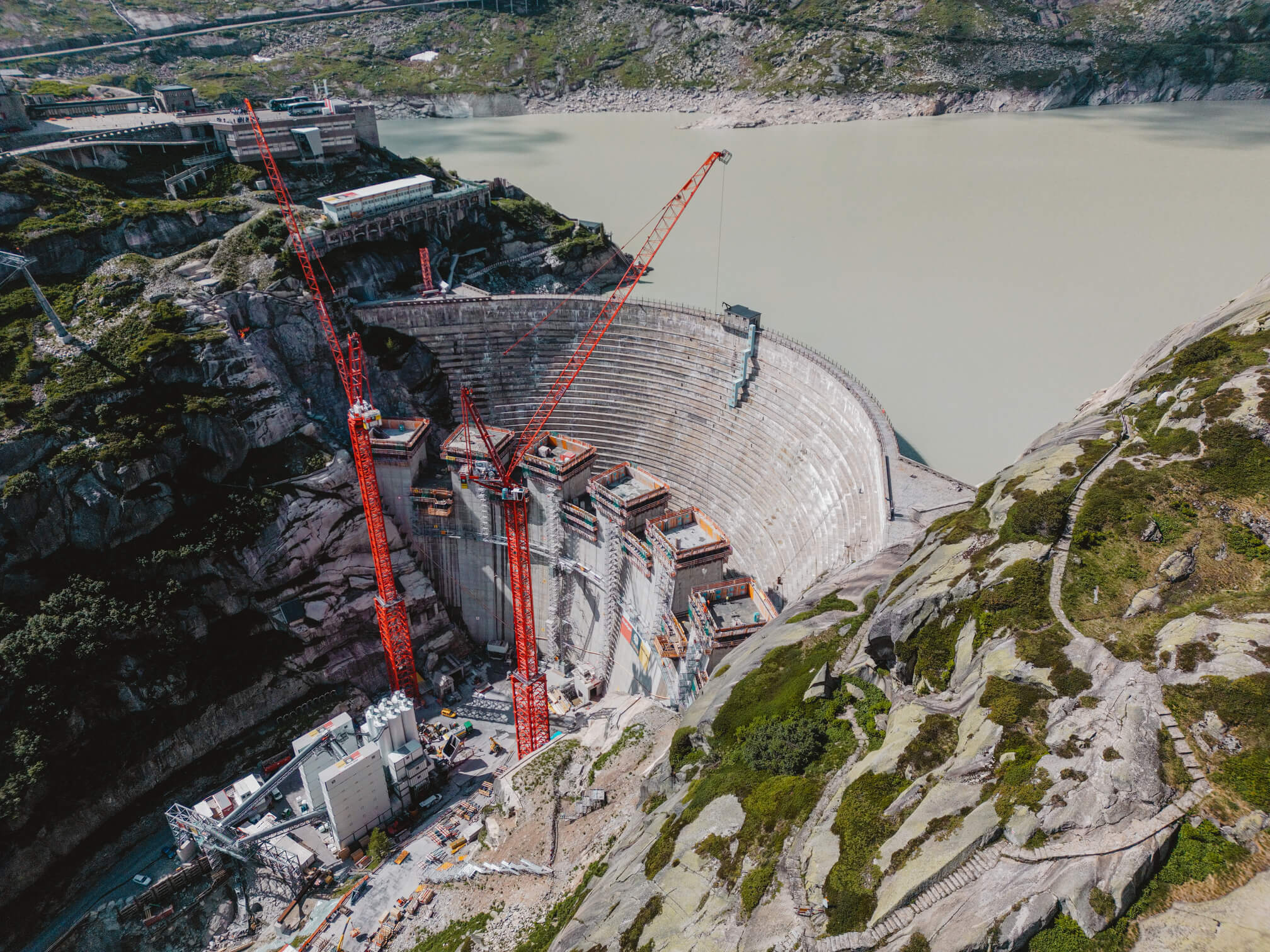
One of Switzerland’s most famous dams, the Spitallamm Dam on Lake Grimsel, is aging poorly. As early as the 1960s, a vertical crack appeared between the facing concrete and the mass concrete—a phenomenon known as structural separation. In addition, an alkali-aggregate reaction (AAR) may be occurring in the dam’s mass concrete. For this reason, the operator, Kraftwerke Oberhasli AG (KWO), decided to construct an identical new dam directly in front of the old one.
This has three advantages: First, construction can take place in dry conditions; second, Kraftwerke Oberhasli can continue to generate electricity using water from Lake Grimsel during the seven-year construction phase; and third, the new dam will have the necessary structural integrity to allow for a future height increase. In the awarding of this prestigious project, Implenia will share the contract on an equal footing (42.5 percent) with the local favorite, Frutiger AG. The key factor in winning the contract was the company’s track record in successfully raising the Vieux Emosson dam for the Nant de Drance pumped-storage power plant (see above).