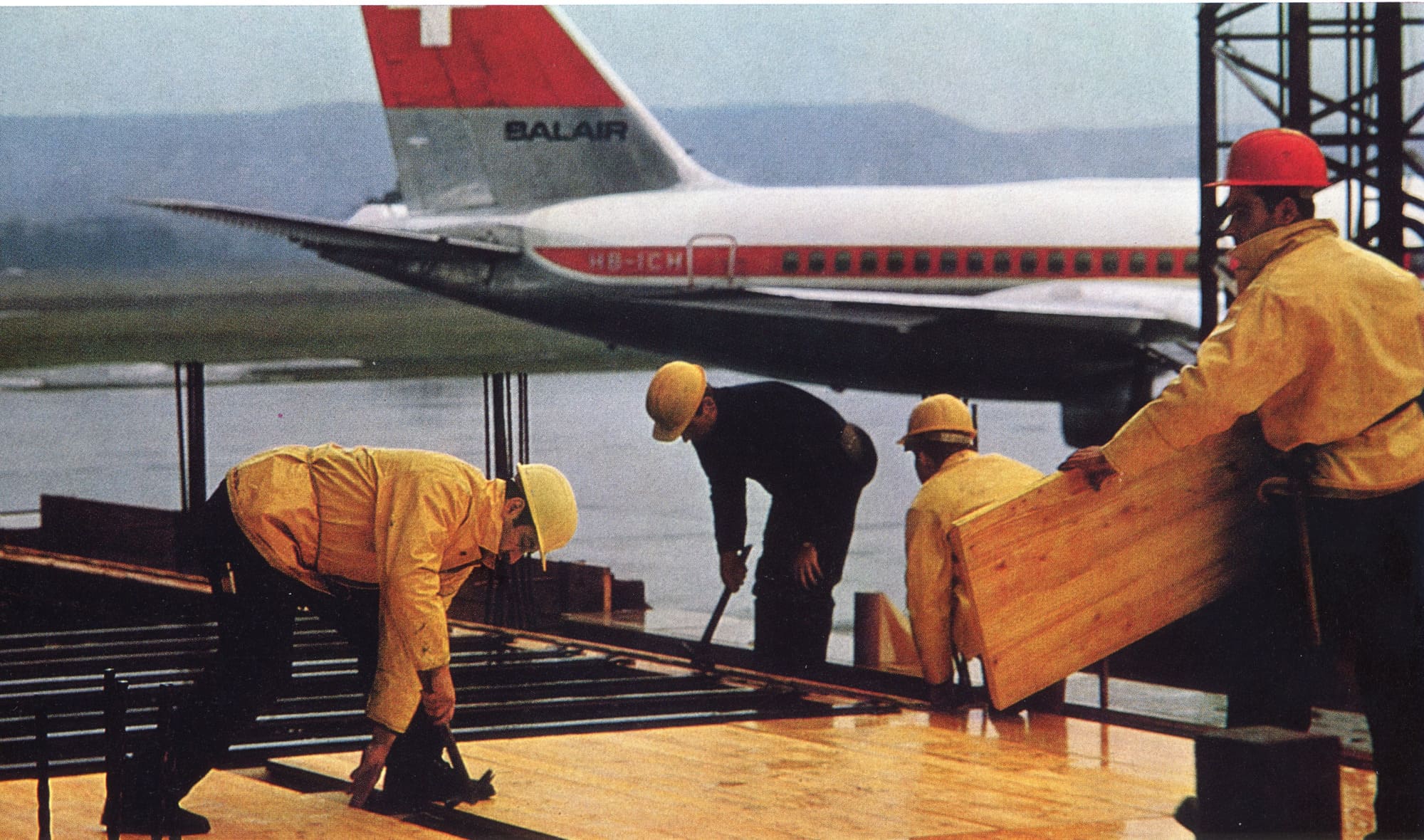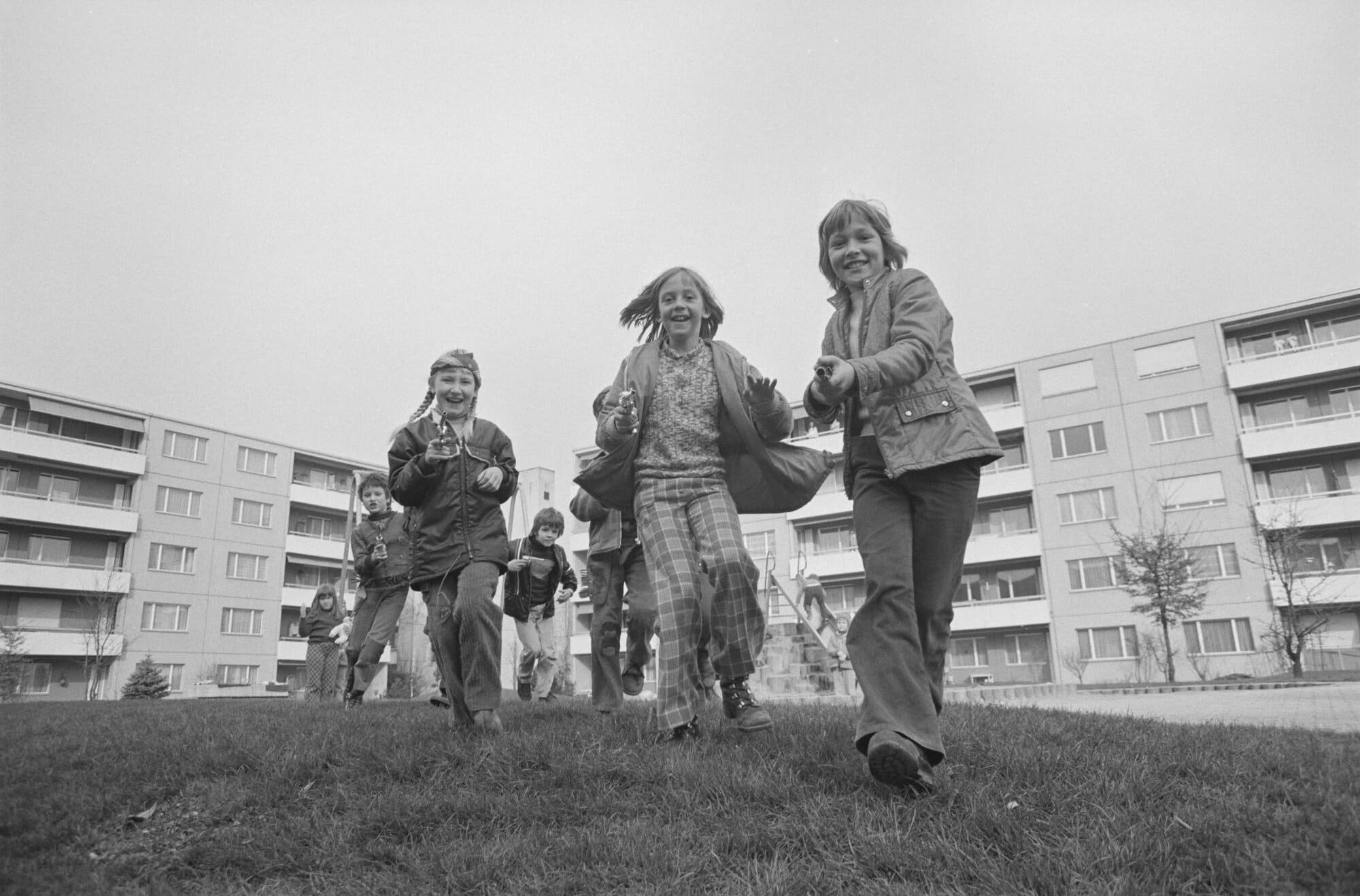



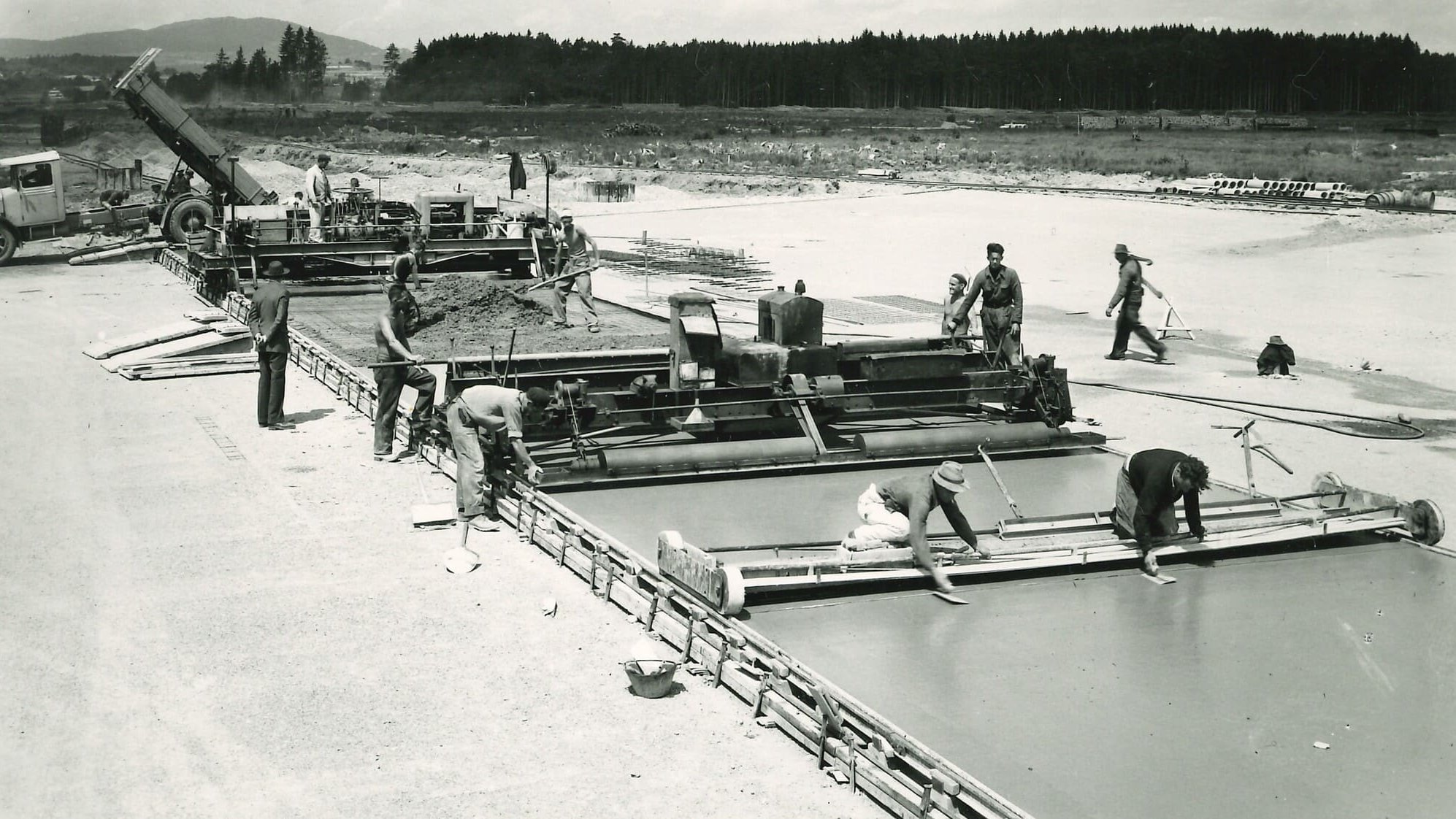
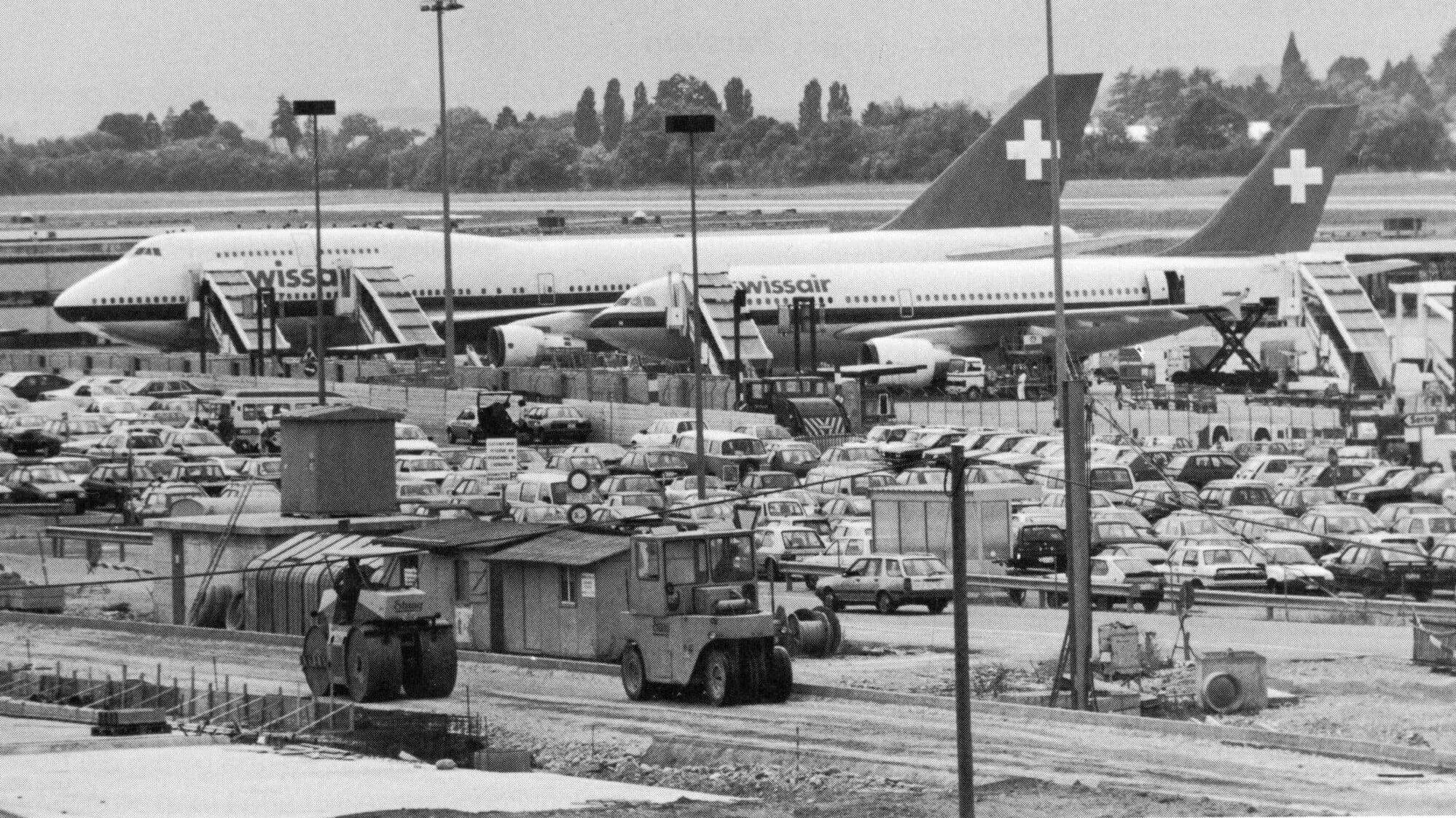
Formwork work at Zurich Airport, 1970
Employees of Ad. Schäfer+Cie AG
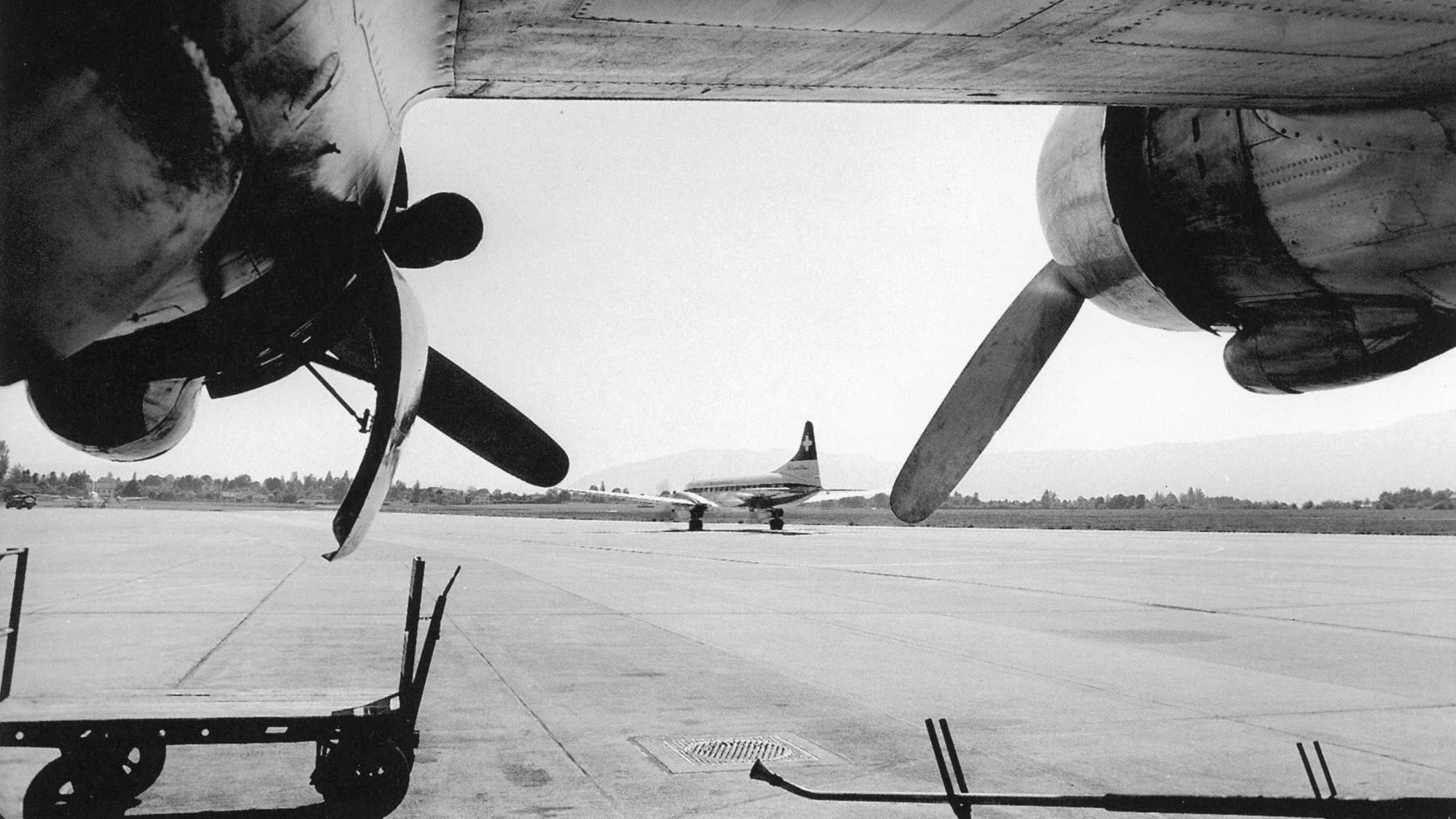
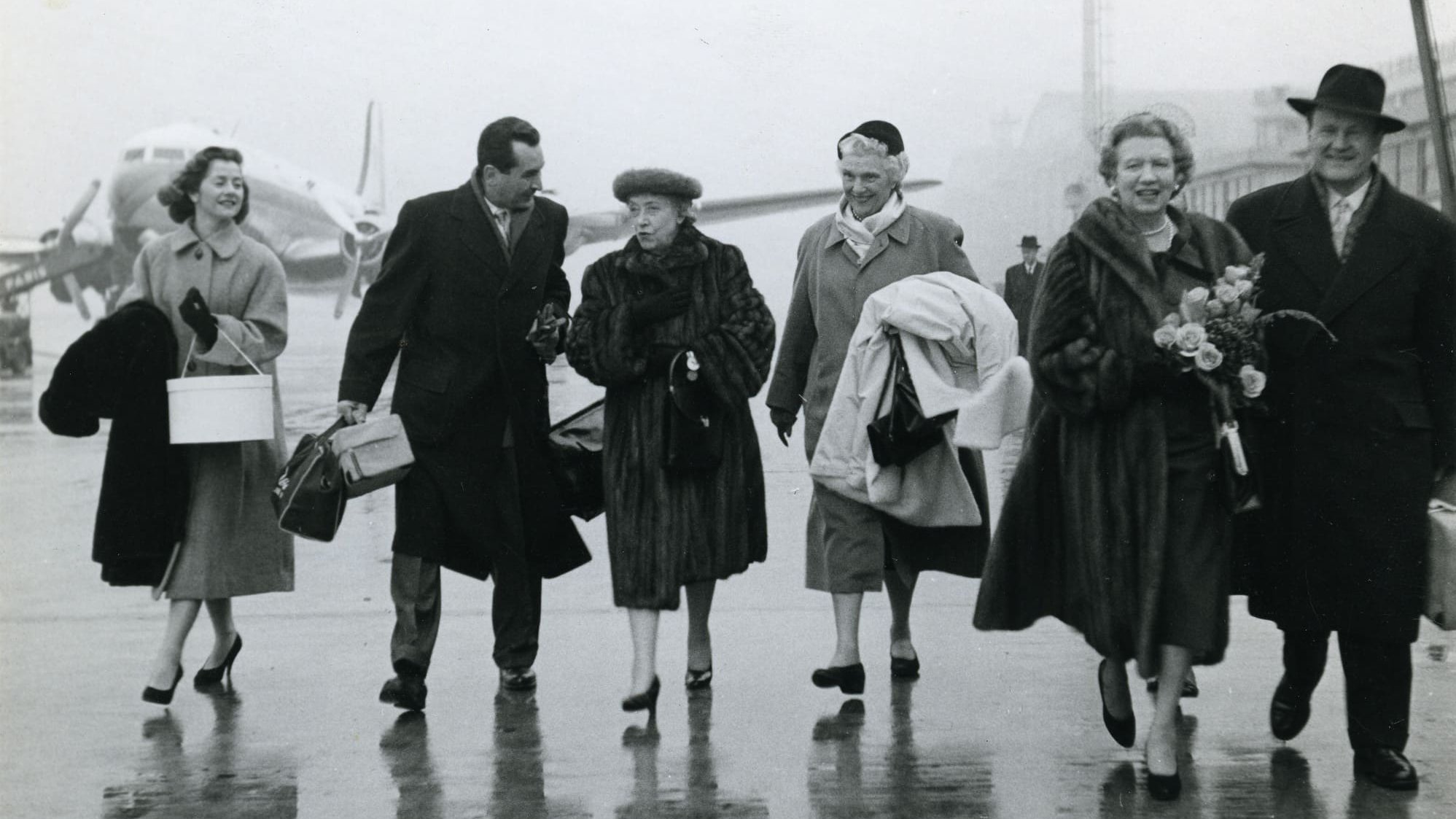
In the back: Belair's first jet - a Convair 990
20 years of Implenia, 160 years of shaping the future
Flying for all
For thousands of years, flying was a dream of mankind. Until the airplane conquered the skies in the 20th century and flying became a consumer good. Although no evidence has been found that Implenia or its predecessor companies ever built an airplane... with asphalt and concrete, they helped to make it possible for everyone to fly safely and comfortably.
Night shift for Implenia
Only when the last plane has landed at Zurich Airport at around 11 p.m. do the construction workers make their meticulously coordinated appearance. And when the first plane takes off right here the next morning, all these men and women have disappeared again like the brownies. What has happened in the meantime on runway 10-28 at Zurich Airport:
Mobile noise barriers are being set up; two 90-ton excavators are breaking up the old runway surface.
The pipes for the new lighting system (signal lights) will be laid in the foundation.
Laying the 28-centimeter-thick base course; rollers compact the low-temperature asphalt.
Placement of the mounting brackets for the signal lights; two asphalt pavers are laying the binder course in parallel.
Paving completed; installation of signal lights and marking of the centerline.
Clear the runway, final cleaning, inspection, and acceptance.
Takeoff of the first aircraft.
From the first to the last slope
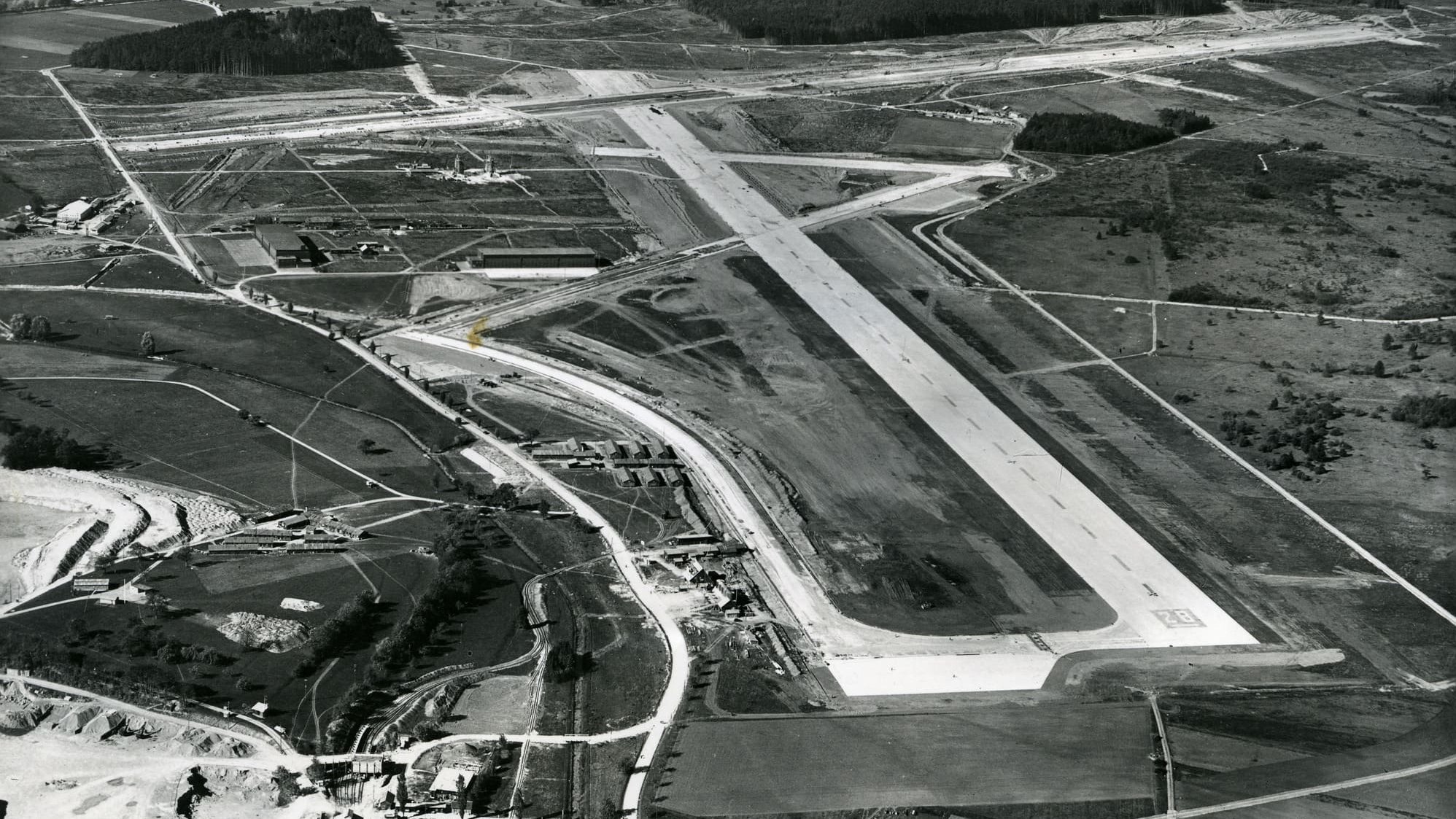
For 80 fall and winter nights in 2022/23, ARGE Midnightforce, in which Implenia was involved, renovated Zurich Airport's west runway 10-28. Little did the Implenia team know that they were following in the footsteps of their predecessors. Because runway 10-28 is the oldest of the three runways at Zurich-Kloten Airport, which opened in 1948. And who built it? Heinr. Hatt-Haller AG and SA Conrad Zschokke from Geneva.
It was not the first runway that Implenia renovated as part of a consortium. In fact, the renovation of runway 10-28 was the conclusion of a comprehensive runway renovation: in 2008, Implenia renovated runway 16-34 as part of the Midnightrun consortium, and in 2014, runway 14-32 as part of the Midnightspeed consortium.


The pioneering phase of airport construction - with a head start for Geneva
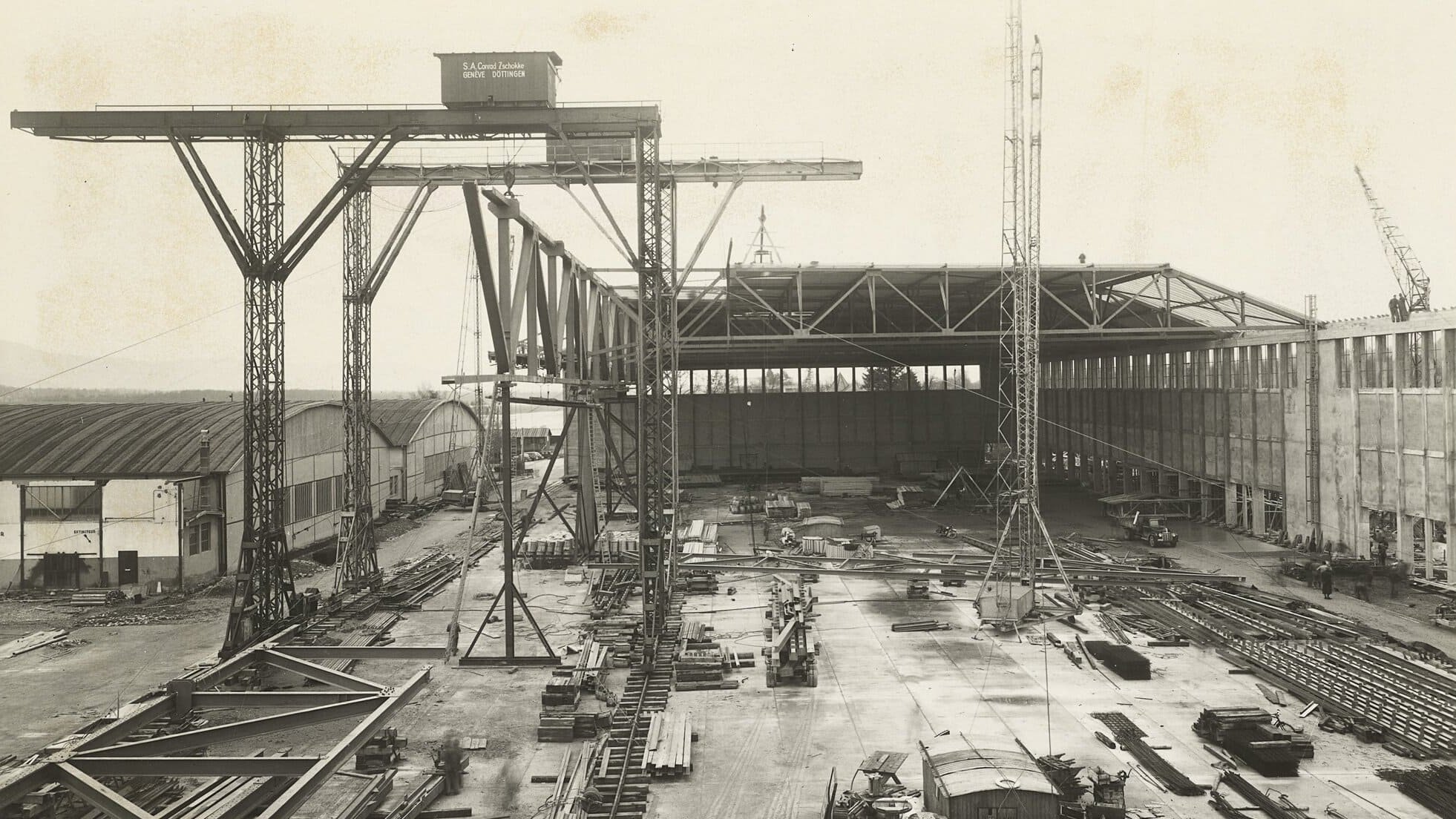
However, the pioneer of civil aviation in Switzerland was not Zurich, but Geneva, which was much more "international" at the time. Geneva had had an airfield in the suburb of Cointrin with a license for commercial air traffic since 1922. In 1938, the canton of Geneva acquired further land around the airport in order to expand it. Three years later, construction work began - despite the war economy and rationed cement supplies. At the forefront: SA Conrad Zschokke, which extended the runway to 2000 m from 1941 and built the first large hangar at Geneva-Cointrin Airport in 1946 with its experience in metal construction.
It is this experience in airport construction that SA Conrad Zschokke later brings to the construction of Zurich Airport, where Hatt-Haller is clearly the "top dog". Nevertheless, when construction work began on the airport in Zurich, intercontinental flights were already operating in Geneva: Trans World Airlines (TWA), and not Swissair, had been operating the New York-Geneva-Rome-Cairo route here since April 8, 1946.


The democratization of flying
With the economic upturn in the post-war period, commercial air traffic in Switzerland also developed rapidly. In 1945, the number of passengers was 16,000; by 1975 it had risen to 10.6 million and by 2000 to 34.4 million, with Swissair alone flying to 117 destinations in more than 70 countries. Today, the number of passengers in Switzerland is 60 million.
While flying was initially a luxury good, it increasingly became a consumer good in the 1980s. Swissair's first intercontinental scheduled flight from Zurich via Dakar and Natal to Rio de Janeiro cost around CHF 8,000 in 1949 - that would be almost CHF 40,000 today, excluding the return flight! Today, the same journey costs CHF 1000 and takes half as long.
Airports also have to keep pace with this rapid development in air travel. Almost all of Implenia's predecessor companies are involved in this constant expansion: Hatt-Haller and Zschokke, who extend runways and build new freight and post office buildings, but also smaller companies such as Ad. Schäfer und Cie. AG, which installed the external heating systems at Terminal B in Zurich-Kloten in 1972, and Stuag, which specialized in road construction and built access roads to Geneva-Cointrin Airport in 1986.
With its international reputation, SA Conrad Zschokke even manages to "export" airport construction. Between 1982 and 1984, it extended the dreaded, short runway at Funchal Airport in Madeira with a subsidiary. Due to the topography, the runway had to be extended into the sea, where Zschokke's expertise in hydraulic engineering came in handy.
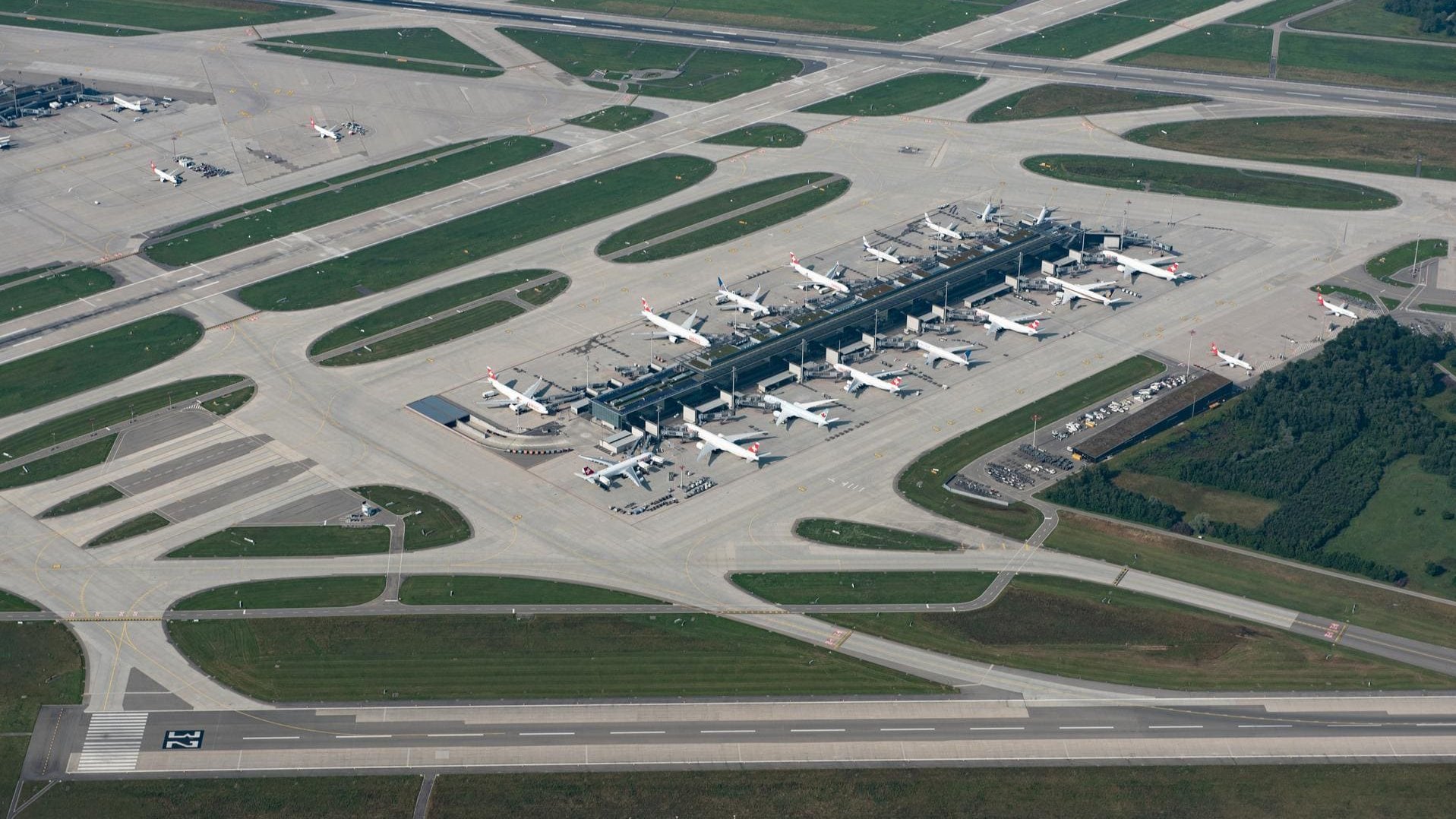
Back at Zurich-Kloten Airport, Batigroup took on the master builder work for the international terminal "Dock E", known as "Dock Midfield", which was opened in 2003 and offers space for up to 27 additional wide-bodied aircraft. Zschokke Locher was involved in the construction of the underground "Skymetro" aerial tramway between the Airside Center and Dock E.
Implenia is airworthy - until today
Implenia combines this expertise from its predecessor companies. Whether in building construction or civil engineering, Switzerland's largest construction and real estate service provider knows its way around airports. As with runway construction, the short time frames and complicated logistics are a constant challenge. Deliveries, the use of heavy equipment and lifting gear - all this is only possible outside of operating hours, i.e. at night. However, Implenia feels at ease under such conditions, so that in 2025, for example, the new Rächtenwisen freight hall can be opened - a sustainable, modern timber construction, just like the first buildings by Zschokke and Hatt-Haller.
A year earlier, Implenia completed the façade work on Terminal 3 at Frankfurt Airport: 10,000m2 of façade and windows in futuristic architecture.
The current renaissance of military airport construction has an unpleasant reason - the international sabre-rattling of the major powers. But it could also be described as a return to the roots, because in the first half of the 20th century, airport construction was almost exclusively military in nature. What is definitely different today is that there is an increasing lack of people. For example, Implenia has built an airport just for the Swiss military's new drones at the traditional Emmen military airfield, home of the Patrouille Suisse.
-
Main photo: Workers of Ad. Schäfer+Cie AG during formwork work at Zurich Airport, 1970. Eight years later, the long-established Aarau-based company becomes part of the Zschokke Group. Ad. Schäfer+Cie AG, Aarau 1870-1970
History stories
The content will be expanded throughout the anniversary year
For more information about Implenia's roots and how Implenia has shaped and continues to shape the past, present and future of Switzerland and many other countries: