
Types of Wood and Their Uses
Maple
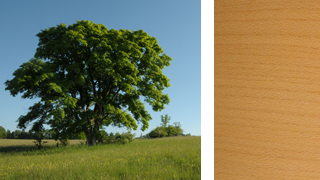
Maple yields light-colored wood that ranges in color from nearly white to light brown with a reddish tint (yellowish in the case of sycamore maple). The grain of European maple is fine and uniform; however, bird’s-eye and other distinctive patterns may also occur. Maple darkens quickly when exposed to sunlight. Maple is often used for flooring, furniture, veneers, kitchens, and tables.
Birch
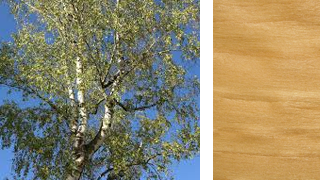
As expected, birch wood is light in color and usually has a reddish-yellow hue. The wood has a subtle grain; however, flamed birch and ice birch feature patterns resembling flames or ice flowers, which create interesting grain patterns. Birch is used frequently, particularly in the Scandinavian countries. It is primarily used in hardwood flooring, as veneer, or as lumber for furniture making.
Beech
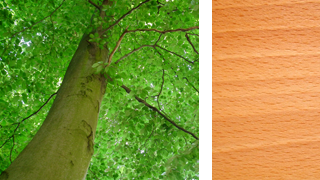
Beech wood is light in color, yellowish or reddish—older trees often have a reddish-brown heartwood. Beech wood has only a faint grain. The European beech is the most widespread deciduous tree in Europe. No wonder beech is one of the most important commercial timbers in our part of the world. Beech is hard, elastic, dense, and strong—similar to oak. Consequently, the wood is widely used, for example, for flooring, furniture, veneers, and heavily loaded structural components.
Douglas fir
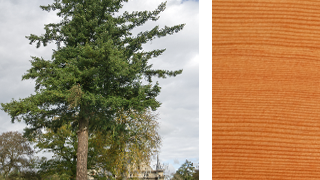
This softwood, native to North America, has a light-colored sapwood and a heartwood ranging from yellowish to reddish-brown, which darkens significantly over time. It grays rapidly when exposed to the elements. Douglas fir is soft, tough, and strong. It has good load-bearing capacity and is virtually unaffected by the elements. For this reason, it is often used outdoors and in shipbuilding, but is also used as veneer, in flooring, and for paneling.
Oak
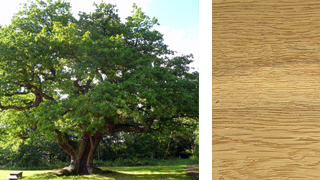
This hard, yellowish-brown wood is a classic among hardwoods. Oak is synonymous with hardness, weather resistance, and durability. In addition, the wood is remarkably elastic. Oak has a beautiful grain, and its growth rings are clearly visible. The wood is widely used for flooring, wainscoting, furniture, veneers, and structural applications—in other words, practically everywhere, both indoors and outdoors.
Ash
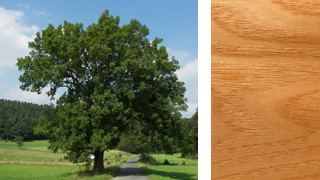
The sapwood and heartwood of ash are light in color, ranging from white to yellowish or reddish. Ash wood, much like oak, has a mottled appearance and irregular streaks. Ash wood is more resistant to tension, has greater bending strength, and is tougher than most other native wood species; however, it is not very weather-resistant and is therefore used almost exclusively indoors for flooring, furniture, paneling, and veneers.
Spruce
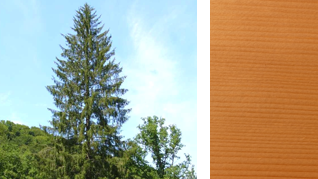
The spruce produces a soft, non-weather-resistant wood with a lustrous reddish hue. The growth rings are clearly visible; the wood typically has a finely striped grain, interrupted by prominent knotholes. Characteristic of spruce wood are the prominent resin canals that run through it. Spruce wood is very soft and has a very low density. However, its mechanical properties are surprisingly good, which is why spruce wood is frequently used as building and structural lumber. Spruce wood is also used for flooring, furniture, and veneers.
Pine
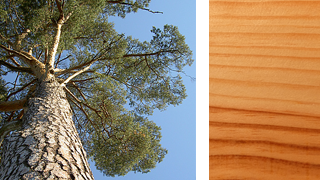
The heartwood of pine is noticeably darker than the yellowish-white sapwood. The wood has a visible grain, and knotholes are also clearly visible. Pine wood is of medium density and has good mechanical properties compared to spruce. Nevertheless, pine is not necessarily suitable for outdoor use; it is best suited for furniture making or as structural lumber.
Cherry
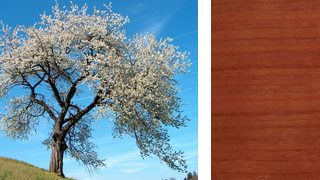
Medium-density cherry wood exhibits a relatively pronounced color difference between the sapwood and heartwood. The sapwood is yellowish-white, and the heartwood ranges from yellowish-red to reddish-brown. Cherry wood is easy to work with and polish. These properties, combined with its warm color, make cherry wood a premium timber that is primarily used for interior applications: high-end flooring, wainscoting, furniture, veneers, and decorative items are made from cherry wood—or in combination with it.
Larch
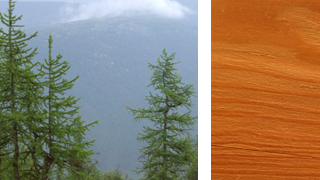
The color of the heartwood and sapwood in larch differs significantly, with the heartwood being noticeably darker than the light yellow to reddish outer layer. The heartwood also contains nail knots—small, dark knots that have grown into the wood. Larch wood is the strongest and heaviest softwood, making it very durable. It is also well-suited for outdoor use, as long as it does not come into contact with the ground. Larch wood is frequently used in construction; doors, gates, window frames, and exterior siding are also often made from larch. The alpine huts—known from mountainous regions—that are lined with larch exude their own unique charm and a cozy scent.
Walnut

Walnut wood is notable for its characteristic, intricate grain pattern. The colors range from light to dark brown and even almost black. Walnut wood is sometimes described as the finest of the native woods. It is used accordingly: it is used to make high-quality flooring, sophisticated furniture, veneers, paneling, and doors.
Silver Fir
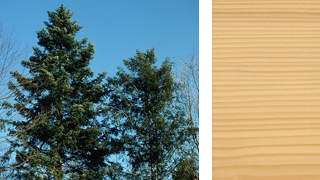
The matte silver fir wood is uniformly yellowish or reddish-white throughout. The wood has a distinct striped grain. The grain is regularly interrupted by clearly visible knotholes. Silver fir wood is used in construction; however, it is also used to make fiberboard, veneers, crates, poles, furniture, and pallets.
