

Achieving Climate Goals Through Wooden Buildings
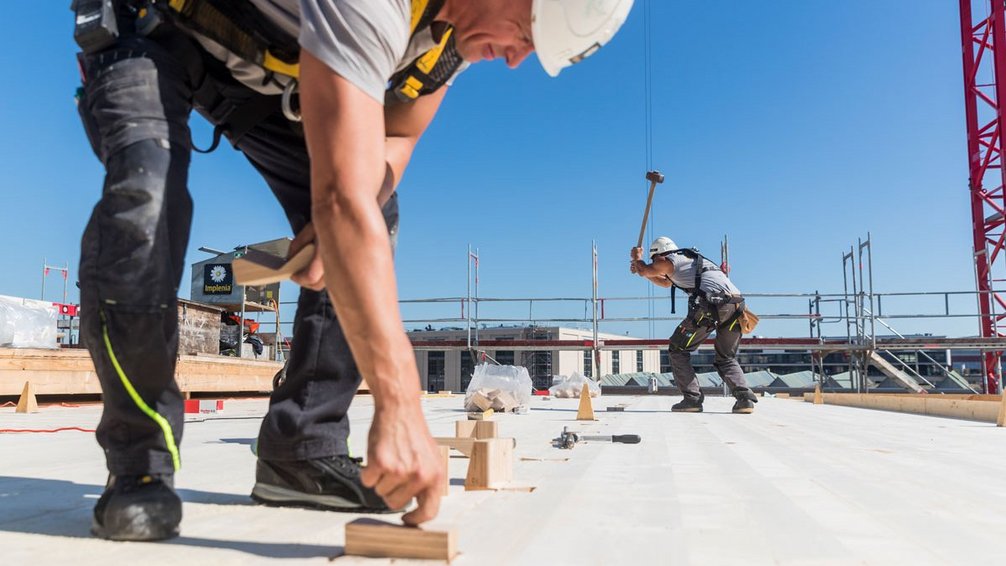
Energy and climate have been political priorities for many Swiss cities long before young people began making their voices heard in the climate movement. Overall, 60 percent of Swiss women
and men already live in so-called “Energy Cities.” Winterthur, for example, is one of 48 Swiss municipalities currently awarded the “Energy City Gold” label for its exceptional commitment to more efficient energy use, climate protection, the promotion of renewable energy, and environmentally friendly mobility.
The building sector is key
However, the city on the Eulach has already embarked on a more ambitious path toward sustainability. In 2012, the population voted in a referendum to adopt the even stricter goals of the 2,000-Watt Society by 2050. A key area of focus on this path is the sector of buildings and settlements. In Winterthur, this sector is responsible for more than 40 percent of greenhouse gas emissions, among other things. And this is precisely where the natural material wood comes into play. Not only can wood be produced and processed with exceptional energy efficiency, but trees also store CO₂ from the air as they grow, resulting in a negative greenhouse gas balance. Compared to other building materials, each metric ton of wood ultimately saves about 5.6 metric tons of CO₂.
Greater Savings Potential Than in Air Travel
Two figures illustrate the overall potential: First, the building materials concrete and steel are responsible for about 8 percent of global CO2 emissions (air travel accounts for about 3
percent). Second, researchers at ETH Zurich caused a stir last July with a study showing that consistent reforestation of all possible land areas worldwide could remove two-thirds of the total CO2 released into the atmosphere by human activities.
Wooden buildings increase the storage capacity of forests
The effect of reforestation is further enhanced when the trees are used to construct wooden buildings. This is because the CO2 remains stored in the building material throughout the building’s lifespan, and new, regrowing trees can absorb additional greenhouse gases during this time. Instead of just the approximately 70 years it takes for a tree to grow, a forest can thus absorb CO2 for roughly 140 years, effectively doubling its storage capacity.
Up to 30 percent less gray energy
The “Krokodil” project in Winterthur serves as a prime example of how wood impacts the sustainability footprint of buildings. The perimeter-block development, with its 254 cooperative, rental, and owner-occupied apartments, is part of the Lokstadt district, which is being built on the site of the former Swiss Locomotive and Machine Factory (SLM) and aims to achieve the demanding certification as “2,000-Watt Site.” “A construction method that is as compact as possible is fundamental to the energy balance in building operations. In addition, wood makes a difference—especially when it comes to CO2 and gray energy,” explains Fritz Huber, who is responsible for Lokstadt at Implenia. Wooden buildings not only store CO2; they also require up to 30 percent less so-called gray energy—the energy expended during the production, transportation, storage, and disposal of building materials.
Wood is becoming the new basic chemical material
And this balance will continue to improve. At the end of their life cycle, wooden houses will no longer be recycled primarily as fuel, as is the case today. Scientists are constantly developing new materials from this natural resource. The British science magazine *New Scientist* even predicts a veritable “Age of Wood.” According to the magazine, large wood refineries will soon replace oil refineries as the primary suppliers of chemical raw materials—for plastics and medications, for example, or even for self-insulating windows. The Japanese plan to prove as early as next year that these are not just distant visions. As part of the Olympic Games in Tokyo, they will present a car built entirely of wood. In the future, after a house is dismantled, it might become an engine block or an active ingredient for treating a serious illness.
The Age of Wooden Skyscrapers Dawns
Similarly, in wood construction, today’s techniques are still far from reaching their limits. This is evident, among other things, in the fact that wooden buildings are rising ever higher into the sky. This year, two high-rises over 80 meters tall were inaugurated in Vienna and in Brumunddal, Norway. In Stockholm, Chicago, and Tokyo, skyscrapers measuring 133, 228, and 350 meters are already in the planning stages. And the era of wooden high-rises is also dawning in Switzerland. In Zug, a project for a spectacular 80-meter-tall building that widens as it rises was presented in September.
