

A Modern Take on the Legendary “Göhner Settlement”
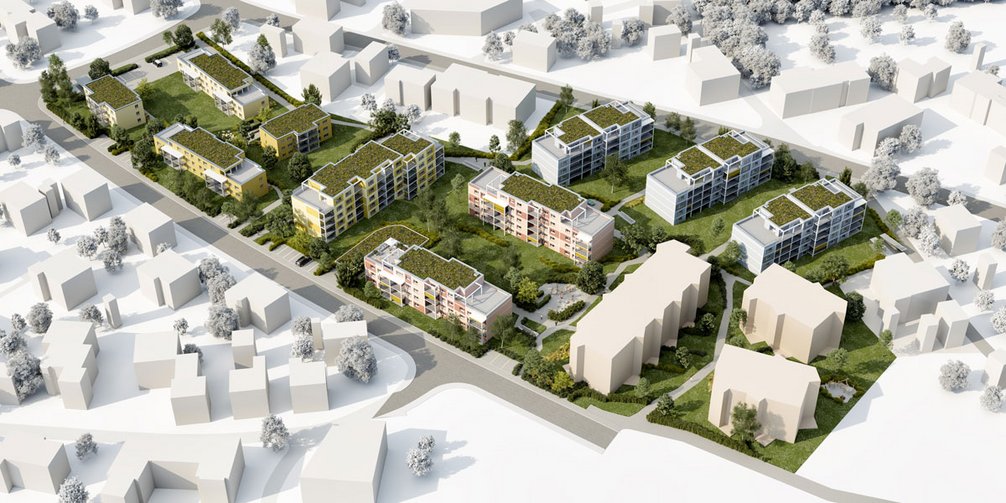
Nestled between the idyllic Kemptnertobel recreational area, downtown Wetzikon, and Lake Pfäffikon lies the Vogelsang neighborhood. The area was developed in two phases during the 1970s and 1980s. The first construction phase—and thus the majority of the development—is attributed to the legendary Zurich real estate magnate Ernst Göhner, the Swiss pioneer of prefabricated construction. Using his panel construction method with prefabricated concrete elements, he built approximately 9,000 apartments starting in 1965, primarily in the greater Zurich area, featuring spacious floor plans and affordable rents for the rapidly growing young middle class of the time.
Revitalization of “Göhnerswil”
Now, on behalf of the developer Credit Suisse, Implenia is modernizing the Vogelsang housing complex in several phases and reinterpreting its simple style. Ten of the existing twelve buildings are undergoing a complete interior and exterior renovation. At the same time, these timber-frame buildings are being expanded from 110 to 146 residential units. As part of a project development by Implenia, three apartment buildings with a total of 52 condominiums, to be known as “purNatur,” will replace two other Göhner buildings in a subsequent construction phase. At the same time, the entire site will be given a more unified design, which is intended to visually emphasize the cohesion among the individual buildings. As a result, the former “Göhnerswil” will be transformed into a modern residential community for people who want to live in a green setting without having to sacrifice proximity to the city.
One-Stop Solutions
For this project, Implenia is providing in-house services from various business units—ranging from development and general contracting to timber construction, engineering, and construction execution. “Our client benefits greatly from this group-wide collaboration,” says Manuel Angst, construction team leader for the Vogelsang project, explaining: “Because the project is the focus—not the individual departments involved—everyone is working toward the same goal. In addition, there are fewer contracts and bidding processes, and response times are shorter. This flexibility brings enormous scheduling advantages for the entire construction project.”
Consequently, the project is progressing rapidly: According to Manuel Angst, more than half of the work has already been completed since construction began in July 2017, and 32 rental apartments are even already occupied. In the coming weeks, additional units will be handed over to the client, Credit Suisse.
Additional Speed Through Wood and Lean Management
According to Manuel Angst, however, the comparatively short construction period is due to other factors as well: “Adding stories using wood not only promotes sustainability but also saves an enormous amount of time compared to traditional construction methods, thanks to the high degree of prefabrication and planning precision.” Proven lean management methods further accelerate the project by synchronizing and standardizing construction processes to ensure the most efficient and reliable execution possible. All rental apartments are scheduled to be completed and handed over to the developer by spring 2019. Occupancy of the condominiums in the three new apartment buildings is scheduled for winter 2020.
Short lines of communication and flat hierarchies
Adrian Ulrich (pictured, right), Project Manager for Timber Construction/Carpentry, and Marcel Fink (pictured, left), Site Supervisor for Joinery, explain how Implenia can offer its full range of services from a single source.

How do your departments work together?
Adrian Ulrich: The timber construction and carpentry departments have numerous points of overlap, so we work very closely together.
Marcel Fink: As a cabinetmaking shop, we’re heavily dependent on the wood construction division. That means we have to be able to rely completely on the dimensions provided. In our experience, this works better internally than when we collaborate with third-party companies. Additionally, if anything is unclear, we can ask questions directly and without red tape on the construction site, and we also have access to all the planning documents. This is particularly important for large-scale carpentry projects, such as the Vogelsang housing development, where we handled the entire wood interior finishing—with the exception of the kitchen construction.
Implenia offers a wide range of construction services. Does it often happen that you work exclusively with internal partners?
Ulrich: Internal collaboration has indeed intensified significantly, for example with the engineering and construction teams. For projects carried out almost exclusively by Implenia units, details can be optimized early on, which benefits the entire construction process.
Does this simplify day-to-day work?
Fink: The shorter communication channels save us a lot of time. We know each other well, and responsibilities are clearly defined. Additionally, we generally use informal addresses with one another, following the Scandinavian principle. This fosters flatter hierarchies and makes many things easier.
And how are obstacles handled?
Fink: Minor challenges are dealtwith quickly and directly, or we get together briefly for a roundtable discussion.
Ulrich: We address larger obstacles through the Implenia Management System (IMS). Here, much like a ticketing system, we can assign tasks to the various departments or responsible parties and set appropriate deadlines.
