


Interview with Implenia: In-Depth Insights
The interview was conducted and recorded by Marie Sammet and will appear in its original form in September 2026 in Polis Magazine .
Cities are growing, becoming more densely populated, and at the same time more vulnerable to extreme weather events. Implenia is a construction and real estate services provider that carries out large-scale underground infrastructure projects. Will the underground become the city’s second level in the future?
I’m convinced of it. However, I would distinguish between a second infrastructure leveland a second city. I don’t believe that in the future we’ll be moving entire residential neighborhoods, shopping centers, or public spaces underground. People need daylight, green spaces, and time outdoors. That won’t change in the future either. The situation is different when it comes to technical infrastructure. In my view, everything that does not require sunlight and takes up valuable space on the surface will gradually move underground. This includes transportation, logistics, energy supply, utility networks, and storage facilities. The subsurface will thus become the city’s technical layer—and that is precisely where its great potential lies.
THOMAS FIEST
holds a degree in engineering and completed his studies in civil engineering at RWTH Aachen University. He has been working in international tunnel and infrastructure construction for more than 25 years. His career has taken him to companies including Walter Bau, Züblin, STRABAG, and Bechtel. During this time, he held leadership and project management roles in Germany, Austria, Canada, and Saudi Arabia, including on the Riyadh Metro project. Since 2021, he has been responsible for tunnel construction at Implenia in Germany; today he is the Managing Director of Implenia Civil Engineering GmbH and heads up tunnel construction in Germany and Austria. He began his career as a shift engineer; since then, he has worked his way through all areas of tunnel construction—from operational project work to project and division management, and ultimately to executive leadership.
Cities like Montreal, Helsinki, and Singapore have extensive underground networks that connect transportation, commerce, and public facilities. Could this also serve as a model for Central European cities?
I lived in Canada for a while myself and experienced the underground transit systems there firsthand. However, one must always consider the specific local conditions. In Canada or Finland, climatic conditions play a major role. If you can get from one building to another at minus twenty degrees without having to go outside, that’s obviously a significant advantage. I see less of a need for this in Central Europe. That’s why I don’t believe we’ll develop entirely underground urban landscapes. But that by no means implies that the underground is losing importance—quite the contrary. Rather, I believe we will systematically shift a city’s technical functions underground. If we succeed in doing so, we’ll reclaim surface-level space that we currently need for roads, traffic, or technical infrastructure. That’s exactly where the true quality of life will emerge.
So you see the future more in giving people more living space above ground rather than moving it underground?
Exactly. I find this idea much more compelling. If we organize transportation, logistics, and large parts of the technical infrastructure underground, entirely new possibilities will emerge above ground. Imagine if roadways could be unpaved, greened, or transformed into public spaces. Where truck traffic dominates today, trees, bodies of water, or public squares could emerge in the future. That would enormously change the quality of a city. I’m also thinking about logistics. Underground logistics systems could help significantly reduce truck traffic on the surface along heavily trafficked inner-city corridors, thereby relieving pressure on roads, residents, and the environment. Data centers and power plants can also be located underground at suitable sites—for example, where land is scarce, where special security requirements apply, or where existing caverns can be utilized. This won’t be a one-size-fits-all solution, but it can make sense in specific cases. Anything that is functionally necessary but does not require a connection to public urban space could be relocated underground in the long term.
However, the subsurface is not a space that is freely available. Its use must be coordinated over the long term, and the additional construction effort must be justified by clear social and economic benefits. What matters, therefore, is not moving as much as possible underground, but rather using the underground space where it creates genuine long-term added value for the city and its residents.
“I believe that we will systematically move a city’s technical functions underground. If we succeed in doing so, we will reclaim surface-level space that we currently need for streets, traffic, or technical infrastructure. That is precisely where the true quality of life is created.”
Thomas Fiest
Climate change is posing ever-greater challenges for cities—heat waves, heavy rainfall, and periods of drought are occurring more frequently. What role can the subsurface play in making cities more climate-resilient?
I see enormous potential here. The underground is often associated primarily with transportation or tunnel construction. That is certainly still an important aspect, but in my view, it doesn’t go far enough. Especially in light of climate change, the underground can take on a central role in the future. Take heavy rainfall events, for example. Today, we’re seeing more and more often that enormous amounts of water are falling on cities within a very short period of time. The problem here is less the total amount of precipitation and more its intensity. In many places, our existing drainage systems aren’t designed to handle such peak loads. That’s why I see great potential in creating underground storage and retention areas. Rainwater could first be collected and temporarily stored there, rather than being immediately discharged into the sewer system or waterways. This relieves pressure on the infrastructure while also reducing the risk of flooding.

For me, however, the idea doesn’t end with retaining the water. We really need to ask ourselves why we’re rushing to drain this water out of the city in the first place. Wouldn’t it make much more sense to store a portion of it in a targeted manner and make it available again during dry spells? This could be used to irrigate green spaces, water city trees, or support other water-intensive areas. Especially during prolonged periods of heat and drought, water is becoming an increasingly valuable resource.
Does that mean the “sponge city” concept should be applied not only above ground but also underground in the future?
Exactly. The term “sponge city” is often associated with green roofs, unpaved surfaces, or infiltration basins. All of that is important. But I am convinced that we should integrate the subsurface much more closely into this overall system.
In many regions of Central Europe, annual average precipitation is generally still sufficient. The problem, however, increasingly lies in its temporal and spatial distribution: prolonged dry spells alternate with very intense precipitation events. If we can temporarily store water underground, we gain time and flexibility. We can store excess water and then use it where it is needed later. The subsurface thus becomes an active component of urban water management—not just as a technical storage facility, but as a key building block of a climate-resilient city.
You mentioned another aspect: the subsurface as an energy source. What opportunities do you see there?
I find that even more exciting. At depths of about ten to fifteen meters, the temperature of the subsurface fluctuates only slightly with the seasons and is often around ten to twelve degrees in Central Europe. Using geothermal probes and heat pumps, this temperature level can be utilized as a heat source in the winter. In the summer, conversely, the ground can absorb heat from buildings and thus serve as a heat sink. There are already pilot projects in which thermally activated tunnel components extract heat from the surrounding soil. This isn’t yet a widespread standard solution, but the technical possibilities exist and are continuously evolving.
I find this approach particularly interesting because it suddenly gives infrastructure a dual function. A tunnel then no longer serves exclusively for transportation but also for energy supply. It is precisely these types of multiple uses that will gain importance in the future.
Underground construction always begins with a geological question. At the same time, planning and construction are becoming increasingly digital. How has tunnel construction changed in recent years?
I would even say that tunnel construction has changed fundamentally over the past twenty years. In the past, the subsurface was, in many areas, still largely unknown. Boreholes were drilled at regular intervals along a planned tunnel axis, and geological cross-sections were created from them. That was the basis for planning. Today, we still work with boreholes—in that respect, not much has changed at first glance. The key difference lies in what we do with this data afterward. Today, the individual borehole data points are used to create three-dimensional models of the subsurface, which integrate geological, geotechnical, and hydrogeological information. These models enable us to run simulations that were simply not possible in the past. For example, we can calculate how the ground will behave under load, what settlements can be expected, or how groundwater flows might change. This allows us to assess risks much more effectively and plan construction processes with significantly greater precision.
Of course, the subsurface will never be fully predictable. Tunnel construction always involves working with natural conditions. But we understand the foundation much better today than we did a few decades ago.
What role does groundwater play in this? It’s a particularly sensitive issue in densely built-up cities.
Groundwater is indeed one of the most important planning considerations. Larger underground structures can influence natural groundwater flows. That is why hydrogeology is now one of the core disciplines in any tunnel planning project. Our goal, however, is not to permanently alter these flows, but to preserve the natural water balance as much as possible. Digital models help us with this as well. They show very precisely what impact a structure could have on groundwater and what measures are necessary to minimize that impact. There are various solutions for this. For example, groundwater passages can be provided, or special filter layers can be installed so that the water can continue to follow its natural path. In other cases, infiltration wells are used to deliberately return water to the ground. These options in particular demonstrate just how much tunnel construction has evolved. In the past, many of these interrelationships would not have been recognized until construction began. Today, we can simulate them during the planning phase and take them into account accordingly.

Fire safety, ventilation, emergency exits, or complex soil conditions—what is the biggest technical challenge in underground construction today?
We now have comprehensive regulations and well-established technical solutions for these issues. Nevertheless, they continue to shape project planning. The real challenges today, however, often lie in the complex conditions surrounding inner-city projects: existing buildings, ongoing traffic, utility networks, residents’ interests, and extremely demanding construction site logistics.
A good example is our construction site at Marienhof in Munich. There, as part of a joint venture with our partner Hochtief and as part of the second main line, we are constructing one of Germany’s deepest underground stations—right in the heart of the city’s historic center. We are building approximately 45 meters below the surface, directly next to City Hall and in close proximity to historic buildings protected as cultural monuments. This means that we are not only constructing a technically highly complex station, but must also take into account a wide range of existing infrastructure. Subway lines, utility lines, sewers, historic structures, and, of course, ongoing city traffic—all of these already exist and must continue to function throughout the entire construction period.
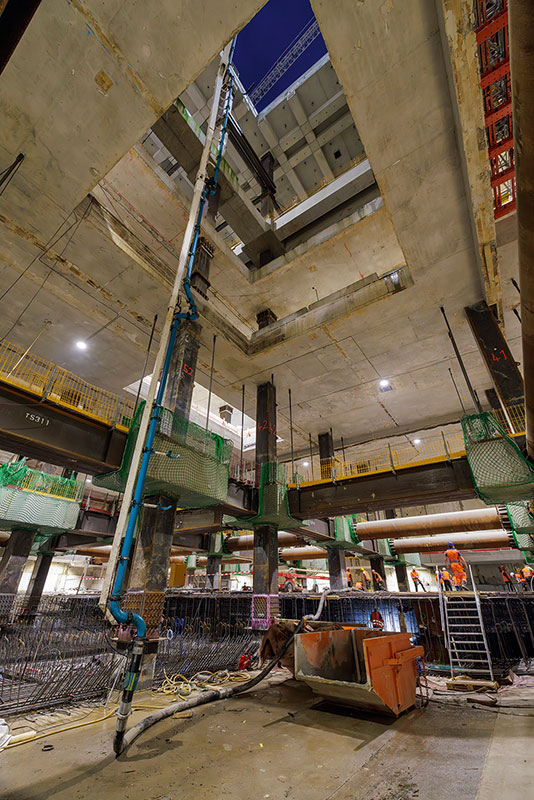
For inner-city projects, the particular challenge therefore often lies less in a single technical discipline than in the interplay of all technical, logistical, and urban conditions. The real art lies in implementing these complex construction projects in a way that disrupts urban life as little as possible.
Implenia consistently relies on digital planning methods such as Building Information Modeling (BIM). What role do digitalization and artificial intelligence play in tunnel construction today?
For me, the greatest advantage lies not primarily in the use of artificial intelligence, but in a shared, integrated database. In the past, virtually every planning discipline created its own plans. Geologists, structural engineers, and MEP engineers often worked in isolation from one another. As a result, many conflicts only became apparent on the construction site.
With BIM, all stakeholders now work on a shared digital model. Geology, hydrogeology, structural engineering, building services engineering, and existing infrastructure all converge there. This allows us to identify conflicts or design errors much earlier and resolve them as early as the design phase.
Enormous amounts of data are now generated on the construction site itself. Modern tunnel boring machines continuously provide information on contact forces, tool wear, material behavior, and mortar consumption. This data can be compared with the digital ground models. AI-supported methods are increasingly being used for such analyses. This allows us to detect very early on when the actual subsurface behaves differently than expected. We can react more quickly and adjust the tunneling process accordingly.
Another important area is what is known as predictive maintenance. In the past, repairs were often not carried out until a component had failed. Today, we continuously analyze the machines’ operational data and detect many signs of wear well in advance. This allows maintenance work to be scheduled before unplanned downtime occurs. This not only increases machine availability but also significantly improves the cost-effectiveness of projects.
The next step in tunnel construction is the broader use of digital twins. Unlike a static BIM model, a digital twin is continuously updated with measurement and operational data. This allows planning, construction, operation, and maintenance to be integrated throughout the entire life cycle. In building construction, this is already standard practice to some extent.
You’ve been involved in tunnel construction for nearly three decades. What initially fascinated you about this field—and what continues to inspire you today?
I’ve always been drawn to the fact that the subsurface is something we can’t see directly, yet it forms the foundation for nearly every piece of infrastructure. When I got into tunnel construction in the late 1990s, there was still a certain sense of adventure to it. With every tunnel drive, we had a rough idea of what to expect based on the exploratory work—but we never knew exactly. You’d open up the tunnel face and had to decide within a short time how to stabilize the ground and how to proceed. Especially as a young engineer, that was an enormous responsibility. That direct connection between theory and practice really appealed to me back then.
Today, the job has changed significantly. Thanks to digital models, simulations, and modern measurement technology, many aspects have become more predictable and safer. That’s a very positive development. As a result, tunnel construction has become more data-driven, transparent, and better manageable in many areas—without losing any of its appeal. What inspires me most today is the scale of the projects and their significance for society. We build infrastructure that will be used for generations. When you look back at a construction site years later and see the added value it has created for a city or an entire region, it’s a very fulfilling feeling.
Are there any projects that particularly well reflect this development for you?
There are quite a few. One that I find particularly exciting is certainly the second main line in Munich, which I mentioned earlier, where we’re building another section—the Ostbahnhof—in addition to the Marienhof station. Projects like this impressively demonstrate just how challenging inner-city tunnel construction has become today. And then, of course, there are the major Alpine crossings. Implenia is currently working on the second tube of the Gotthard Road Tunnel, the Semmeringand Brenner Base Tunnel as well as the Mont-Cenis Tunnel on the Lyon-Turin corridor. Such structures are far more than just tunnels. The three rail projects, in particular, are transforming traffic flows throughout Europe and creating additional capacity for shifting freight traffic from road to rail. It is precisely this international dimension that makes such projects incredibly exciting. We’re not just building for a single city, but for a European transportation network.
With an eye toward Europe, there is currently renewed and more intensive discussion about shelters and civil resilience. What role could this topic play in underground construction in the future?
In Switzerland, civil defense shelters have been a natural part of public and private infrastructure for many years. There, they are incorporated into the design of residential buildings or municipal facilities from the very beginning. This has developed over time. I believe that in the future we will give more thought to combining different functions. If underground infrastructure is being built anyway, we should examine whether it could also be used for civil protection in case of need. Subway stations or other large underground structures, for example, can be designed to serve additional protective functions in an emergency. In my view, this is less about constructing entirely new structures exclusively for this purpose. It seems much more sensible to me to make intelligent, multiple-use of existing infrastructure. It is precisely these multifunctional capabilities that will become increasingly important in the future.
To conclude, let’s take a look into the future. When you imagine the European city of the year 2050—what picture comes to mind?
I see a city that is conceived much more consistently as an integrated system. There, the underground space will take on many tasks that currently still occupy space above ground. Transportation, logistics, energy supply, utility networks, storage facilities, and even data centers will form a high-performance technical infrastructure beneath the ground. This creates space above ground for what makes a city worth living in: green spaces, water, public squares, and places for people to gather. This not only makes cities more attractive but also more resilient to the challenges of climate change. That’s why I’d sum up my vision in one sentence: People live above ground—technology works below.
Thank you very much for this fascinating insight!