

It's hard to get away from tunnel construction
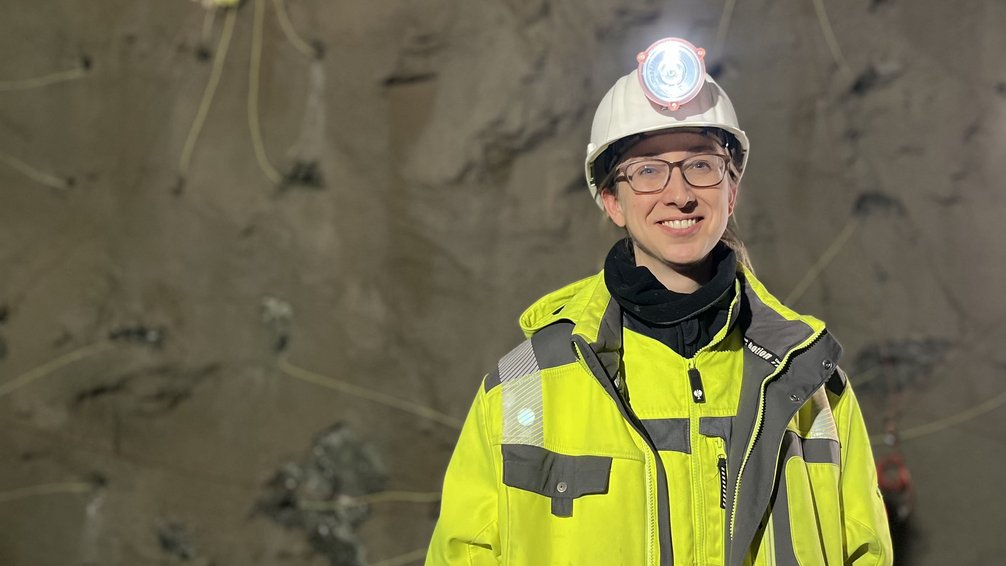
"Once you've got it, you really can't get rid of it," says shift engineer Marieke Czwikla.She talks about the much-mentioned "tunnel virus", which her first construction site manager had already told her about. And she really has caught it: for the 35-year-old German, it is this unique combination of exciting projects and incomparable teamwork that is so fascinating.
"It's enormous"
She has been working on the Brenner Base Tunnel project for two years as a shift engineer for interior lining and cyclical tunnelling and coordinates work preparation, procurement, construction scheduling, logistics and personnel planning. "The scope of the construction work we are carrying out here is enormous," she explains. In terms of the variety and quantity of work, it feels like several large construction sites at the same time.
Tunnel construction by chance
Born in the Lower Rhine region, she came to tunnel construction by chance. During her civil engineering studies in Aachen, she initially completed an internship at Implenia Hamburg in special civil engineering, where she actually wanted to return after her master's degree. But when the opportunity arose at short notice to go to Switzerland for a tunnel construction project, she accepted. "That's how it all took its course."
Differences in mentality in a confined space
Her stations in tunnel construction have taken her to Switzerland, back to Germany and now to Austria, enriching her with valuable experience. "Although they are neighboring countries that basically speak the same language, there are still remarkable differences in mentality," she says. "In Germany, we tend to think everything through and consider it very carefully. In Switzerland, I noticed a strong focus on solutions and in Austria the ability to quickly get down to work – and I was able to learn something everywhere."
"Like a small family"
What fascinates her about tunnel construction to this day is not only the uniqueness of the projects, but above all the teamwork. "They say that tunnel construction is like a small family. We have to be able to rely on each other." Good leadership, a certain degree of composure to master the sometimes challenging conditions and respectful interaction with one another are crucial. Because at the end of the day: "We are building this tunnel together." You don't get far as a loner.
Persevering in work and leisure
She greatly appreciates the fact that her job allows her to work in such different and beautiful places where others go on vacation – even if twelve-hour shifts during the decade often leave little time for leisure activities in the surrounding area. So, as far as possible, she has to take time off to enjoy the surroundings: Here in Tyrol, hiking, skiing or running. Last year, Marieke proved that it's not just in her job that she has staying power: together with running enthusiasts, she completed her first half marathon in Vienna.
What can top that?
Professionally, it remains to be seen what the next few years will bring. "It feels like what's to come can hardly surpass what's come before," she says. No wonder, when you've been able to experience such great moments as she has: "The breakthroughs at the burner or the drive start of the hydro shield machine with the shaft exit at the Cable Diagonal Berlin were very exciting and impressive experiences." That brings us back to the "tunnel virus" that many people like Marieke can't shake off.
The Brenner Base Tunnel project

The Brenner Base Tunnel is a flat rail tunnel that connects Italy and Austria. It runs between Innsbruck and Franzensfeste over a length of 55 km and, including the connection from the "Inntal Tunnel", will form the longest underground rail link in the world with a total of 64 tunnel kilometers.