



MehrSpur Zurich - Winterthur, Brüttenertunnel
Short description
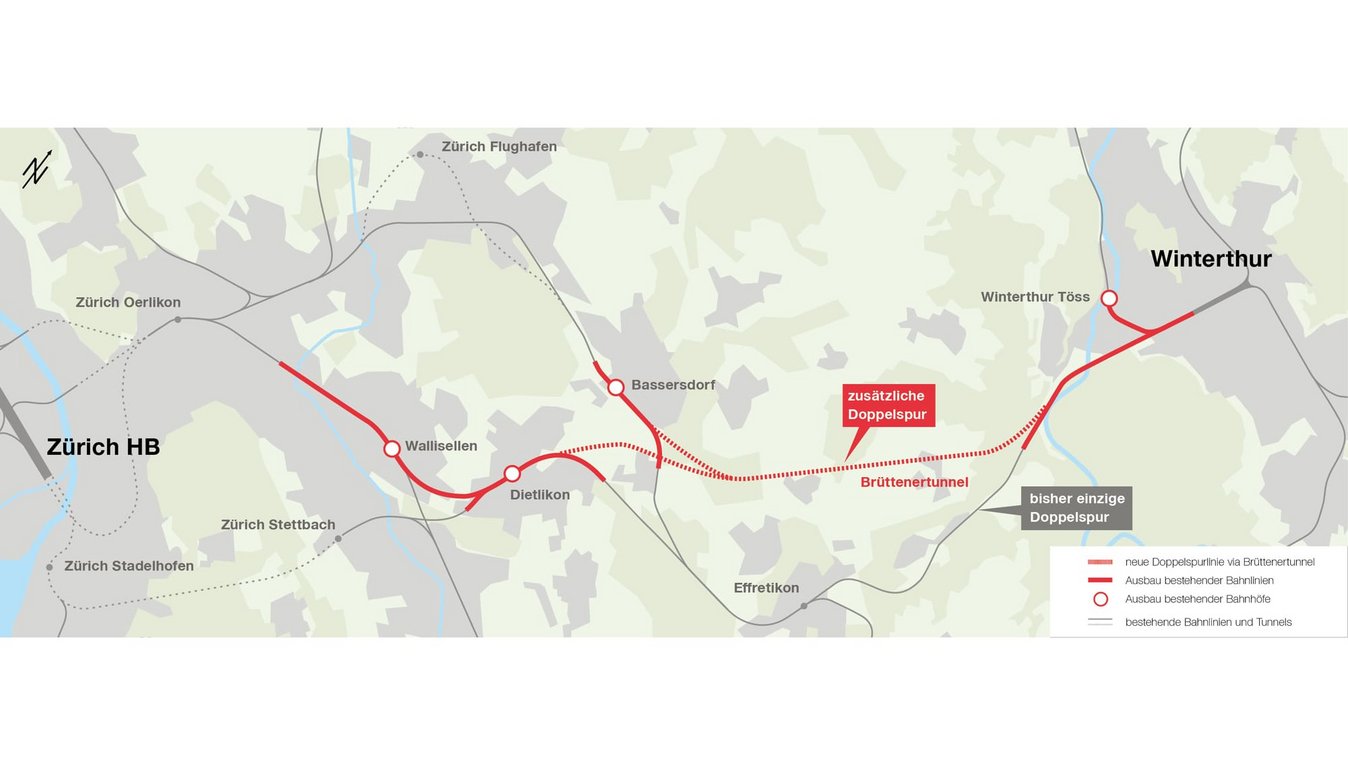
The centerpiece for eliminating the capacity bottleneck between Zurich and Winterthur is the approximately 8.3 km long Brüttener Tunnel, which has an approximately 1 km long branch in the direction of the airport.
The project
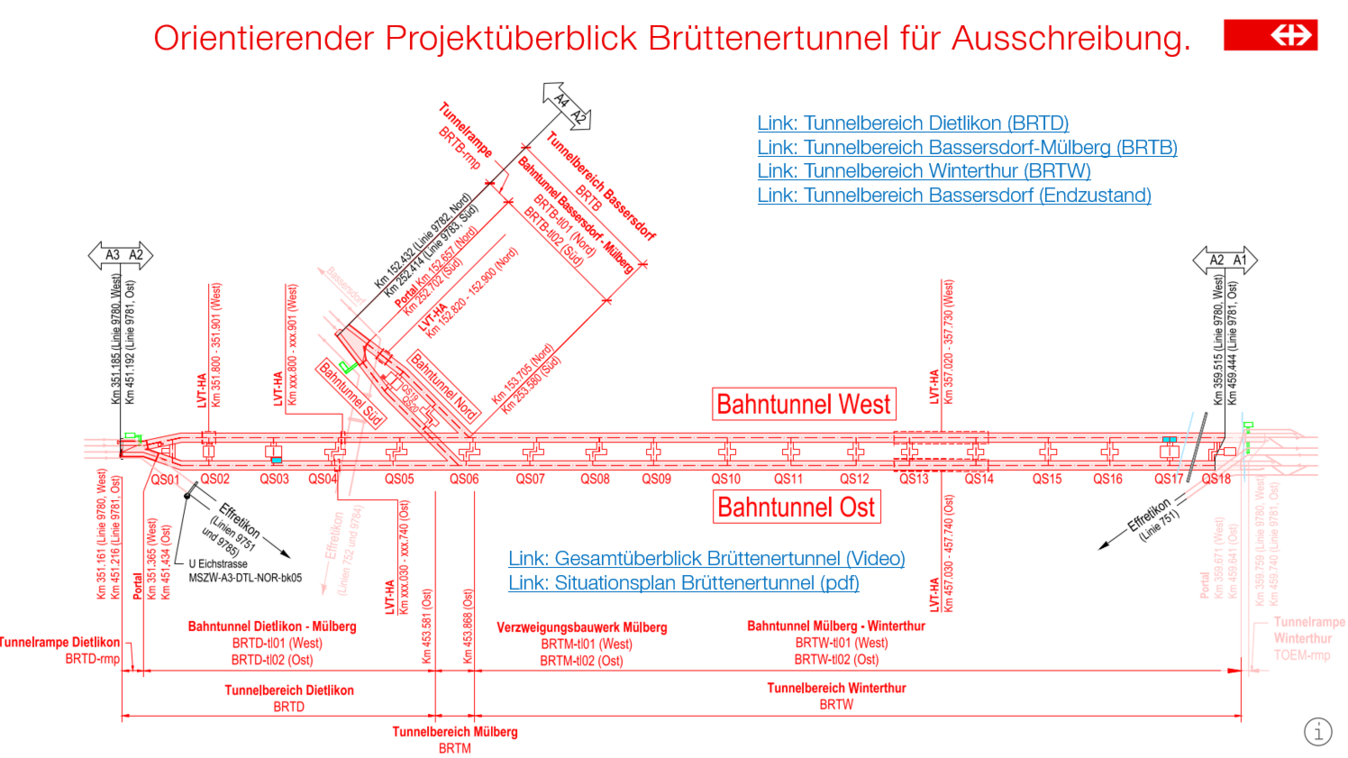
A single-track tunnel with an internal diameter of around 8.3 m will be built for each direction of travel for this underground double-track extension. The two single-track tunnels will be connected by a total of 20 cross-connections at maximum intervals of 500 m.
The construction of the tunnel between Dietlikon and Winterthur will mainly be carried out using a tunnel boring machine from the installation site at the Dietlikon portal in the south with a tunnel length of around 2 x 8,000 m. The two rail tunnels in the Bassersdorf tunnel area will be excavated over 600 and 700 m respectively from the Bassersdorf installation site. The connection between the three tunnel areas of Dietlikon, Winterthur and Bassersdorf is provided by the Mülberg tunnel area with two underground branching structures.
The following construction work is required for the construction of the entire tunnel system:
Sheet pile walls
bored piles
diaphragm walls
nail walls
Stirrup walls
Tensioned anchors
Ground improvement
Driving and securing - TBM, SM, MUF, MUL
Sealing
Cladding work
Interior lining of tunnels
Segment production
Material management with interim storage, conveyor belt system, loading station and rail loading
- Landscaping
Services in detail
- Excavation (rock and loose rock): approx. 2,000,000m3
- Concrete (in-situ concrete and shotcrete): approx. 600,000m3
- Reinforcement: approx. 26,000 tons
- Sheet pile walls: approx. 31,000m2
- Nail walls: approx. 4,000m2
- Pile walls: approx. 7,000m2
- Diaphragm walls: approx. 15,000m2
- Tensioned anchors: approx. 73,000 m
Challenges
- The tender is based on a digital 3D structural model. The 3D structural model of the Brüttener Tunnel forms the basis for the realization of the Brüttener Tunnel by the contractor in the form of the BIM-to-field methodology.
- The use of the BIM methodology is intended to increase quality, efficiency and safety for the planning process and realization for all parties involved.
Sustainability
For the implementation of ecological sustainability, the entrepreneur defines a sustainability officer (sustainability specialist) who is available for the project and ensures ecological sustainability at the entrepreneur.
Further information
Images: ©SBB