
Introduction
Business model
Implenia is a leading multinational construction and real estate service provider that offers a comprehensive range of services and outstanding expertise. With integrated services from a single source, the company plans, implements and manages large-scale real estate projects in urban centres as well as complex infrastructure for mobility and energy. Implenia supports its clients throughout the entire lifecycle of their buildings. Clients benefit from the high-level expertise of our consulting, development, planning, execution and management units, which work together seamlessly to provide optimum solutions (read more).
Sustainability organisation
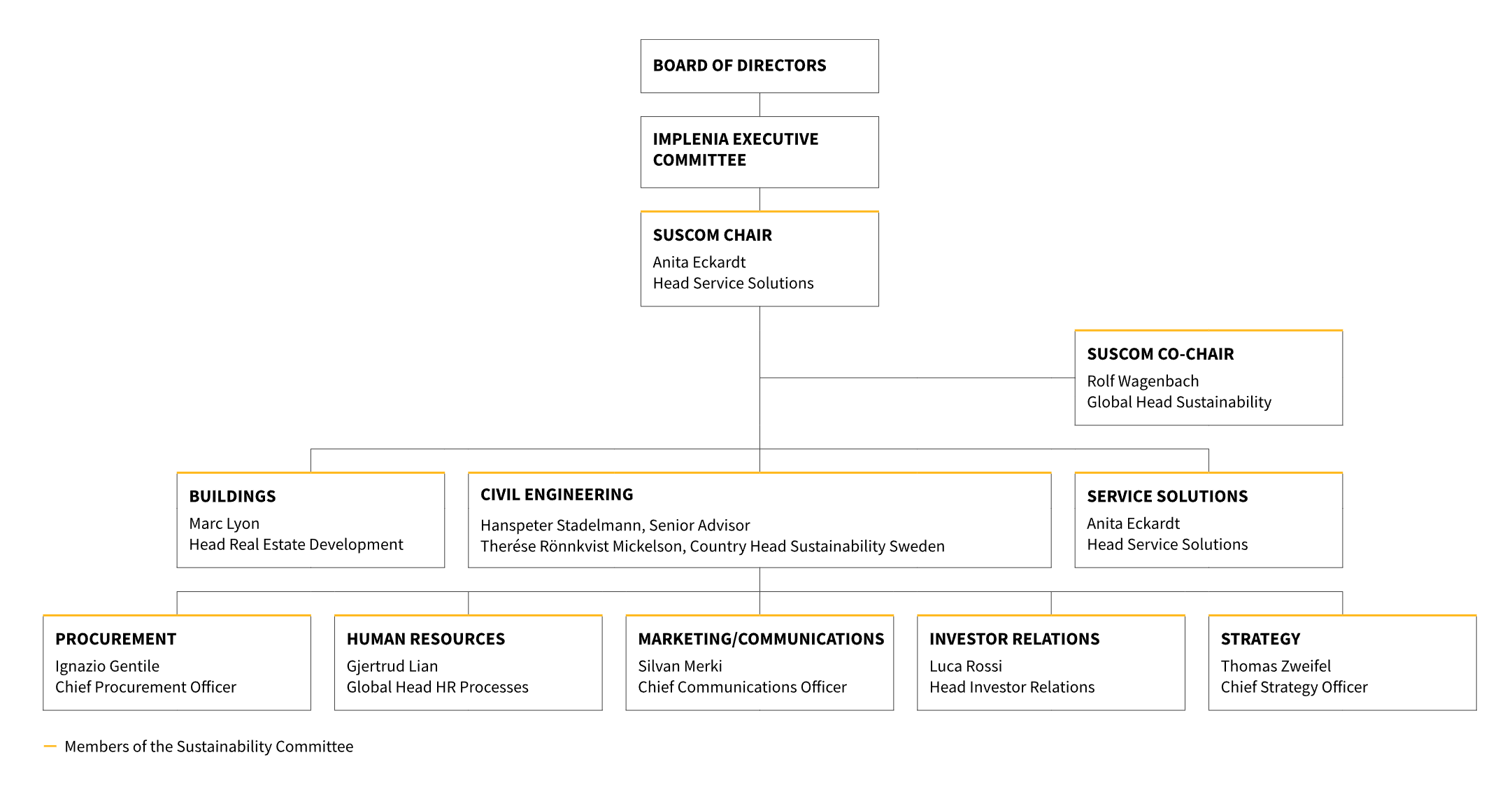
Implenia's sustainability organisation is tasked with embedding and ensuring sustainable development within the company.
The Sustainability Committee (SusCom) is made up of representatives from every Division and global function, and meets four times a year. SusCom defines Group-wide sustainability goals, anticipates new regulations and trends, takes strategic decisions and launches Group-wide initiatives. SusCom also supports regular sustainability reporting.
The Chairs of SusCom (Head Service Solutions and Global Head Sustainability), together with the Chief Strategy Officer, bring the goals and important sustainability issues to the Implenia Executive Committee (IEC). This anchors strategic management of sustainability directly in the IEC and links it to operational implementation.
The Global Sustainability Team has been part of Implenia's Strategy function since April 2025. The Sustainability Team helps the Divisions and global functions achieve their sustainability goals, takes charge of sustainability management and reporting, and drives initiatives at Group level. The Team provides both project-specific services relating to sustainable/circular construction and environmental protection as well as internal tasks such as the further development of sustainability goals and climate strategy.
Local sustainability specialists in the Divisions and countries ensure measures are actually implemented in our projects. They work closely with the Global Sustainability Team, support construction projects, provide data for reporting and ensure Group-wide specifications are implemented on the ground.
The Group’s highest operational body, the Implenia Executive Committee (IEC), deals regularly with sustainability and climate-related issues, approves the necessary resources and represents these issues in dealings with external stakeholders. The Head Division Service Solutions is a member of the IEC and a Chair of SusCom.
Compensation of IEC members has been directly linked to the achievement of sustainability goals since 2023: 10% of the “Short-Term Incentive” payments depend on the extent to which each member achieves their individual sustainability goals. The Short Term Incentive makes up half of members’ basic salaries. In the coming years, the link to climate-related issues will be strengthened. You can find out more about compensation here.
The Board of Directors is also integrated into the sustainability organisation. As the highest supervisory body, the Board approves the sustainability strategy, the long-term Group goals and the annual Sustainability Report. It takes into account the risks involved, particularly climate-related challenges (read more). Roughly two thirds of the Board members have substantial experience in sustainability. Further information can be found in the Corporate Governance Report.
The CEO reports on sustainability issues at every regular Board meeting (approximately eight times a year). The Chair of SusCom also gives the Board of Directors a direct detailed briefing three times a year about the status of the sustainability goals and other important developments.
The Audit Committee (AC), which consists of three members of the Board of Directors, meets three times a year, and monitors both financial and ESG reporting. The Global Head Sustainability reports to the AC on current and upcoming sustainability issues.
Sustainability management
Sustainable development must be implemented across all Divisions and put into practice by everyone throughout the company. It is a Group-wide responsibility that touches on all activities and requires the commitment of all employees at every level of the company. This is why Implenia practises an integrated form of sustainability management, with a Global Sustainability Team and with specialists in the Divisions and global functions.
The Global Sustainability department’s job is to address significant issues in consultation with stakeholders, set Group-wide standards and propose measures and targets for the various organisational units. Responsibility for implementation usually rests with operational line management in the Divisions and global functions. Each Division appoints individuals who are responsible for safety, quality and sustainability.
At the beginning of each year, the Divisions and global functions define and sign off on their annual goals, which are based on the company-wide sustainability goals. Over the course of the year, divisional management talks to the individuals responsible for the goals at a series of strategy and progress meetings. At the first meeting, the annual goals are discussed, amended where necessary and approved. At subsequent meetings, the progress of implementation is discussed and next steps are defined. This process allows Implenia to check regularly whether the measures are on course and to coordinate between different business units. At the end of each year, the Sustainability Committee determines the degree to which the sustainability goals have been achieved (see goals overview). This status is then ratified by the IEC together with the Sustainability Report and approved for publication by the Board of Directors.
Sustainability strategy
Sustainability has been anchored in Implenia’s values since 2009 as an integral part of the company’s strategy.
1. DIALOGUE WITH STAKEHOLDERS
The following overview shows how Implenia works with its key stakeholders.
1.1 Employees
Implenia requires its managers to foster active dialogue with their staff. The annual target-setting meetings and performance reviews, which take place every year, are major vehicles for this. The company also uses various internal communications tools, including the Intranet, the employee magazine “Impact”, staff events (in-person and virtual) and newsletters at all levels of the organisation. In addition, Implenia communicates via internal and external social media platforms such as Viva Engage, LinkedIn, Facebook, TikTok and Instagram to bring employees together and promote dialogue between them.
1.2 Customers
Implenia attaches great importance to continuous and transparent dialogue with its customers. As well as regular contact at project level, the company encourages general communication with its customers to create mutual understanding and bring in valuable external perspectives. Alongside this direct communication, Implenia carries out systematic customer satisfaction surveys to identify potential improvements. By getting involved in the early planning stages, the company can identify opportunities for more sustainable solutions and give comprehensive advice on alternatives and options.
1.3 Shareholders and investors
Implenia follows an open, transparent and timely information policy in the interests of its shareholders and investors. See also “Media & Investors”.
1.4 Business partners
Implenia works with business partners that share its core values. Subcontractors, suppliers and manufacturers have to sign up to the Code of Conduct For External Business Partners. Implenia also has a supplier management system, which makes business relationships more transparent and enables communication on an equal footing. Regular audits are conducted with the most important suppliers, providing an opportunity to develop possible improvements.
1.5 Public authorities
Implenia values open and professional relations with governmental institutions. The company works hard to comply with all the laws that apply to its heavily regulated field of activity. In the event of alleged or actual infringements, the company cooperates fully with the authorities, helps with investigations and communicates transparently.
It also maintains close contact with public sector bodies when engaged in urban development and infrastructure projects. Implenia runs such major projects in close cooperation with the relevant authorities and prioritises holding architectural design competitions, which help ensure projects meet the highest possible standards in terms of sustainability, functionality and aesthetics.
1.6 Social partners
As one of the leading companies in the construction sector, Implenia has a special responsibility as an employer and maintains constant and active dialogue with its social partners. Regular meetings are held to share information and discuss each other’s needs.
1.7 Associations
Implenia has representatives working with various organisations and industry associations, including the Swiss Association of Building Engineers and its sections and professional associations, the Swiss Network for Sustainable Building (NNBS), and the Hauptverband der deutschen Bauindustrie in Germany. Environmental organisations are also important partners in the company’s activities. Open dialogue is fostered through active participation in business and trade associations in different countries. This underlines the commitment Implenia has made to actively drive the change towards a sustainable construction and real estate industry together with its customers and partners. A list of Implenia's memberships can be found here.
1.8 Local population
At its large-scale construction projects, Implenia invites local authorities and members of the local community to get involved during planning and implementation. Activities range from information events and site visits to targeted dialogue with specific stakeholders.
1.9 Media
Implenia runs an active and open communications policy. Corporate Communications provides the media with timely and comprehensive information about important events. Journalists are regularly invited to information event with the aim of ensuring they remain personally up to date with the company’s activities and business performance. In this way Implenia provides transparency to the broader public as well as to its specific stakeholders.
1.10 Society
Alongside media communication, Implenia attaches great importance to direct exchanges with the general populace and values their insights into its activities. For example, the company invites school children to visit construction yards and projects in Switzerland and Germany as part of its annual Futures Day. Implenia also invites the general public to visit its major construction sites and organises public events to mark project completions; recent examples include a metro construction site in Oslo (Norway) and the opening of a tunnel and railway station in Varberg (Sweden). Working with universities and other educational institutions, Implenia gives students from different disciplines the opportunity to gain insights into various business areas and visit selected project sites.
2. Material topics
Implenia’s sustainability strategy encompasses the economic, environmental and social dimensions of sustainable development. Working with internal and external stakeholders, the company conducted an initial materiality analysis in 2015 based on guidelines set by the Global Reporting Initiative (GRI). Implenia carried out an all-new analysis in 2023 based on the “double materiality” approach. In addition to the previously identified topics, this analysis took account of aspects identified by the GRI Standards and European Sustainability Reporting Standards (ESRS). In 2024 and 2025, the global sustainability team reviewed and sharpened the material topics from the previous year. Clarifications of specific impacts, risks and opportunities relating to ESRS thematic standards were incorporated into the current report.
The double materiality approach aims to assess a company’s impact on the environment, society and the economy (inside-out perspective), while also evaluating the financial opportunities and risks of sustainability issues for the company’s business (outside-in perspective). An internal survey was conducted among members of the Board of Directors, the IEC, senior management and sustainability specialists in order to identify major issues that have a financial impact on the business. Meanwhile, the impact on the environment, society and economy was assessed in an online survey targeted towards external stakeholders, including key clients, suppliers, NGOs, investors, banks, universities, trade associations, unions, competitors, the media and the authorities.
This extensive analysis helped Implenia to identify the following material topics as defined by the GRI standards. Links are given to the chapters containing the goals and measures that relate to the topics:
- Health & safety (GRI: Occupational Health and Safety)
- Internal working conditions (GRI: Employment, Diversity and Equal Opportunity,
Training and Education) - Circular economy (GRI: Materials)
- Integrity (GRI: Anti-corruption, Anti-competitive Behaviour, Non-discrimination)
- Environmental protection (GRI: Waste)
- Energy and CO₂ (GRI: Energy, Emissions)
- Supply chain (GRI: Supplier Environmental Assessment, Supplier Social Assessment)
- Economic performance (GRI: Economic Performance)
- External workers (GRI: Employment)
The material topics match the requirements of the Swiss Code of Obligations Art. 964b as follows:
- Health and safety: Employee concerns
- Internal working conditions: Employee concerns
- Circular economy: Environmental concerns
- Integrity: Respect for human rights, combatting corruption
- Environmental protection: Environmental concerns
- Energy and CO₂:Environmental concerns
- Supply chain:Respect for human rights, environmental concerns
- Economic performance: Description of business model
- External workers:Respect for human rights
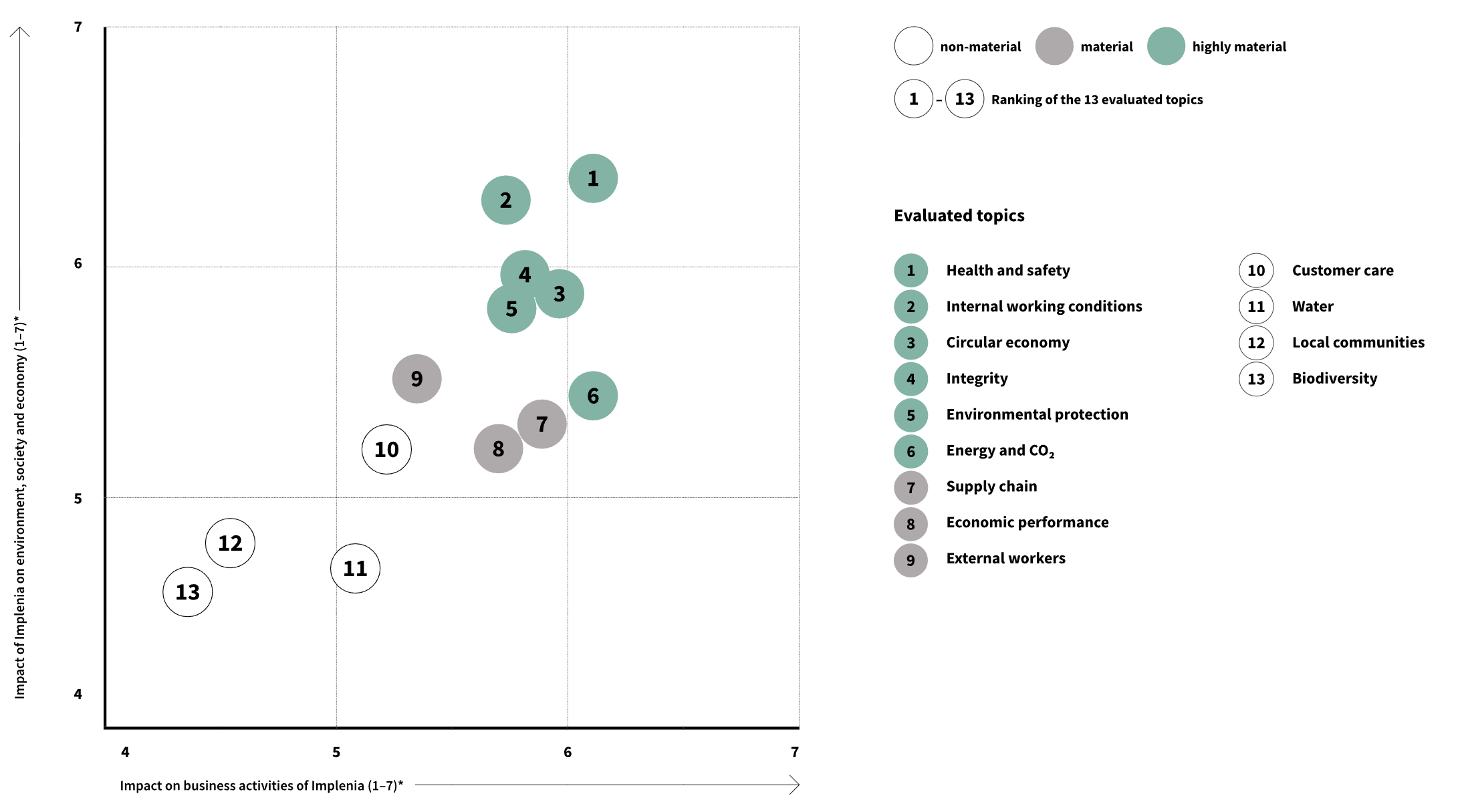
* The graph shows a section of the materiality matrix. No topic scored less than 4.
3. Risks and opportunities created by climate change
3.1 Risk management at Implenia
The systematic management of opportunities and risks is the central pillar of successful corporate management. This is why Implenia uses a comprehensive enterprise risk management (ERM) system based on integrated processes and clearly defined responsibilities.
The ERM helps management make decisions and achieve strategic and operational goals. Twice a year, management identifies the most relevant risks. Within the Board of Directors, the Audit Committee handles all risk management matters.
As a construction and real estate services company with a broad portfolio, Implenia is affected by climate change in a variety of ways. The ERM also helps the Group assess opportunities and risks relating to climate change and other sustainability matters. These are identified, evaluated and monitored on an annual basis using standardised processes, with measures being formulated accordingly. Implenia has defined a five-level impact scale to assess the possible impact and determine the probability of a risk occurring. Implenia also uses the ERM impact scales in its materiality analysis to ensure consistency.
3.2 Process to identify climate opportunities and risks
Implenia is continuously expanding its risk process, with guidance from the recommendations of the international Task Force on Climate-related Financial Disclosures (TCFD). The company considers both physical risks (such as the increasing frequency of extreme weather events) and transitional risks (such as regulatory changes and shifts in market demand). Implenia uses qualitative and quantitative methods to assess the significance of these risks.
In 2025, Implenia optimised its climate-related assessment framework to better capture the risks and opportunities created by the transition to a low-carbon economy. Building on the previous methodology, which limited itself to the 1.5°C scenario, the company is now evaluating a broader range of possible climate scenarios. This multi-option approach, which follows the recommendations of the TCFD, enables Implenia to stress-test strategies and investments under various potential future scenarios.
Climate scenarios are model-based pathways that explore alternative futures based on assumptions about policies, technologies, energy demand and behaviour. They lead to different levels of global warming and are defined at the global level rather than being tailored to individual companies or sectors. While Implenia can assess potential financial impacts and the probability of risks under each scenario, it cannot influence the scenarios themselves.
The list below presents a comparative summary of the key characteristics of the three climate scenarios used by Implenia:
1.5°C scenario (IEA NZE 2050)
This scenario assumes the Earth will warm by a maximum of 1.5°C compared to pre-industrial levels. The construction sector is under strong pressure from regulators, investors and customers to decarbonise. Transitional risks dominate, while physical risks remain low. However, there is a high reputational and compliance risk.
Opportunities: Competitive advantage through early adoption of low-carbon technologies, circular construction and leadership in sustainable innovation.
Scenario “well below 2°C” (IEA B2DS)
This scenario assumes the Earth will warm by well below 2°C compared to pre-industrial levels, with higher warming than the 1.5°C scenario. Therefore, the consequences of climate change become clearly noticeable. This scenario combines increasing physical risks – such as heat stress and flooding – with accelerated transition demands. It changes building design, energy systems and choice of materials.
Opportunities: Growth potential in the areas of climate-resistant infrastructure, urban adaptation planning and electrification through the integration of renewable energies.
4.3°C scenario (RCP 8.5)
If the Earth warms by 4.3°C compared to pre-industrial levels, serious physical climate impacts dominate, including property damage, weather-related delays and rising insurance costs. Transition risks are less immediate, but long-term disruptions threaten business continuity.
Opportunities: Increasing demand for climate-resistant infrastructure, retrofitting at-risk structures and redesigning buildings to withstand extreme conditions.
Within the risk assessment process, Implenia focuses on factors that particularly affect the company. These include general developments in the construction and real estate markets, upcoming legislative changes and emerging trends in important markets. Risks and opportunities are then prioritised based on probability of occurrence and potential impact.
The company also takes account of regional differences and varying time horizons, and aligns its risk assessment with its financial planning cycles. Risks are considered over the following time horizons:
- Short-term horizon (less than 1 year): Focus on operational risks such as supply chain disruptions, project delays, short-term interest rate fluctuations and the immediate impact of extreme weather events (acute physical risks) that may impact construction sites or logistics.
- Medium-term horizon (2 to 5 years): Assessment of strategic risks, including regulatory changes (e.g. new building regulations, ESG reporting standards, or CO2 pricing mechanisms such as the EU Emissions Trading System), shifts in market demand, labour availability and rising insurance costs associated with climate-related risks.
- Long-term horizon (over 5 years): Considers chronic physical risks (such as rising temperatures and sea levels) and technological shifts in the way things are built. These risks can affect asset resilience, long-term investment decisions and the profitability of certain types of projects.
During the assessment process, the potential financial impact, likelihood of occurrence and possible mitigation measures were identified for each material climate-related risk. Thanks to this detailed analysis, effective strategies can be developed that address the risks and take advantage of the opportunities offered by the transition to a low-carbon economy.
3.3 Overview of climate-related risks
The following tables show Implenia’s climate risk analysis, which was carried out in accordance with the recommendations of the Task Force on Climate-related Financial Disclosures (TCFD), taking into account the three scenarios described above. They represent the potential impact and probability of occurrence of each risk in each scenario. For this, we distinguish between transition and physical risks. Transition risks arise from the shift towards a more climate‑friendly economy. They do not result from climate change itself, but from political, regulatory, technological and market‑driven changes associated with the transition. Physical risks, by contrast, stem from the direct impacts of climate change and affect operations, projects, assets and supply chains.
Transition risks
Policy & legal
| Climate-related risks | Possible financial impact | Impact | Likelihood | Risk mitigation measures | ||||
|---|---|---|---|---|---|---|---|---|
| Scenario* | 1.5°C | <2 °C | 4.3°C | 1.5°C | <2°C | 4.3°C | ||
| Failure to meet ESG criteria |
| High | Medium | Low | Very likely | Likely | Possible |
|
| Non-compliance with environmental standards in the construction sector |
| High | Medium | Low | Likely | Likely | Possible |
|
| Increased CO₂ cost |
| High | Medium | Low | Very likely | Likely | Possible |
|
*1.5°C (IEA NZE): Low physical risks and high transition risks due to rapid and stringent climate policy.
<2°C (IEA B2DS): Increased physical risks and high transition risks, as climate impacts increase and regulations remain strict.
4.3°C (RCP 8.5): Very high physical risks and lower transition risks caused by limited climate action.
Market
| Climate-related risks | Possible financial impact | Impact | Likelihood | Risk mitigation measures | ||||
|---|---|---|---|---|---|---|---|---|
| Scenario* | 1.5°C | <2°C | 4.3°C | 1.5°C | <2°C | 4.3°C | ||
| Changing customer behaviour |
| High | Medium | Low | Very likely | Likely | Possible |
|
| Availability and increasing cost of raw materials |
| Medium | High | Low | Possible | Likely | Very likely |
|
| Non-sustainable supply chains |
| Medium | Medium | Low | Very likely | Likely | Possible |
|
*1.5°C (IEA NZE): Low physical risks and high transition risks due to rapid and stringent climate policy.
<2°C (IEA B2DS): Increased physical risks and high transition risks, as climate impacts increase and regulations remain strict.
4.3°C (RCP 8.5): Very high physical risks and lower transition risks caused by limited climate action.
Technology
| Climate-related risks | Possible financial impact | Impact | Likelihood | Risk mitigation measures | ||||
|---|---|---|---|---|---|---|---|---|
| Scenario* | 1.5°C | <2°C | 4.3°C | 1.5°C | <2°C | 4.3°C | ||
| Transition to lower-emission technologies and products |
| High | Medium | Low | Very likely | Likely | Possible |
|
| More complex construction methods |
| Medium | Medium | Low | Likely | Likely | Possible |
|
*1.5°C (IEA NZE): Low physical risks and high transition risks due to rapid and stringent climate policy.
<2°C (IEA B2DS): Increased physical risks and high transition risks, as climate impacts increase and regulations remain strict.
4.3°C (RCP 8.5): Very high physical risks and lower transition risks caused by limited climate action.
Reputation
| Climate-related risks | Possible financial impact | Impact | Likelihood | Risk mitigation measures | ||||
|---|---|---|---|---|---|---|---|---|
| Scenario* | 1.5°C | <2°C | 4.3°C | 1.5°C | <2°C | 4.3°C | ||
| Negative stakeholder feedback |
| High | Medium | Low | Very likely | Likely | Possible |
|
| Processes that do not focus sufficiently on sustainability |
| Medium | Medium | Low | Very likely | Likely | Possible |
|
*1.5°C (IEA NZE): Low physical risks and high transition risks due to rapid and stringent climate policy.
<2°C (IEA B2DS): Increased physical risks and high transition risks, as climate impacts increase and regulations remain strict.
4.3°C (RCP 8.5): Very high physical risks and lower transition risks caused by limited climate action.
Physical risks
Acute
Climate-related risks | Possible financial impact | Impact | Likelihood | Risk mitigation measures | ||||
|---|---|---|---|---|---|---|---|---|
| Scenario* | 1.5°C | <2°C | 4.3°C | 1.5°C | <2°C | 4.3°C | ||
| Extreme weather events |
| Low | Medium | High | Possible | Likely | Very likely |
|
*1.5°C (IEA NZE): Low physical risks and high transition risks due to rapid and stringent climate policy.
<2°C (IEA B2DS): Increased physical risks and high transition risks, as climate impacts increase and regulations remain strict.
4.3°C (RCP 8.5): Very high physical risks and lower transition risks caused by limited climate action.
Chronic
Climate-related opportunities and potential financial impact
5. Sustainable development goals
Implenia’s commitment is based on the UN's Sustainable Development Goals (SDGs). The Group hopes its sustainability efforts will help the global community achieve these goals, particularly the following ones:

 planned
 on Track
 not on Track
 critical
| Processing period and status | ||||||
|---|---|---|---|---|---|---|
| Group target 2025 | 2021 | 2022 | 2023 | 2024 | 2025 | |
1. Sustainable development & constructionWe develop and build according to the highest sustainability standards and contribute to their further development. Subgoals | on Track | on Track | on Track | on Track | on Track | |
1.1 We certify all our development projects according to established sustainability labels and strive to achieve the highest certification requirements (e.g. SNBS, DGNB, SEED) | on Track | on Track | on Track | on Track | on Track | |
1.2 We reduce the CO₂ footprint (operational and embodied carbon) of our own development projects and consistently promote timber construction. | on Track | on Track | on Track | on Track | on Track | |
1.3 We systematically increase the share of renewable energies (e.g. by installing PV systems) and minimise the consumption of energy (including CO₂ emissions), water and waste in our own development projects. | on Track | on Track | on Track | on Track | on Track | |
2. Sustainable supply chainWe work with sustainable partners and continuously improve together. Subgoals | on Track | on Track | not on Track | on Track | on Track | |
2.1 At least 75% of Implenia's award sum goes to subcontractors and suppliers who have been evaluated according to sustainability criteria and meet our increased requirements. | on Track | not on Track | not on Track | on Track | on Track | |
2.2 We adopt Group-wide procurement guidelines with respect to sustainability criteria and train all purchasers and project managers. | on Track | on Track | on Track | on Track | on Track | |
2.3 We intensify cooperation with the largest and most relevant partners in our construction projects and agree on regular stakeholder dialogue and audits. | on Track | on Track | not on Track | on Track | on Track | |
3. Eco construction siteWe convince and support our clients by offering project-specific sustainability concepts and implementing outstanding sustainable solutions during construction. Subgoals | not on Track | on Track | on Track | on Track | on Track | |
3.1 In the project acquisition phase we place at least one focus on a sustainability topic and systematically analyse sustainability options for our clients. In doing so, we lay the basis for a project-specific sustainability strategy. | not on Track | not on Track | on Track | on Track | on Track | |
3.2 We define our own standard for sustainable construction site management, and we audit and award our best projects annually. | on Track | not on Track | on Track | on Track | ||
3.3 We offer consulting services on sustainable construction as part of our range of services. | on Track | on Track | on Track | on Track | ||
4. CO2-reductionWe aim for net zero emissions across Scope 1, 2 and 3 by 2050 and a reduction in our Group-wide sales-related CO₂ emissions in Scope 1 and 2 by 15% by 2025 in comparison to 2020. Subgoals | not on Track | on Track | not on Track | critical | critical | |
4.1 We consistently pursue our decarbonisation strategy, reduce our annual sales-related CO₂ emissions in Scope 1 and 2 of the entire Group by 3%, and by 15% by 2025 in comparsion to 2020. In doing so, annually collect our CO₂ footprint from each country in which we operate and define country-specific CO₂ reduction paths. | not on Track | on Track | not on Track | critical | critical | |
4.2 We examine all of Implenia’s suitable roofs and façades for the use of solar panels with the aim of tripling internal solar power production to 3 GWh. | on Track | not on Track | not on Track | critical | ||
4.3 We improve the energy efficiency of all our production facilities and properties. | not on Track | on Track | on Track | on Track | on Track | |
4.4 We define a Group-wide mobility concept with fossil-free cars, and implement specific concepts at each location with 50 or more employees. | on Track | on Track | on Track | on Track | not on Track | |
4.5 We are continuously increasing the proportion of renewable energy in our electricity purchases and aim for 100% renewable energy in our properties, yards and production facilities. | on Track | not on Track | on Track | on Track | on Track | |
5. Environmental protectionWe carry out professional environmental management for all projects to prevent environmental incidents. Subgoals | on Track | on Track | on Track | on Track | not on Track | |
5.1 We consistently report our environmental incidents as categorised by severity and apply corrective action to consistently our annual environmental incidents with the aim of achieving zero serious incidents. | on Track | on Track | on Track | on Track | on Track | |
5.2 We reduce construction waste, introduce waste separation systems at all our construction sites and increase the recycling rate to 100% for materials that can be separated in a technically sensible manner. | on Track | on Track | on Track | not on Track | not on Track | |
5.3 We establish our environmental organisation so all personnel have competent contact persons for environmental protection and are trained three times a year on an environmental topic. | not on Track | on Track | on Track | on Track | on Track | |
6. Circular economyWe develop new circular business models and promote the closing of material cycles. Subgoals | on Track | on Track | on Track | on Track | on Track | |
6.1 We develop the Implenia circular strategy and create a common understanding of the topic. | on Track | on Track | on Track | on Track | on Track | |
6.2 We develop and test new business models that span the entire value chain and help to close material cycles | on Track | on Track | on Track | on Track | ||
6.3 We position ourselves as an important player in the field of circular economy, organise specialist events and advise customers on the subject. | on Track | on Track | on Track | |||
7. Sustainability in our DNAWe live up to sustainability in our daily actions and transparently communicate our lessons learned our results. Subgoals | on Track | on Track | on Track | on Track | on Track | |
7.1 We position Implenia as leading the way in sustainable construction and as a real estate services provider in the field of sustainability via all media. | on Track | on Track | on Track | on Track | on Track | |
7.2 We promote the sustainable actions of our employees to act sustainably in the office and on construction sites. | on Track | on Track | on Track | on Track | on Track | |
8. Engaged employeesWe aim for zero accidents and stand unconditionally for safety at work, modern working conditions, high employee satisfaction and a low fluctuation rate. Subgoals | not on Track | on Track | on Track | on Track | not on Track | |
8.1 We continuously improve our safety performance through measurable actions. | on Track | not on Track | on Track | on Track | on Track | |
8.2 We support the training and further education of our employees and are committed to long-term personnel development for blue-collar and white-collar personnel. | not on Track | on Track | on Track | on Track | on Track | |
8.3 We create a modern, family-friendly work environment and continuously increase employee satisfaction over five years. | on Track | on Track | on Track | on Track | on Track | |
8.4 We promote diversity & inclusion within our company and define a plan in each country with binding annual goals. | not on Track | on Track | on Track | on Track | on Track | |
8.5 Based on our Group-wide sustainability goals, we define at least one binding annual sustainability goal with our employees. | on Track | on Track | not on Track | |||
9. Implenia without bordersWe engage in social partnerships and collaborate with our stakeholders beyond the construction site. Subgoals | not on Track | on Track | on Track | on Track | on Track | |
9.1 We stand in our industry examplarily for a successful “Corporate Social Responsibility” strategy. | on Track | on Track | on Track | on Track | on Track | |
9.2 We support social projects financially in all of our markets or through the engagement of our employees and participate in social events. | not on Track | on Track | on Track | on Track | on Track | |
9.3 We strengthen or start dialogues with politics, business and society in our markets. To this end, we invite our most important stakeholders to recurring exchange. | on Track | on Track | on Track | |||
10. Ethical governanceWe embrace a zero-tolerance policy towards compliance violations, always do business in a responsible and ethical manner, and demand the same conduct from our partners. Subgoals | on Track | on Track | on Track | on Track | on Track | |
10.1 We raise awareness of compliance among our employees through e-learning and personal training, thus minimising the occurence of compliance incidents. | on Track | on Track | on Track | on Track | on Track | |
10.2 We create structures and processes to maintain incident investigation and handle compliance incidents professionally and promptly. | on Track | on Track | on Track | on Track | on Track | |
10.3 We require our partners to comply with our own compliance requirements and carry out targeted audits. | not on Track | on Track | on Track | on Track | on Track | |
11. Sustainable financeWe incorporate ESG criteria into our business and investment decisions – for clients, investors and society at large. Subgoals | on Track | on Track | on Track | on Track | on Track | |
11.1 We continuously improve our sustainability reporting in terms of transparency, timeliness and materiality, and achieve improved results in the ESG ratings that are relevant to us. | on Track | on Track | on Track | on Track | on Track | |
11.2 We define specific ESG criteria that are incorporated into all investment decisions, the awarding of contract and project bids. | on Track | not on Track | on Track | on Track | ||
12. Digital & integrated processesWe consolidate our reputation for operational excellence and high-quality standards. Subgoals | on Track | on Track | on Track | on Track | on Track | |
12.1 We develop, produce and operate real estate products on the basis of digital planning. | on Track | on Track | on Track | on Track | on Track | |
12.2 We embed all sustainability topics into our management, support and core processes via Inspire and IMS. | on Track | on Track | not on Track | on Track | on Track | |
12.3 We reduce resource waste and deficiency rates by applying Lean principles to all class 1 & 2 construction projects. | on Track | on Track | on Track | on Track | on Track | |