Environment
Contents
To the complete Sustainability Report 2025 as PDF
Energy and climate
1. CO₂ EMISSIONS
Implenia consistently aligns its climate strategy with the Paris Agreement and pursues the goal of achieving net zero across all scopes by 2050 at the latest. At the same time, the company takes into account even more ambitious climate targets set by the individual countries in which it operates. Many of Implenia's large-scale infrastructure projects make a long-term social contribution to CO₂ reduction, for example through more efficient transport and supply networks or shorter distances. However, due to their size and technical requirements, these projects often generate higher emissions during the construction phase.
The level of CO₂ emissions fluctuates from year to year and is strongly influenced by the type of project, the choice of construction methods and the progress of the project. Whether a tunnel is built using blasting or a tunnel boring machine, for example, can make a significant difference. In addition, the widespread use of diesel-powered machinery and vehicles throughout the construction industry – and thus also at Implenia – has a significant impact on Scope 1 emissions. With this in mind, Implenia is continuing to develop its decarbonisation strategy in a targeted manner from 2025 onwards. The focus will be on reducing Scope 1 and Scope 2 emissions and expanding Scope 3 data collection, particularly in the categories of purchased goods and services and waste. These categories are among the biggest levers in the industry, as they particularly affect the use of emission-intensive materials such as cement, concrete and steel. Implenia is working to increasingly implement low-emission construction processes, for example through the electrification of machinery and vehicles or through efficiency improvements in planning and execution.
1.1 Greenhouse Gas Protocol
| Category | Definition |
|---|---|
| Scope 1 | Emissions caused directly by a company’s use of fuel in operations and transport as well as fugitive emissions. |
| Scope 2 | Indirectly generated emissions resulting from the use of purchased electricity, steam, heating and cooling. |
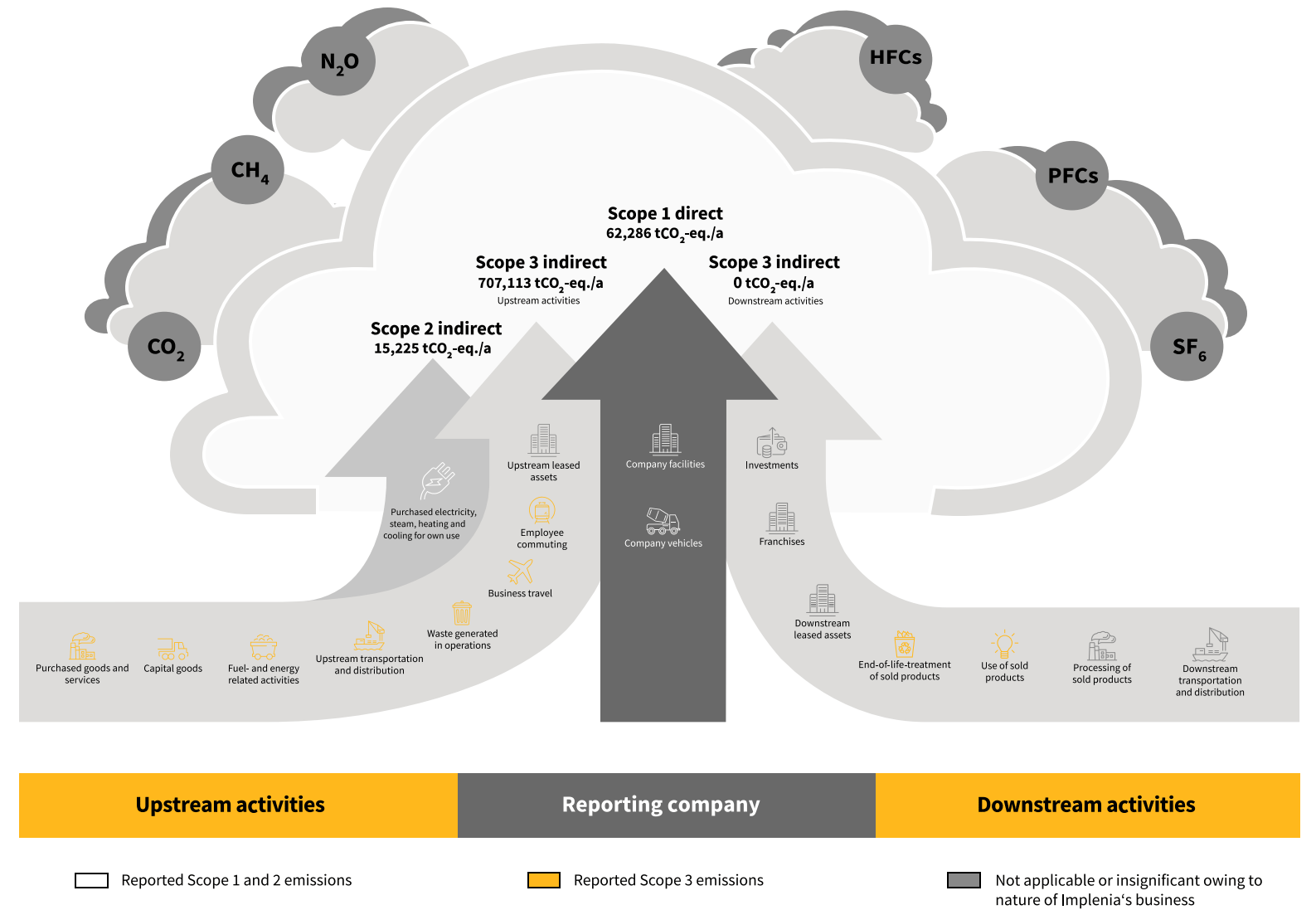
| Scope 3 | All other indirect emissions in a company’s value chain caused by its activities. |
1.2 Scope 1 and 2 emissions
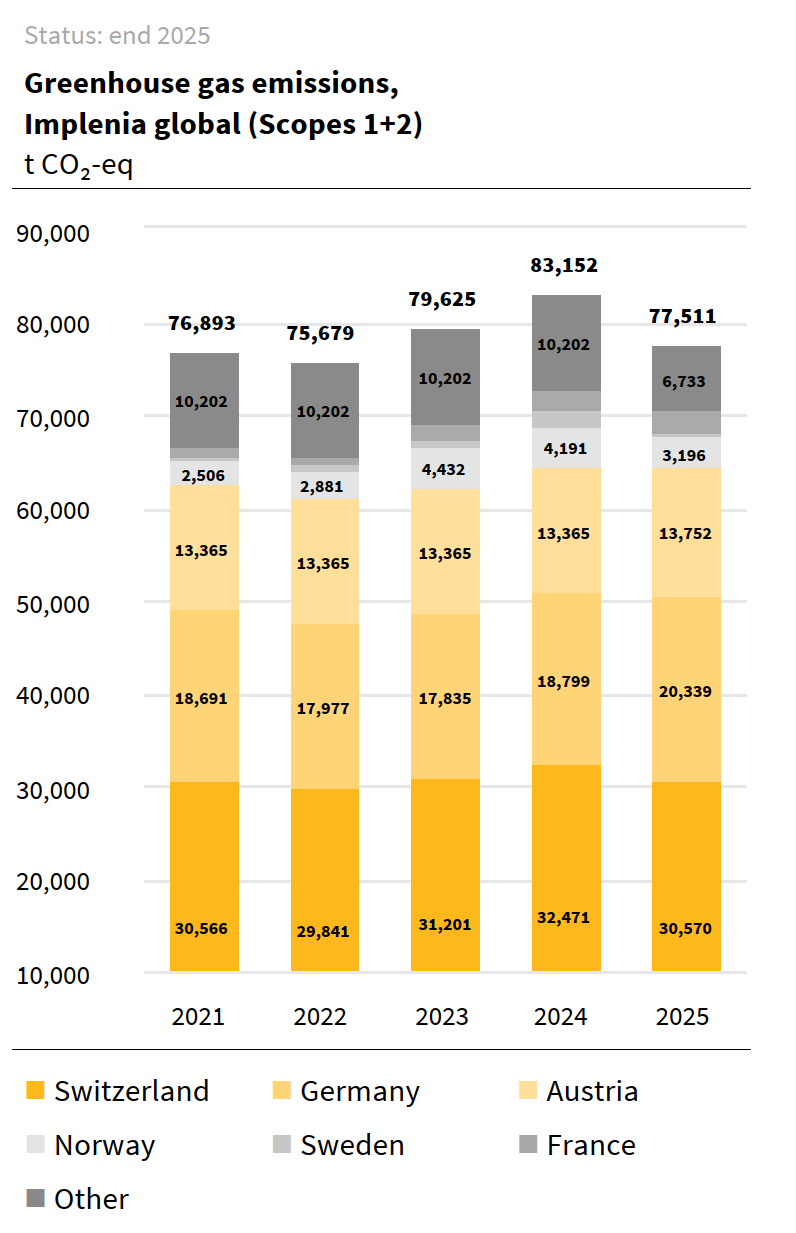
Implenia has been publishing its CO₂ footprint for Scopes 1 and 2 since 2012. This includes direct emissions from the operation of our own construction machinery, trucks, production facilities and depots (Scope 1) as well as indirect greenhouse gas emissions from grid energy, such as electricity and district heat (Scope 2). Data collection is being continuously expanded and now covers the entire Group. This includes Switzerland, Germany, Austria, France, Sweden and Norway. Data on Implenia’s non-European activities has also been collected since 2024.
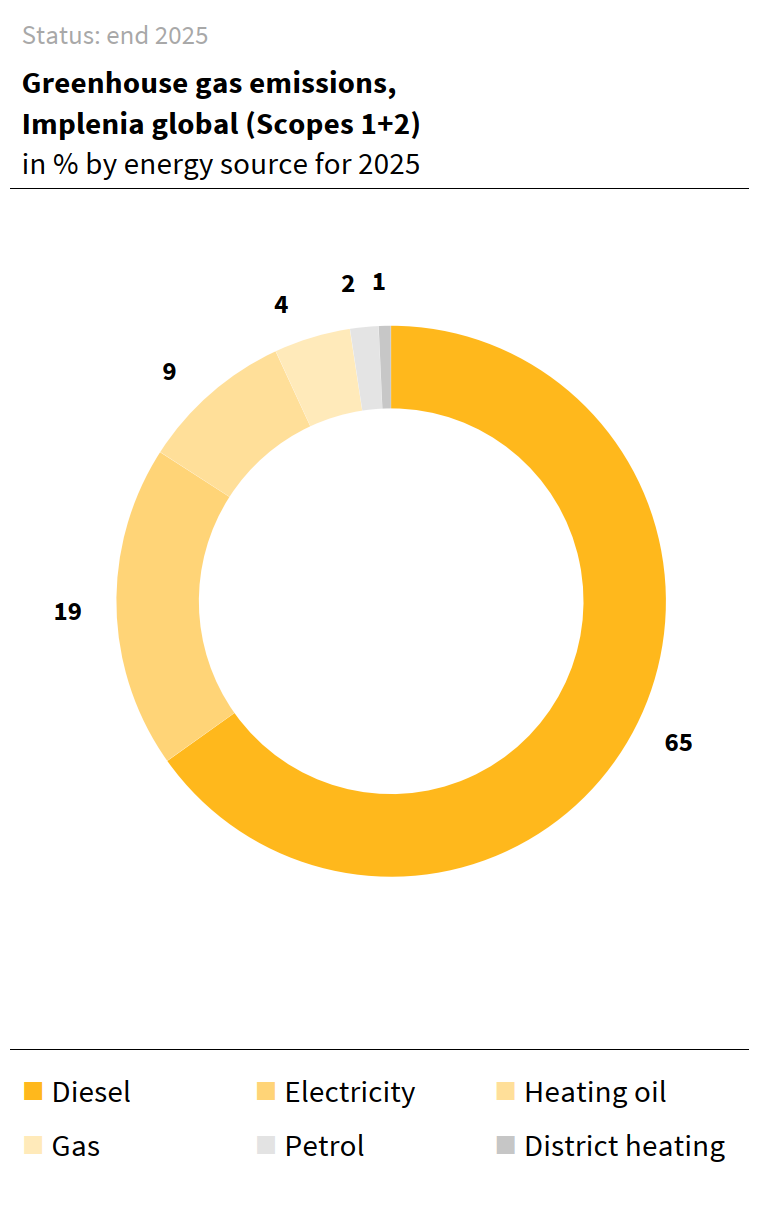
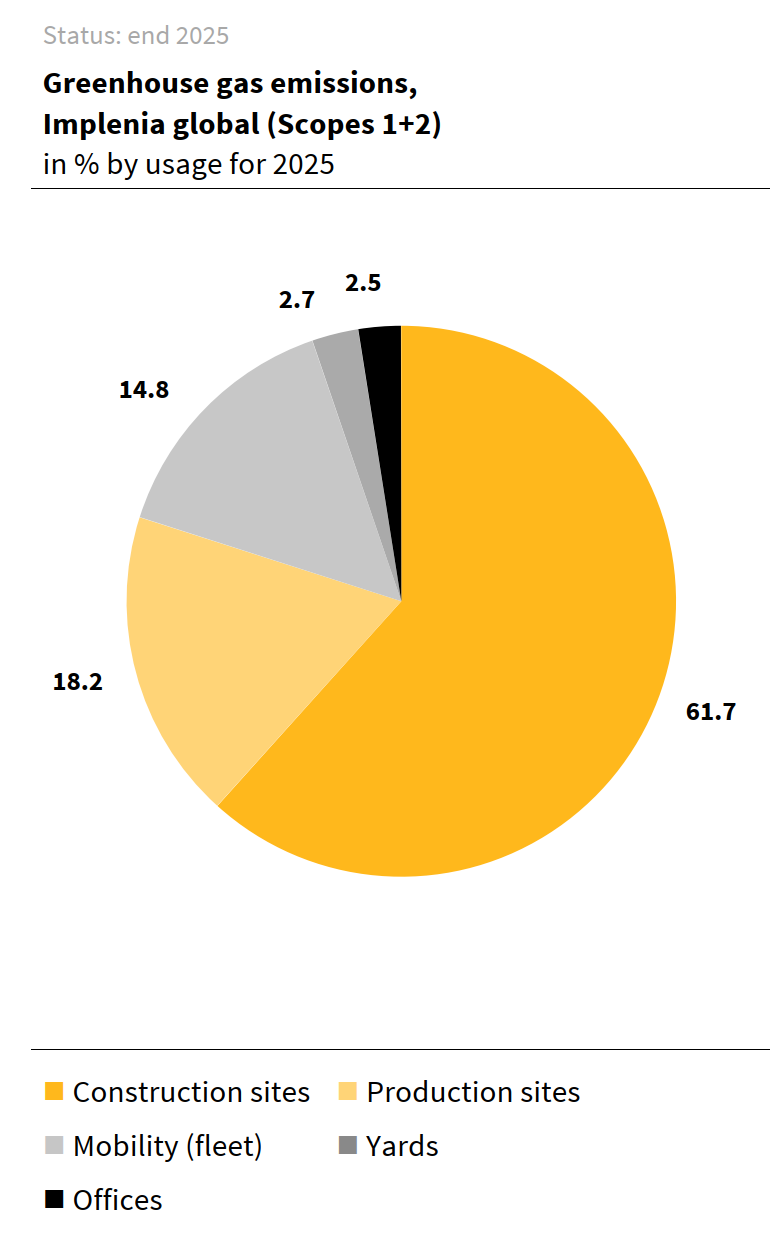
Most Scope 1 and 2 greenhouse gas emissions are caused by Implenia’s construction sites and production facilities. Around 65% of emissions are generated by diesel combustion. A country-by-country breakdown shows that around 39% of absolute CO₂ emissions are accounted for by Switzerland, followed by Germany with approximately 26% and Austria with around 18%. The remaining 17% of total emissions is accounted for by the other countries. Switzerland's comparatively high proportion is in part due to the fact that more construction work is done there than in other countries.
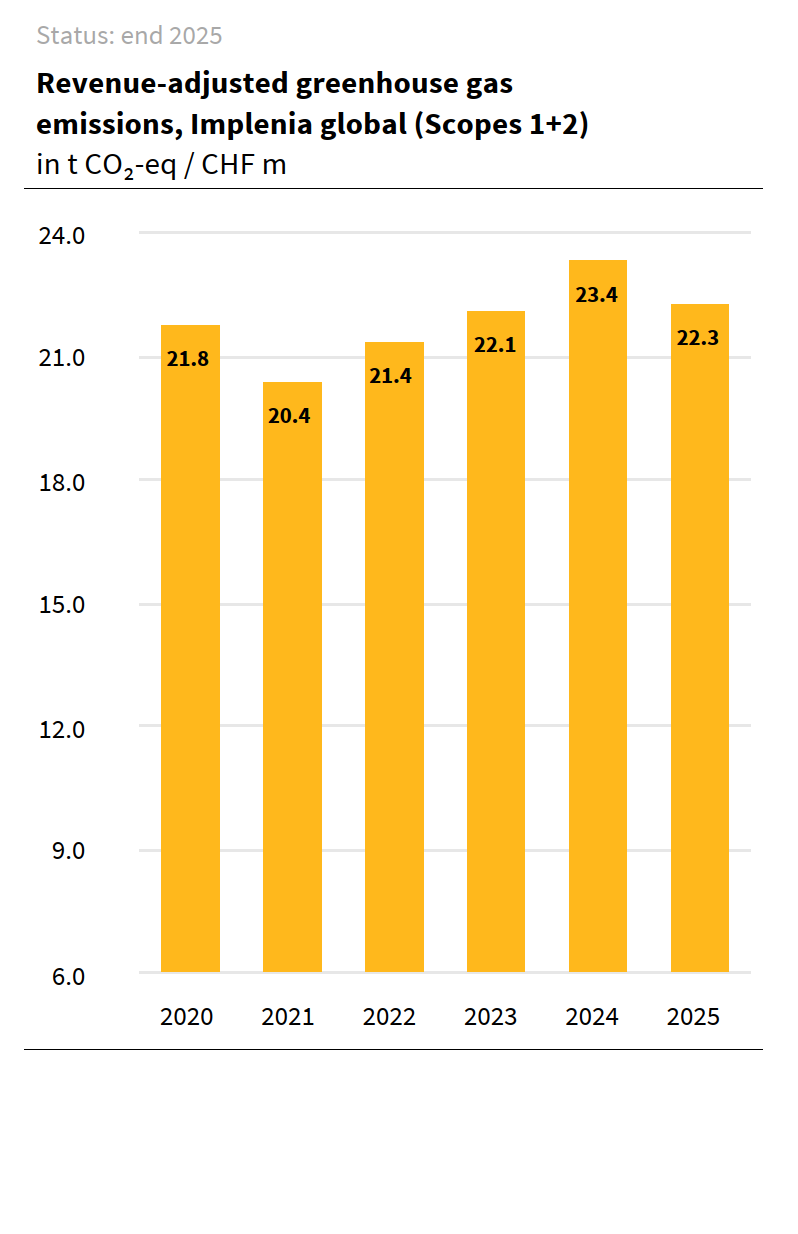
Implenia defined 2020 as the base year for its 2025 sustainability goals. The Group emitted 21.8 tonnes of CO₂ equivalent per million Swiss francs of revenue in 2020.
At 77,511 tons of CO₂ equivalent in 2025 (2024: 83,153), Implenia was able to reduce its absolute emissions by 10.9% compared to the base year of 2020. This positive development is mainly due to lower diesel consumption, particularly as a result of projects in the Nordic countries being completed or transitioning to less energy-intensive phases. The increased use of electric vehicles also contributed to the reduction.
Despite the decline in absolute emissions, the 2025 goal for revenue-adjusted emissions was not achieved. This is due to the simultaneous decline in revenue and the increasing proportion of complex large-scale projects, particularly in tunnel construction, which have higher energy requirements. The revenue-adjusted figure for 2025 is 2.2 above the base year of 2020.
With the new 2030 sustainability targets, Implenia will increasingly offer CO₂ reduction measures in its projects.
Greenhouse gas emissions, Implenia Global, Scopes 1 + 2 (by energy source)
| Category | Unit | 2025 | 2024 | 2023 | 2022 | 2021 | 2020 |
|---|---|---|---|---|---|---|---|
| Total Scope 1+2 | t CO₂-eq | 77,511 | 83,153 | 79,626 | 75,678 | 76,893 | 87,028 |
| Total Scope 1 | t CO₂-eq | 62,286 | 66,622 | 64,631 | 59,771 | 59,791 | 67,642 |
| Diesel | t CO₂-eq | 50,476 | 54,304 | 51,744 | 47,662 | 50,490 | 56,907 |
| Petrol | t CO₂-eq | 1,300 | 1,647 | 1,461 | 1,745 | 467 | 501 |
| Gas | t CO₂-eq | 3,482 | 3,481 | 4,718 | 4,606 | 4,539 | 5,200 |
| Heating oil | t CO₂-eq | 6,961 | 6,852 | 6,377 | 5,397 | 4,142 | 4,976 |
| Biodiesel | t CO₂-eq | 63 | 337 | 331 | 361 | 153 | 58 |
| Pellets | t CO₂-eq | 4 | 1 | NA | NA | NA | NA |
| Total Scope 2 | t CO₂-eq | 15,225 | 16,531 | 14,995 | 15,907 | 17,101 | 19,386 |
| Electricity | t CO₂-eq | 14,668 | 15,858 | 14,574 | 15,540 | 16,701 | 18,892 |
| District heating | t CO₂-eq | 557 | 673 | 421 | 367 | 401 | 494 |
| Absolute change in CO2 emissions compared to base year 2020 | % | -10.9 | -4.5 | -8.5 | -13.0 | -11.6 | Basis 2020 |
| Total, revenue-adjusted CO2 emissions | t CO₂-eq/million CHF | 22.3 | 23.4 | 22.1 | 21.4 | 20.4 | 21.8 |
| Revenue-adjusted change in CO2 emissions compared to base year 2020 | % | 2.2 | 7.1 | 1.5 | -2.0 | -6.4 | Basis 2020 |
Note: The full calculations are documented in the appendix in the Sustainability Report in PDF.
1.4 Scope 3 emissions
Inspired by its target of achieving net zero by 2050, Implenia is continually expanding its reporting on indirect emissions from upstream and downstream process chains (Scope 3). In particular, the sourcing, production and transportation of construction materials and the subsequent use of buildings and structures cause significant emissions and affect a project’s overall impact.
The GHG Protocol differentiates between a total of 15 categories for recording Scope 3 emissions along the value chain. Implenia has been collecting Group-level data in categories 3, 6 and 7 since 2022. In 2024, the company also began collecting data in category 1, a particularly significant category. Finally, in 2025 Implenia performed a complete screening of all relevant Scope 3 categories for the first time, further developed the inventory and set 2024 as the base year for its Scope 3 emissions.
The following categories have been identified as relevant to Implenia and calculated using the methods recommended by the GHG Protocol. The specific calculation method is shown for each category:
- Category 1: Purchased goods and services (hybrid method using average data & spend-based method)
- Category 2: Capital goods (spend-based method)
- Category 3: Fuel and energy-related activities (activity-based method)
- Category 4: Upstream transportation and distribution (hybrid method using average data & spend-based method)
- Category 5: Waste generated in operations (hybrid calculation method)
- Category 6: Business travel (distance-based method)
- Category 7: Employee commuting (hybrid calculation method)
- Category 11: Use of sold products (hybrid method using average data & location-specific data)
- Category 12: End-of-life treatment of sold products (hybrid method using average & site-specific data)
However, due to the complex structure of the company and a diverse value chain spanning several markets, a certain degree of uncertainty and estimation errors remain. The availability and quality of data varies by business unit and category. Not all relevant resources and data sources have yet been included in the inventory.
Setting 2024 as the base year provides a solid foundation for the Group’s long-term Scope 3 management and provides the starting point for the comprehensive disclosure of greenhouse gas emissions across all Scopes. Implenia is therefore continuously moving in the direction of greater transparency. Over the next few years, the company will further refine the data, increase accuracy and expand the Scope of the resources involved.
Calculated Scope 3 greenhouse gas emissions (t CO₂ eq)
| Category | 2025 | 2024 |
|---|---|---|
| Total | 707,113 | 809,710 |
| Category 1: Purchased goods and services | 582,751 | 654,103 |
| Category 2: Capital goods | 27,472 | 50,433 |
| Category 3: Fuel and energy-related activities | 15,832 | 17,219 |
| Category 4: Upstream transportation and distribution | 3,171 | 3,918 |
| Category 5: Waste generated in operations | 7,618 | 4,044 |
| Category 6: Business travel | 751 | 990 |
| Category 7: Employee commuting | 5,235 | 5,393 |
| Category 11: Use of sold products* | – | – |
| Category 12: End-of-life treatment of sold products* | – | – |
| Unidentifiable emissions** | 64,283 | 73,610 |
Note: The full calculations and category information are documented in the appendix in the Sustainability Report in PDF.
*Emissions are only calculated for projects sold in the year concerned. If no sale is made, the value is 0.
**In order to compensate for possible uncertainties and avoid underestimation, an additional 10% is added to the calculated emissions.
2. Energy consumption
Implenia used approximately 392 gigawatt hours of energy in 2025 (2024: 415). The company’s biggest energy source by far (final energy) is the diesel it uses as fuel for machinery and vehicles. Next are electricity and fuels such as natural gas and heating oil, which are used mainly for generating process heat in surfacing works.

2.1 Electricity consumption
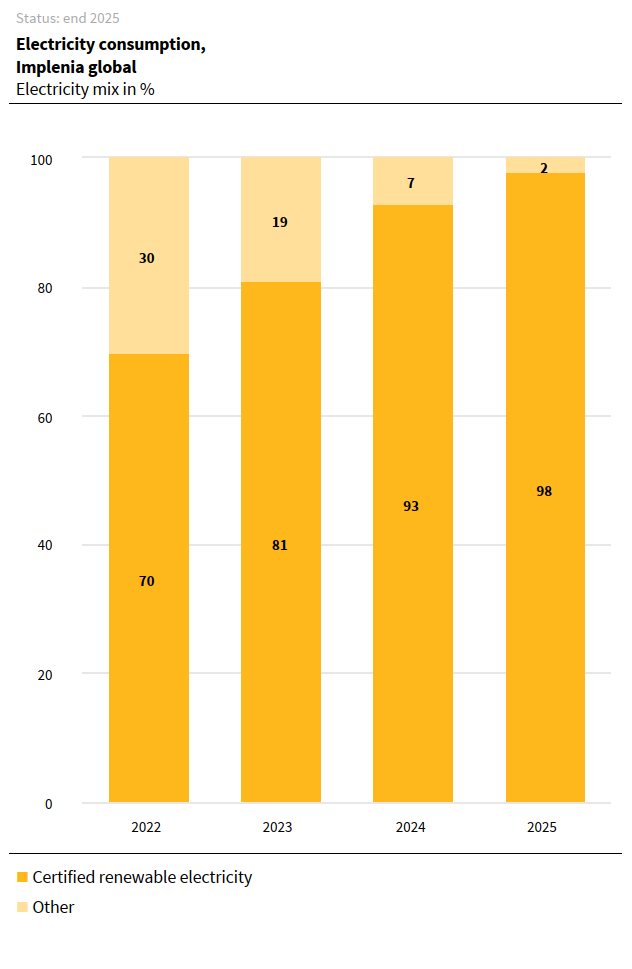
Implenia aims to optimise its energy consumption wherever it can and prioritises clean energy sources. In all European markets, the company obtains its electricity entirely from renewable sources or covers it with guarantees of origin for renewable energy.
In 2025, Implenia achieved a Goup-wide share of 98% certified renewable electricity. This figure also includes all of the company's own properties and production facilities in Europe, meaning that sub-target 4.5 in the area of CO2 reduction has been achieved.
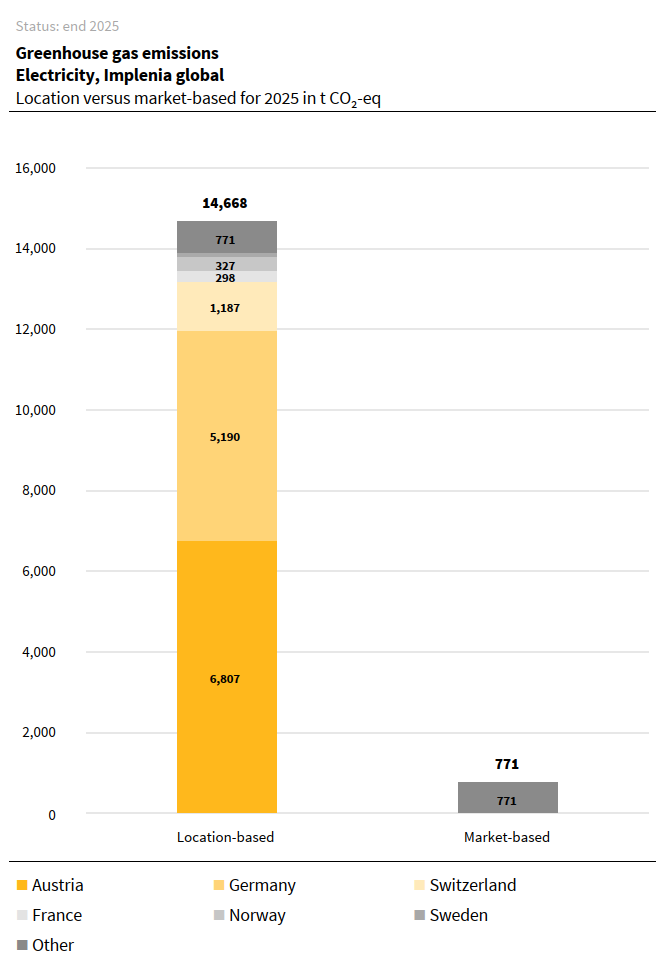
In line with the Greenhouse Gas Protocol, Implenia also reports Scope 2 emissions using the market-based method1 in addition to the location-based method2. The location-based method is currently used to calculate Scope 2 emissions, as no market-based emissions could be calculated when the target was defined in 2020. In the future, the company wants to apply the market-based method, which is not based on average emission factors but on actual emissions based on the real energy mix. The chart for 2025 shows both values.
1 Location-based figures calculated using country-specific emission factors given by the International Energy Agency (IEA).
2 Market-based figures including certificates of origin and emission factors of the electricity suppliers where available.
2.2 Solar power
A well as predominantly using clean electricity, Implenia harnesses its buildings to generate its own electric power. Solar systems on the roofs of its Swiss yards near Satigny (GE), Vétroz (VS) and Schattdorf (UR), as well as at the Ecublens asphalt plant (VD), have been supplying green electricity for years. The 2,500 square metres of photovoltaic modules on the roof of the Ecublens plant generate almost half a gigawatt hour of electricity per year. Since 2024, around 450 megawatt hours of solar power have also been produced annually at the asphalt production plant in Satigny.
Portable cabins on construction sites provide a new option for solar power production. In Norway, Implenia has produced 346 megawatt hours of electricity in this way in 2025 (read more). Solar panels have also been installed on containers in Switzerland, Sweden and Germany.
In total, Implenia generates around 1.8 gigawatt hours of electricity annually from solar systems on its own properties. The goal of producing three gigawatt hours of solar power annually by the end of 2025 was not achieved. One reason for this is the trend towards using leased rather than Implenia-owned locations. Implenia sold its site in Bobenheim (DE) at the end of 2024, for example, which reduced the total solar yield produced on its own properties (see “Solar power produced on own properties” chart). Solar power is still consumed by Implenia at leased sites.
As well as purchasing 100% green electricity and generating its own solar power, Implenia strives to continually reduce its electricity consumption. Initiatives such as digitally controlled ventilation systems and awareness-raising campaigns on saving energy are aimed at reducing unnecessary power consumption and increasing efficiency.

3. MOBILITY
Implenia uses hundreds of vehicles every day. Across the Group, its cars, trucks and vans, along with excavators, rollers and other specialised vehicles and machinery, consume a total of approximately 21 million litres of fuel a year.
When procuring vehicles and machinery, Implenia favours low-emission options. Targeted internal rules on vehicle and leasing in Switzerland, Germany and Sweden encourage the use of electric cars. More than 150 electric vehicles are already in use in Germany. Electric trucks and cars are also deployed in France, Austria and Norway. Many offices provide their employees with e-bikes. Numerous construction sites without good public transport links also use collective buses to enable employees to get to work in an environmentally friendly way.
Wincasa’s mobility strategy includes electric pool vehicles. These are managed via the Urban Connect sharing platform and can be used by employees for business or private purposes on attractive terms.
A key factor in the sensible use of electric vehicles is how environmentally friendly the generation of the electricity has been. Implenia Austria conducted an internal analysis that covered the energy mix and CO₂ emissions of its vehicle fleet. Since the energy mix in Austria is very green, the electrification of the fleet is an effective way to reduce CO₂. The electric vehicles cover a total of 335,000 kilometres per year, which translates into an annual saving of around 50 tonnes of CO₂.
Technology has progressed to the point where alternatives to the traditional internal combustion engine are available not just for cars but also for heavy construction machinery. For example, Implenia operates several hybrid excavators in Switzerland. In Norway the company has gone a step further and completed its first projects using purely electric-powered construction site vehicles. In Germany, a joint venture between Implenia and Hochtief deployed Europe’s first fully electric heavy-duty loaders on a major tunnel construction site in Munich (read more).
Implenia Sweden, together with Finnish manufacturer Sandvik, has developed a dumper fuelled by fully biodegradable hydraulic oil for use on an underground railway construction site in Stockholm. The use of bio-fuels to drive construction machinery is steadily increasing. Implenia Sweden already mainly uses bio-fuels for its own machines.
Implenia uses incentives and awareness-raising campaigns to encourage employees to use public transport for business travel. Employees who regularly travel by train to appointments or who do not use a company car can apply for discount cards and public transport passes.
In summary, Implenia has implemented mobility concepts at many locations, but since not all larger locations have yet been included, it has not fully achieved sub-goal 4.4 within the CO2 reduction area.
Circular economy
To become more sustainable, the economy has to see a long-term shift from linear production chains to closed material cycles. Specifically, products should not be destroyed or deposited in landfills after use. Instead, the materials contained in these products should be recovered, reprocessed and returned to the production cycle as secondary raw materials wherever possible. The concept of “urban mining” goes one step further in that when buildings are demolished, entire components are removed and reused in other construction projects.
Implenia plans to develop further circular business models within its own activities and use innovative methods to close its material cycles. Each business unit is working to implement specific circular principles. Implenia aims to develop and evaluate the widest possible range of practices, always with the aim of minimising material turnover and resource consumption, extending the life of built structures and reusing or recycling building materials.
In new construction projects, the company aims to use increasing amounts of secondary raw materials sourced from demolition work elsewhere. Wherever possible, Implenia already seeks to ensure that at least half the concrete it uses for its own projects is recycled concrete made at a works situated in close proximity to the construction site.
If the conditions permit it, stone that Implenia excavates from building pits is immediately processed on site to make concrete; alternatively it is used for backfilling at the same project. This avoids waste and saves on transport. It is a particularly effective approach in tunnelling, where Implenia can often use the rock it excavates to make concrete locally (read more).
Excess concrete is processed into “modular concrete blocks” in several Implenia projects. These are used in a variety of ways on construction sites and elsewhere. This practical approach to recycling ensures raw materials are used to the fullest extent, while also helping to reduce waste.
1. CIRCULAR THINKING IN PRODUCT DESIGN
Over the long term, closing cycles will have to involve not just the optimisation of the recycling process but also the improvement of product design as much as possible. New products have to be manufactured in such a way that the component materials can later be separated and sorted without excessive use of mechanical processes, energy or chemicals. In the construction industry, the use of mechanical joints, for example, makes it easier to separate and reuse individual elements. Once a component has reached the end of its life, the layers of material can be separated from each other and returned to the cycle as secondary raw materials.
Division Buildings is increasingly pursuing the modlar construction approach. Instead of developing each project from scratch, the Division designs standardised real estate products and seeks out flexible, cost-effective and environmentally friendly solutions that are optimised across the entire lifecycle. The products are based on prefabricated elements and prioritise criteria such as ease of disassembly, durability, flexibility and re-usability.

The aim is to improve both the quality and sustainability of buildings compared to traditional construction methods in order to shorten delivery times and reduce cost uncertainties. Using an online configurator, planners combine prefabricated elements with the help of parametric design methods to give customers an optimised building design very quickly (read more).
Implenia has been an active member of Circular Construction Catalyst 2033 (C33) since July 2024. As part of this network, the company is committed to promoting closed-loop construction in Switzerland and to furthering the establishment of a circular economy in construction through an intensive exchange of know-how within the industry.
Purchased goods and services (mass)
| Category | Unit | 2025 |
|---|---|---|
| Total | t | 2,979,934 |
| Concrete | t | 2,393,428 |
| Shotcrete | t | 219,982 |
| Cement | t | 27,864 |
| Steel | t | 199,890 |
| Tubbing | t | 51,081 |
| Asphalt | t | 21,314 |
| Bitumen | t | 65,131 |
| Wood | t | 1,244 |
| Explosives | t | 15,828 |
Note: The full calculations and category information are documented in the appendix in the Sustainability Report in PDF.
Waste and hazardous substances
Around half of Europe’s total waste is generated by the construction industry, with excavated material accounting for the largest proportion. Waste is a significant issue at Implenia. It is a particularly important consideration when demolishing old buildings, although new buildings also generate significant amounts of waste, most of which can be recycled. In Switzerland, around 70% of demolished materials are now recycled as high-quality secondary raw materials. The recycling rate for excavated material is higher still at 75% (source: Federal Office for the Environment).
Implenia avoids waste through improved processes and good planning, and it is working on components and processes that allow materials to be separated easily and recycled at the end of their lifetime. The company practises systematic waste management on its sites; it invests substantial resources in its efforts to dispose of construction waste by type and to promote recycling. In Switzerland, for example, it uses separate containers for different waste materials, such as concrete, metal, wood and plaster.
In addition, its BCL subsidiary (Building Construction Logistics GmbH) helps to reduce waste and increase recycling rates through optimised construction logistics, at both Implenia and in many external projects.
To make waste flows clearer, Implenia has grouped the relevant waste categories and disposal methods together and documented these broader groups in an internal policy. These waste categories are shown in the table below.
Volume of waste – Norway, Austria, Sweden and France (mass)
| Category | Unit | 2025 |
|---|---|---|
| Total general waste | t | 1,175,422 |
| Total hazardous waste | t | 3,101 |
| Total non-hazardous waste | t | 1,172,321 |
| Excavated material | t | 1,143,581 |
| Demolition concrete | t | 16,963 |
| Asphalt | t | 2,949 |
| Metals (metals and steel) | t | 2,185 |
| Wood | t | 2,161 |
| Oils | t | 349 |
| Plastic | t | 337 |
| Paper and cardboard | t | 80 |
| Plaster | t | 8 |
| Non-identifiable and sorted waste | t | 3,708 |
Note: The full calculations and category information are documented in the appendix in the Sustainability Report in PDF.
Global volume of waste – estimated (mass)
| Category | Unit | 2025 |
|---|---|---|
| Total general waste | t | 2,802,600 |
| Total hazardous waste | t | 3,101 |
| Total non-hazardous waste | t | 2,799,499 |
Note: The full calculations and category information are documented in the appendix in the Sustainability Report in PDF.
The following options have been defined as disposal methods:
- Open-loop recycling (downcycling)
- Closed-loop recycling
- Re-use
- Thermal recovery (burning)
- Composting
- Landfill
- Anaerobic fermentation
Implenia continues to record waste volumes in the following markets: Sweden, Norway, France and Austria. Improvements were made for the 2025 reporting period to better reflect the differences between building construction on the one hand and large-scale infrastructure projects, such as tunnels and bridges, on the other.
Implenia uses two different metrics for the ratio of waste to revenue to estimate global waste volumes: one for building construction projects and another for infrastructure projects. These key figures are based on a detailed analysis of selected major projects, in which both the actual amount of waste generated and the relevant revenue were accurately recorded.
This approach ensures reported waste volumes realistically reflect each Division’s activities and size. While waste volumes can be reliably estimated, recording recycling rates at Group level remains challenging because the relevant data is currently only available for certain types of waste and selected projects. The global recycling rate therefore cannot yet be reported with the effect that environmental protection sub-goal 5.2 has only been partially achieved.
The company takes special care with hazardous on-site materials and products such as diesel, petrol, bitumen, gas cylinders, lithium batteries and spray cans. To protect people and the environment, Implenia regularly trains construction site personnel on the rules and procedures for storing and transporting hazardous substances. Implenia continuously invests in innovative processes in this area. It has, for example, learned how to reduce hydrocarbon residues in excavated material; microorganisms can be used to minimise the concentration of harmful substances, allowing spoil to be processed for reuse. This means that several projects have already to avoided having to take spoil to landfill.
Biodiversity
Wherever buildings and infrastructure are built, valuable habitats and natural sites are impacted by the construction activity and subsequent usage. At the same time, the construction sector, like everything else, depends on functioning ecosystems. Biodiversity is not just important for the environment but also for the economy.
Implenia focuses on the preservation of biodiversity in relevant projects, particularly its large-scale projects, and takes account of European and national biodiversity strategies in all its markets. The company carefully reviews the ecosystems at its project sites and, where necessary, takes steps to minimise impacts and protect natural habitats. Special attention is paid to species listed as threatened, endangered or highly endangered on the Red List published by the International Union for Conservation of Nature (IUCN).
During the E39 Lyngdal project in Norway, for example, local flower seeds were collected before the soil was removed; these will be re-sown after the project is completed and the topsoil replaced. Wildlife crossings were created and invasive non-indigenous plants were removed. At the Ingenbohl drainage tunnel construction site, which is part of the new Axenstrasse project in central Switzerland, Implenia worked with the client to set up a biotope with a safe access path for small animals.
Meanwhile, at the Green Village development in Geneva, around 30% of the site has been reserved for plants and animals. Its green areas include wetlands, wooded areas, fallow land, meadows and shrubs. Blossom and fruit trees will also be planted to improve the food base for pollinating insects, such as bees, and other species (read more).
Implenia also actively raises awareness of this topic among its employees. Since 2024, the Sustainability Academy, Implenia’s internal continuing education platform, has offered a special module on biodiversity.
Water consumption
Water is as important to construction sites as the actual building materials. Large volumes of water are needed for drilling, mixing concrete, mortar and plaster, cleaning, humidifying components, sanitary installations and more. Careful water management is becoming increasingly important in the construction industry.
Implenia takes many steps to reduce its water consumption, including treating and reusing waste water directly on the construction site. In many cases, groundwater, rain water and surface water that comes onto the site also has to be treated before it can be returned to the natural water cycle or the wastewater system outside the construction site.
Implenia has been measuring water consumption on all its construction sites in France and Sweden for several years. Around 115,000 cubic metres of water were consumed in France in 2024. Consumption in Sweden that year was around 4,000 cubic metres. Water consumption has also been recorded in Austria since 2024. The first two projects recorded total consumption of 6,000 cubic metres.
Implenia is gradually expanding this reporting to other countries. As well as recording consumption, the system is designed to provide valuable information about where and how water can be saved or reused.
The company is already implementing measures to ensure water is used more economically at many locations. The Voerde yard in North Rhine-Westphalia, for example, has launched a pilot project to save fresh water, using rainwater for the high-pressure washing of construction equipment, machinery and drilling tools.
Environmental management
Implenia operates an ISO 14001-certified environmental management system. At the end of 2025, 65% of its business units were certified under this standard. Each Division has several specialists in sustainability and environmental protection who help project managers implement environmental measures on construction sites and report environmental incidents. The aim is to increase energy efficiency and optimise resource utilisation by improving construction processes, promoting the circular economy and optimising internal waste management.
1. ENVIRONMENTAL STANDARD AND ENVIRONMENTAL CONCEPT
An internal environmental standard is applied across all areas of Implenia’s business. The standard includes Group-wide minimum requirements for waste disposal, soil protection, water treatment, noise reduction, clean air and energy consumption. These are summarised on an information sheet for ease of use, and must be followed by project teams on all construction sites.
In addition to its general environmental standards, Implenia applies project-specific environmental concepts to its building construction and infrastructure projects, especially the large-scale ones. These concepts govern the way construction sites are organised and include comprehensive environmental and sustainability criteria.
In the case of building construction, project managers are issued with a manual that gives them the contextual information they need to assess environmental risks correctly and take precautionary measures at an early stage.
Checklists help project teams monitor energy consumption and noise pollution, take steps to reduce this pollution, optimise waste management and minimise impacts on air, soil and water. This not only makes it easier to comply with legal requirements but also meet additional criteria set by clients or requirements necessitated by the desire to achieve a particular environmental certification.
2. GREEN CONSTRUCTION SITE GUIDELINES
During the tendering, preparation and execution phases of a project, “Green Construction Site” guidelines set out the central priorities for environmentally sound site management and serve as a tool for evaluating potential measures. There are five main topics: environmental protection, materials, energy, construction logistics and circular economy. Principles have been formulated for each topic, showing how they can be put into practice through specific measures on the construction site. Additional measures can also be agreed with clients or project owners in order to meet project-specific requirements.
3. SENSITISING EMPLOYEES
Implenia regularly informs and educates employees about environmental issues, with the knowledge that this can have a positive influence on energy and resource consumption. Three awareness-raising campaigns are carried out each year on construction sites in Switzerland, addressing key environmental issues such as soil protection, water purification, air pollution, noise reduction, waste disposal and CO₂ emissions. Awareness-raising campaigns involve measures at different levels: Site personnel receive a short training session, and a multilingual information poster is hung up in highly visible places on the construction site for several weeks. Project managers receive additional training and detailed documentation.
Division Civil Engineering also runs environmental training courses in other European markets. Two e-learning courses were offered on environmental topics in 2023 (see Sustainability Academy). In Germany, Implenia sustainability experts regularly give presentations with Q&A sessions to deepen their colleagues’ knowledge of the sustainability goals.
Office-based employees are also made aware of sustainability issues on a regular basis. Sustainability information is posted at least once a month on the intranet or on digital screens in buildings, and a sustainability newsletter is published twice a year.
4. REPORTING ENVIRONMENTAL INCIDENTS
A lot can happen on a construction site. A mistake or accident could lead to diesel or hydraulic oil contaminating the ground or water, nearby roads could become polluted, or a protected tree could be damaged. Implenia takes as many precautions as it can to prevent such incidents. However, if they cannot be prevented, the rapid assessment, notification and management of the situation is vital so that the environmental impact can be kept within limits.
In 2020, the Group introduced a standard structure across all countries and Divisions for investigating every type of incident. Environmental incidents are recorded as a separate category. Following any incident, the responsible person carries out a root cause analysis, usually in consultation with the safety officer. Any measures that are needed can then be taken and their effectiveness monitored.
By the end of 2025, serious incidents were being reported systematically in all countries and business units in line with the Group’s sustainability goals. Awareness-raising measures remain ongoing. For example, explanatory videos encourage employees to report any environmental incident, regardless of its severity.
In 2025, 144 (2024: 265) environmental incidents were reported across the Group. This included an incident that had potentially serious consequences: When the subsoil broke away at a lakeside construction site, a compressor and an excavator slid into the water. Implenia immediately reported the incident to the authorities. The fire brigade quickly installed an oil barrier, the equipment was recovered after a few days and no one was harmed. Only small amounts of oil and fuel leaked out, so the incident was ultimately classified as causing limited environmental damage.
Project-specific CO₂ reduction
Proactive climate mitigation measures reduce CO₂ emissionen